Adam Parks (00:08)
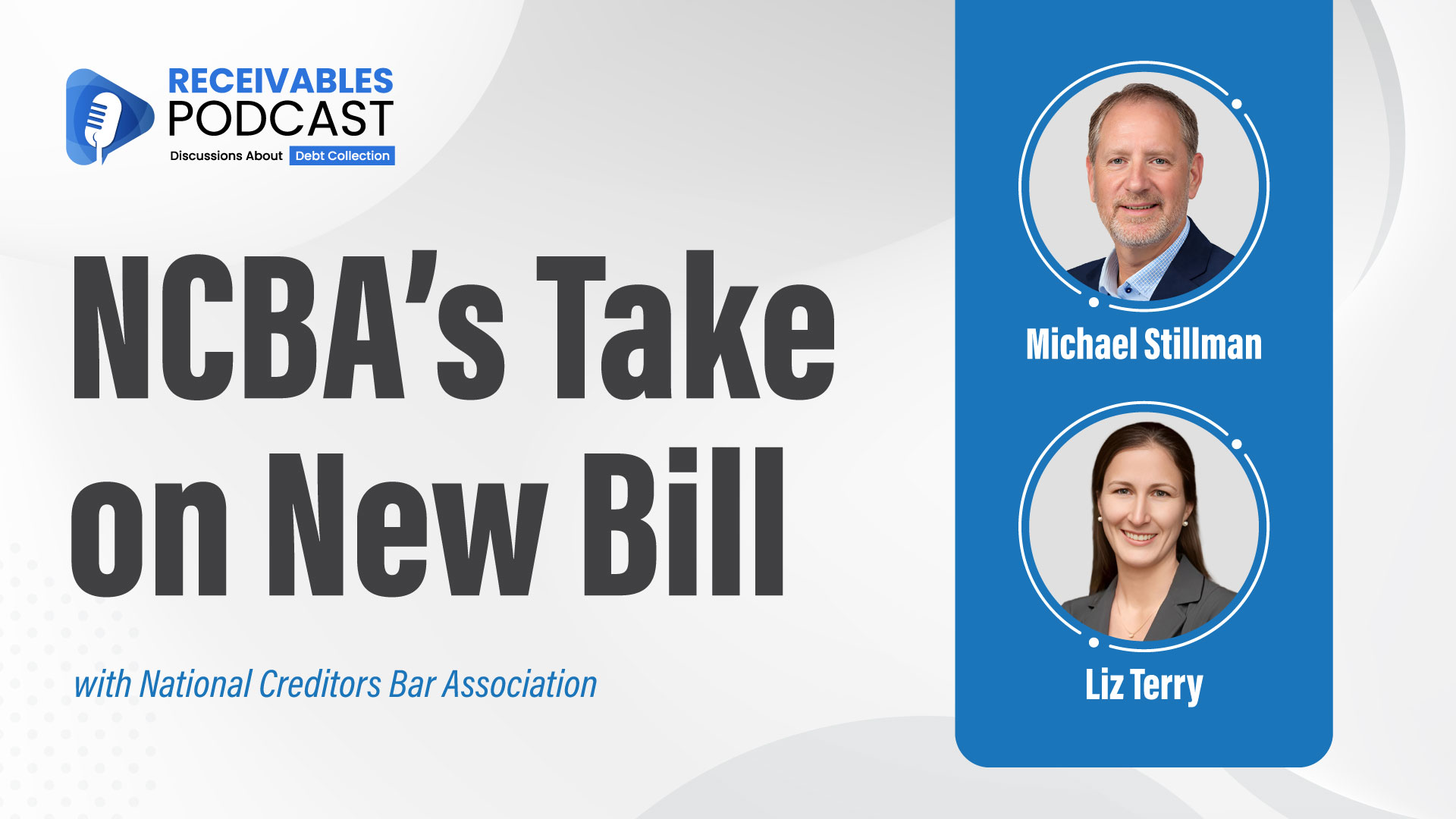
Hello everybody, Adam Parks here with another episode of Receivables Podcast. Today I'm here with two of my favorite people from the debt collection industry, Mr. Michael Stillman, the immediate past president of the National Creditor's Bar Association or NCBA, and also Elizabeth or Liz Terry, who is the executive director for NCBA. I asked them to join me today because I was at the NCBA Connect Conference not that long ago.
And in talking with some of the board members, I learned a little about some of the challenges that the law firms are facing when it comes to the regulatory environment and being a debt collector versus being a lawyer. And I was so fascinated by the subject. I asked them to come on, join me today and try and give me a little bit of a history lesson and a little of an update as to what's happening in that regard. So thank you both so much for joining me today. I really do appreciate you coming on and sharing your insights.
Michael Stillman (01:05)
Thanks Adam.
Liz Terry (01:05)
Absolutely. Thanks, Adam.
Adam Parks (01:07)
So, starting at the beginning, what is the challenge that the law firms are currently facing as it relates to being a lawyer or being a debt collector.
Michael Stillman (01:16)
Wow. I think, look, very broad question. Look, for those of us that our primary focus of our practices is debt collection. We're not trying to have any sort of unfair advantage over somebody that is in debt collection, in the debt collection world that's not a lawyer, i.e. someone, a collection agency, right? We understand that there are rules and we're here to follow them. And we do so, I mean, our own...
Liz Terry (01:19)
you
Adam Parks (01:18)
Broad question.
Michael Stillman (01:42)
bylaws require that we follow strict guidelines, et cetera. However, as a lawyer, we are the only lawyers in any field of practice that are governed really by a government entity that gives us instructions of what we can and cannot do and creates a situation where we are always a debt collector, whether we are communicating at the beginning and the onset of a matter when we first receive a file and we're just communicating with the consumer via email and or phone call or letter, where we acknowledge we are debt collectors because we are acting as a debt collector. However, at some point in time in that file, in that case, we end up moving to a litigation process where we become lawyers, right? And we are subject as a lawyer to ethical responsibilities of our individual state Supreme Court requirements that dictate and give us the ability to practice law. And at the same time, we're subject to requirements put out by the CFPB under the FDCPA. And sometimes those requirements are at odds with each other. And that creates a huge problem for us. Like I said before, we're not saying we shouldn't be subject to the Fair Debt Collection Practice Act. We're not saying we shouldn't be subject to the requirements of the CFPB and or regulation out, but when we're a lawyer we should be responsible to what is required of us and our ethical responsibilities within our individual states. We shouldn't have to be governed by two masters and that's pretty much the big picture.
Adam Parks (03:13)
masters that may be conflicting. I would think that there's a challenge that comes along with getting two sets of rules and being able to manage what that process looks like. I'm, mean, I'm not a governmental expert by any stretch of the imagination, but I do believe there's three branches of government and they're supposed to be governed separately. How does the government look at that and say that you should be subject under two different sets of sections of the government?
Michael Stillman (03:15)
Absolutely. Well, I think you really have to look at the history of the Fair Debt Collection Practice Act. I think that's where it really comes in play, right? And when the act was originally introduced in 1977 and put into place in 1978, the sponsor of that act was a congressional member by the name of Frank Annunzio. And when he introduced it, when the act was originally introduced, lawyers were exempt, which one might, as a lawyer, say, great. However, perhaps some lawyers took unfair advantage of that. Perhaps some people felt or thought that lawyers could take unfair advantage. Whatever the case may be, at a later date in the 80s, there was an amendment that was brought into play. And that amendment made a change. It was in 1986 was the amendment. And that amendment brought lawyers back into the fold. And it got rid of the attorney exemption.
At that time, that same representative Annunzio explained, and he was not only the sponsor of the original bill, but also a sponsor of the amendment, his explanation was, A, he said that attorneys had increasingly entered the debt collection business and were using that exemption in ways that Congress never intended. Be that as it may, he said, and this was his comment, that the act regulates debt collection, not the practice of law. that it applies to attorneys when they are collecting debts, not when they are performing tasks of a legal nature. So really the full intention of the Fair Debt Collection Practice Act after that 1986 amendment, which included attorneys once again, never anticipated that the Fair Debt Collection Practice Act should hold attorneys accountable under the FDCPA when they are litigating. So fast forward, creation of the CFPB.
Regulation F, Regulation F dealt with a lot of communication issues and it really has come to light more recently under Regulation F, which has a lot of restrictions or requirements with respect to communication and not all bad. Some of those were good requirements. As a matter of fact, you know, it defined certain things for us instead of leaving things that are questionable and not knowing where we can go and not go, right? It gave us guardrails, which is not a bad thing, but some things that's definitely created problems.
Liz Terry (05:53)
And I think just going to your question about what do others, what do the people here in Washington say about it? I I will say that we've spent years going up to the Hill and talking to regulators about this issue and they all acknowledge and understand it. Does that mean that they sign on and maybe we can get there? There is a bill sponsored by Congressman Fitzgerald who happens to sit on both judiciary and House Financial Services. He's the only member of Congress that sits on both. Bill 3213 has been assigned to both committees and we've spent a ton of time on the Hill with our members. I'm lucky enough to have Michael and Barbara here this week. And in the May, we bring in our whole board plus additional members who are interested. And then I'm on the hill in between all of that. And I will say, even in the Democrat offices, they understand it. It's the political environment that prevents us from moving this beyond where we have, but we aren't giving up. We've got a good environment and we're taking steps to try and advance the cause.
Adam Parks (07:02)
And even though they know it's right, it's about the headlines, right? They're all very concerned with what's the headline going to read when we say that, you know, the debt collection attorneys are either operating in one of these two spaces. But I think, Michael, to your point, right, if you're sending out digital communications and you're acting as pre-litigation channels and things, like maybe you do fall under that guideline. But once you're practicing law, I mean, you're a lawyer and you have these restrictions, but there's got to be some conflict between.
Liz Terry (07:05)
Yeah.
Adam Parks (07:30)
the requirements that are coming as a debt collector versus how you need to handle things. And if you're limiting communications, you have some communication responsibilities as an attorney, if I understand it correctly.
Michael Stillman (07:41)
Yeah. And let's be clear, right? As much as, you know, as a lawyer, my primary focus is to advocate for my clients and make sure that their needs and the outcome is best for them. However, having said that, in the world we live in, the sandbox we play in, we're not out there to hurt people or make people go through undo and unnecessary
Adam Parks (07:43)
and
Michael Stillman (08:06)
discomfort in their life, right? So if we can make their lives easier, at the end of the day, it's going to make our lives easier. We're going to, you know, it's a two way street. And so our effort and our goal is to try to go through this process that is probably to most people, you know, it's a difficult time. I mean, they're not used to it, although some people are used to it because they've got many, many, many accounts. But most people, you know, they didn't get into this situation on purpose. It's just a situation they ended up with.
And we want to try to work with them to make it as easy as possible. And that's not always possible. Under Reg F, there are requirements where we have communication time limitations that we can communicate with the consumer, the seven and seven rule. So if we have had a right party contact within seven days, unless we have specific approval from that consumer to communicate that with them again within the next seven days, We are not allowed to reach out to them. So in one of the examples I like to use, and it's pretty simple, but let's say someone from my office spoke with consumer A yesterday, and on the phone with them, they were trying to work it out or what have you. And my person, before terminating the call, asked the consumer, do we have permission to contact you within the next seven days again? And let's just say that that consumer has had enough and they don't want to talk to us anymore. And they say, no, okay, because they've had enough. They want the next seven days to be free. However, what they forgot about is that there's a court hearing tomorrow. And so our attorney goes to that court hearing and maybe our attorney walks into court and the judge says, well, have you talked to the consumer? And our attorney says, well, you my office spoke to them yesterday and they said that we can't contact them again. Well, you know, Mr. Attorney, the judge says, Mr. or Mrs. I want you to go out in the hall and call. And my attorney says, I can't, I don't have permission, Judge. The judge says, I'm telling you to call. Well, Judge, are you also gonna indemnify me when I get sued? I mean, I cannot communicate with them. So that's a problem, right? Another situation might arise where maybe we had a debt settlement or debt negotiating company communicate with us previously.
And maybe that negotiating company is actually also a law firm. Are they representing the consumer as a lawyer or not? They've failed to file an appearance in the court case, but yet they've reached out to us and said they're representing the consumer. So now we can't communicate directly with the consumer without communicating with them through this alternate source. And that alternate source isn't communicating with us. It creates problems.
Adam Parks (10:37)
Well, it creates a lot of problems. I mean, you can see the conflicts here.
Liz Terry (10:43)
Yeah, I was just going to add like the other conflict that has come up and it's not based on just following Reg F but in 2023, spring of 2023, director, then director Rohit Chopra put out a policy statement requiring all entities, financial entities working with a consumer to work in the best interest of that consumer. Well, to Michael's point about representing our creditor and his client, the creditor, we can't our members cannot possibly zealously represent their client while also acting in the best interest of a consumer who's on the other side of that equation. And so those are exact examples of where the CFPB and or FDCPA are requiring things of us or asking things of us where we literally cannot comply with both sides.
Adam Parks (11:33)
And so how does the bill that you've been working on and kind of educating Congress on the challenge, how does that impact or change the playing field to balance these things out so that you can act the way that you should as a lawyer?
Michael Stillman (11:50)
So before actually Liz, you can take it, but before answering that, why don't you give a little context into the creation of the bill, our partners in the bill, and who supported it, et cetera.
Liz Terry (11:57)
content. Yeah.
Adam Parks (12:04)
Give me the history of the bill itself, But help me understand really how this will ultimately impact our world.
Liz Terry (12:11)
Right. So this bill has been brought to Congress several times over several Congresses. The current version of this, like I said, is sponsored by Congressman Fitzgerald. And there are co-sponsors on it. And there were several co-sponsors in the prior Congress. There are several this time.
What it says and what it makes very clear is that attorneys engaged in litigation should be regulated and disciplined exclusively by the courts. Federal agencies have no regulatory authority over attorney litigation activities. So if those two things are true, then we can operate as collectors when we are acting as collectors and we can report and respond to the court when we are in litigation activity. So the idea is to separate it. So this version of the bill does not mention the CFPB. Only says it's only about regulatory. The reality is that our attorneys are the only example where this is occurring, where the attorney is being regulated both by the courts and some other regulator. We're the example, but it's not the only, it's possible it could happen in some other industry. So we want to make sure that regardless of what attorney this is, that it's on the record that attorneys should only be regulated by their courts and their state bar associations. â
Michael Stillman (13:37)
Yeah, and Adam, because of what Liz said, right, that while we are kind of the only one being signaled out today, theoretically, this could be a situation for any number of practice areas that deal with any sort of federal regulatory group that, know, alphabet soup of regulations. So accordingly, you know, the American Bar Association has been a co-sponsor of this bill. They helped co-write it and have been supporting it. In fact, it's one of their, I don't know, nine priority items or something this year. And clearly the American Bar Association is a lot bigger than the NCBA, right? And caters to a different group as well, I think, which is good theoretically that it brings in some different people. So the American Bar Association's backing of the bill I think is huge and it says a lot. And then in addition, the bill was also
Adam Parks (14:07)
Okay.
Michael Stillman (14:26)
supported by the Conference of Chief Justices, which is the chief justice of all 50 states and the District Columbia in its five U.S. territories. And they've adopted a resolution endorsing the legislation, which I think also says a lot.
Adam Parks (14:39)
I think that's an incredible amount. Clearly the judicial branch understands that the judicial branch should be its own branch of government and the executive branch should probably not be so rambunctious in how they're trying to apply it. But I think Michael, you brought up a couple of really good examples of how just even in the general process, those restrictions, not being able to walk out into the hallway and make that phone call at the request of a judge
Liz Terry (14:52)
Yeah.
Adam Parks (15:05)
is I think the best example that at least it makes it real for me in terms of how this actually has an impact on the operations. Now the next natural question I would think would be how do you know when you're doing each of these processes? So as someone who runs a pretty significant law firm across the country, how do you see the differences between those two behaviors of the firm? When are you operating as a collector? When are you operating as a law firm?
Michael Stillman (15:30)
Anything that we're doing pre litigation, I'm, I'm a debt collector. And quite frankly, I'm, I'm always going to be a debt collector, right? We're always going to err on the side of caution and we're always going to follow, the most restrictive requirements to, to an extent that they don't stop us from doing what we need to do, to both zealously represent our clients and try to do our best to assist the consumer in resolving their issues. So we're always going to have those requirements in our office. That's never going to change. But the second we litigate, we should be lawyers. We should be treated as such. I shouldn't be a second guest by somebody saying that, well, you're not following what the CFPB or the FDCPA says when I'm presenting a lawsuit to the court. Only us being those lawyers involved in the practice of law involving debt collection, have different requirements from litigation than other lawyers have. I mean, we get different requirements already just in the realm of our own litigation in our own judiciaries. So we're already signaled out, but give us a break. I mean, where does it stop?
Adam Parks (16:34)
That also brings up some really good points.
Liz Terry (16:42)
I I think back to sort of the bill, it is a long game, getting any change in government is a long game. But I think it's one of the main ways that we can differentiate ourselves and communicate on the Hill so that we're our own group, we are represented and we have our own voice and unique issues. And I think that that's an important piece of why NCBA, works along with ACA and RMAI but has its own path and has its own messaging that we also want to carry. There's opportunity given the current environment that we have support. We're hoping to move the bill, but in the meantime, we also have the CFPB with some friendly leadership at the moment. And so we're looking at ways we might be able to, you know, we're asking currently in the process of asking them to acknowledge. So that same policy statement I mentioned from spring of 2023 was rescinded in May right after we met with them. I'm not sure we can take credit, but it was rescinded right after we met with them in May. But it was one of 67 rescinded policy statements. The wording was such that it wasn't permanent. And so we have brought to them this week, Michael, Barb Nilson, and I went to the CFPB and met with Geof Gradler and had a conversation about this policy statement was impossible for our members to possibly adhere to. Yes, it was rescinded, but you yourself, the CFPB themselves, you know, said that it may not be permanent. So what can we do to get on the record that you also agree that you can't ask us to represent the consumer while also representing our client?
So we're hoping for some statement. And again, you know, that's the kind of thing that could be wiped out by the next administration. But the reality is I don't think even a very strong Democrat, Elizabeth Warren, will stand there and say that an attorney can possibly do their job representing both sides of the same case. So we're hopeful that.
Adam Parks (18:45)
It's hard to ask a lawyer to speak out of both sides of their mouth, right? Sure.
Michael Stillman (18:49)
We have serious ethical concerns, that's for sure. And while Liz says she won't take credit for our meeting in May for them rescinding that, I will, I was there and I'll take credit. I think we absolutely were responsible for that. But yeah, like Liz pointed out, getting the bill passed is a long game. I would be remiss if I didn't say that. I would be really happy if that bill got passed during my tenure as actual president of NCBA. Unfortunately, it didn't.
Liz Terry (18:58)
I'm sorry.
Michael Stillman (19:15)
But I'm still a thousand percent behind it and I still have loads of optimism that we can get something going. We've had great responses, not only from Republicans, but also from Democrats. We haven't been able to get any Democrats to sign on yet. I mean, it's a crazy world in Washington right now, but we continue to work on that. And during this most recent visit this week to DC, Liz and Barb Nilsen, myself, John Anderson from our lobbyist firm RFA. We met with a few different people in the Senate and we're looking at introducing a companion bill in the Senate as well. So we're full on and trying to get this bill passed. It just makes sense. All we want is, you know, go back to the way it was originally intended.
Adam Parks (19:54)
Yeah, know, ability to do your job fairly, evenly, and without having to speak out of both sides of your mouth, it seems like a pretty reasonable request. It's not like you're asking to not have to follow all these rules, but like, give me one set of rules to follow. Don't make me try and understand where these things overlap.
Michael Stillman (20:16)
Absolutely, and look, I've been in this business a long time and I've seen a lot of changes, right? And we live in a kill them with kindness world today. And that's not gonna go away, right? Like I said before, we're gonna continue to abide by the strict requirements that we are required to do so. And we're gonna continue to do all we can to treat consumers with most respect and fairness and try to make this process.
Adam Parks (20:26)
Agreed.
Michael Stillman (20:43)
the easiest process for them. But, you know, as it stands right now, we're hindered from doing that in some respects, and that's not fair to the consumer, quite frankly.
Adam Parks (20:49)
I think it's important that we always keep the consumer in mind. But when you have these overlapping requirements, doing what's best for the consumer becomes a lot more difficult because often doing what's right for the consumer is what's doing right for the client in terms of helping them to be able to resolve an outstanding account. I think often when we're talking, especially with Congress, it's been my experience that they often don't understand where debt collection fits into the overall credit ecosystem. The fact that we're keeping interest rates low and credit available to the people that they're trying to help. Because if we can't collect, lenders aren't going to lend to certain subsets and subprime becomes more more difficult for them to get money. And it is a detraction from the capabilities of that consumer, especially in such a credit driven ecosystem.
Michael Stillman (21:40)
Yeah, then they can't get credit to get a car and they can't get to work. So, you know, and it's a crazy world. When I tell you that the kill them with kindness world, you know, I'm at a lot of different email groups in my office. And like the amount of accounts that I see today that we actually close because a client approves a hardship, 10 years ago, the idea of a client considering a hardship, it would have had to have been like so crazy. The fact scenario would have just had to been outlandish, right? And today, I see so many accounts where we close them because of hardships. I and I don't think the world understands that, right? They think we're just out there to make people's lives miserable. And that's not it. If somebody has got themselves in a situation and they're deserving of having some sort of situation given to them, then our clients are there. They're doing it today.
Adam Parks (22:28)
Well, it sounds like you guys are doing the work that needs to be done. I really appreciate you coming on here today to educate me, help me understand what's happening in the environment in which I live, right? The debt collection world, and ultimately our ability to communicate with the government and move some of these things forward while the opportunity is there.
Liz Terry (22:47)
Thank you. Appreciate it.
Adam Parks (22:49)
For those of you that are watching, you have additional questions you'd like to ask Michael, Liz, or myself, you can leave those in the comments on LinkedIn and YouTube and we'll be responding to those. Or if you have additional topics you'd like to see us discuss, you can leave those in the comments below as well. And I'm willing to bet I can get Liz and Michael back at least one more time to help me continue to create great content for a great industry. But until next time, thank you so much for sharing your insights today. I really do appreciate you.
Michael Stillman (23:11)
Thank you, Adam.
Adam Parks (23:11)
And thank you everybody for watching. We appreciate your time and attention. We'll see you all again soon. Bye.