Adam Parks (00:06)
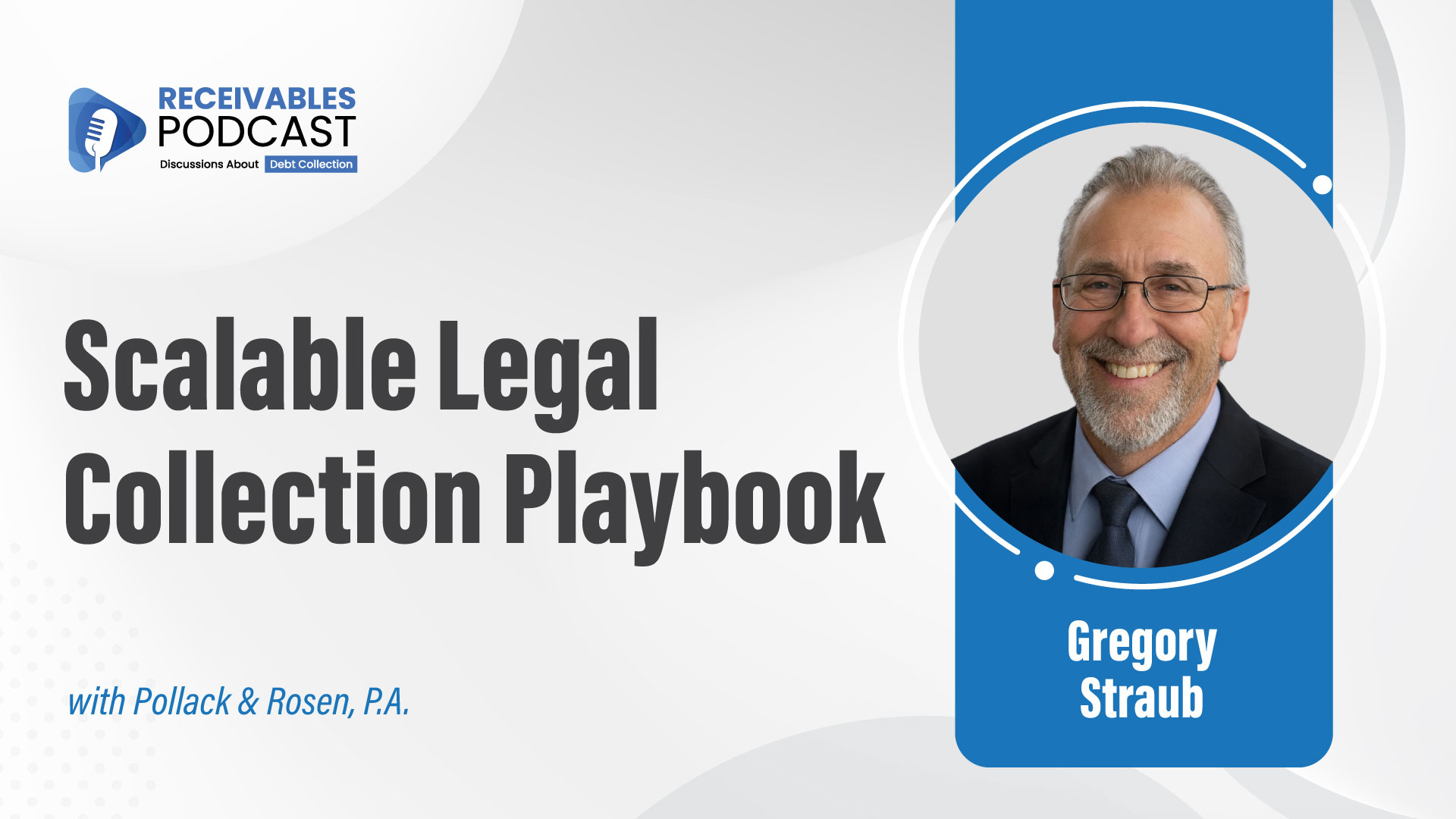
Hello everybody, Adam Parks here with another episode of Receivables Podcast. Today I am here with one of my good friends and a guy that I've been trying to get on the podcast now pretty much since the beginning. That's Greg Straub with Pollack and Rosen. How you doing today, Greg?
gregory straub (00:24)
I'm fantastic, Adam. Thank you.
Adam Parks (00:27)
I really do appreciate you coming on, sharing your insights with me today. I wanted to talk with you about growing a national presence and really growing as a master servicer in the debt collection industry. Litigation has changed so much through the years. And as I've been reading the press releases that Pollack and Rosen has been putting out over the last year, acquisitions, expansions, it just felt like now was the time for us to talk about
Adam Parks (00:52)
all of that and really how the debt collection litigation world is starting to evolve and change at even a more rapid pace. As I was preparing the TransUnion Debt Collection Industry Report from 2025, I saw really law firms leading the way in a lot of different growth activities. And so today could not be better timing for us to start bringing this conversation
gregory straub (00:55)
you
Adam Parks (01:16)
Together. But Greg, for anyone who has not been as lucky as me to get to spend time with you at all the different conferences through the years, could you tell everyone a little about yourself and how you got to the seat that you're in today?
gregory straub (01:28)
Sure. And thank you for that. I started, I've been practicing law for about 35 years and about 30 years ago started working for a large utility company and grew a in-house litigation practice for the utility. I was in charge of all the collections activity, both internal and external, as well as the growth of the litigation piece, because back then I saw the advent of how litigation is important to make sure that you can be as effective as possible in terms of collections. After five or six years at the utility company one of our vendors was an outside third party agency and that agency did standard collection activity for the utility company as well as managed walk-in payment centers. I was offered the opportunity to take over that agency and ultimately purchase that agency. So I did. That agency, we did a lot of national collections work. So from an from a collections agency perspective, spent a number of years kind of refining both the operations as well as my knowledge and my experience in that world. And handled that until sold that company in 2014 and left and joined a firm in California. That firm had a primary office in Los Angeles. Over the next handful of years, we grew that organization to having a brick and mortar footprint in about seven states. It was that next step on that career growth. Now, focused more on the litigation side with the additional piece of agency type collections, whether that be pre-lit or post litigation, post judgment. That experience and that opportunity really led me to the current position. About three years ago, I joined Pollack and Rosen and Joe Rosen and I had worked together. They were actually Pollack and Rosen was a firm that we placed business with from the previous firm. I was buying debt back then and I was placing it and Joe and I became friends first. We were colleagues on the professional side, which led us to the opportunity that presented itself three years ago. Join Pollack and Rosen and we've really changed the dynamic of what the organization looks like. When I joined, Joe's vision was to have more of a national presence, have a much stronger footprint. And there were some ideas that were out there. We all have great ideas and thoughts of what can we do to grow, to expand, to get better.
They were ideas at that point. Well, together, Joe and I and the team at Pollack and Rosen, we really buckled down and said, let's turn these thoughts into reality. We now, as of today, we have brick and mortar in 18 states. So we've really expanded our footprint throughout the country. We are in almost all major metropolitan areas because our clients, whether it be debt buyer clients, original creditor clients, or if it's business that we're purchasing, the bulk of the business is in the major metropolitan areas. So that's where we focused our expansion. In the last year, we've added to that a national network and we acquired that. So our goals of having a presence in all 50 states and truly being the organization that provides an opportunity for clients, whether they're small, whether they're large, we can provide the answers that they're looking for. And so that's how my career growth pattern has moved. And it's really just been a growth step. Each step of the way has been take what you've learned, take the I look at it as kind of a puzzle. There's certain things we can learn. We can learn the right way to do it and we can learn the wrong way to do it. And not all of us will be right all the time. But the critical element is how do we, if we've failed or we've made a mistake, how do we tear it apart? How do we look at what are the elements that caused it to go sideways? And let's make sure we don't replicate those in the future. And conversely, When something is successful, when we do do something correct, let's break that down. Let's look at the core elements and what did we do that made it so successful? And now let's use that as a springboard to continue to get better as we move forward. So it's really.
Adam Parks (06:09)
Sounds like your career has been a series of building blocks. It was learning about like litigation specifically, and then moving into the collection space, and then moving into debt buying. And when you start stacking all of those things together, I mean, those are the broader strokes, but it allows you to kind of dig into those three major disciplines of debt collection and puts you in a position for this rapid growth. Because between the portfolio acquisitions, the growth and the acquisition of AACANet And the other things that you guys have been doing over the last year, I didn't realize that you had brick and mortar in 18 states. That's wild.
gregory straub (06:41)
You know, we want to be able to provide the answers to our clients. And with our Distressed Asset Acquisitions, we're our client as well. So we want to be able to answer the questions and provide the solutions for all of the clients, ourselves included.
Adam Parks (06:57)
Well earlier in my career, I want to say it was 2015 or 2016, I had the opportunity to meet Joe and to go in as an auditor for a major debt buyer in the US. from that point forward, Pollack and Rosen was kind of the standard that I was holding all of my vision of law firms to. Because it was the first collection operation or the first collection law firm that I had spent enough time with to really feel comfortable and confident.
And I started using that as my standard as I was building audit programs for debt buyers and creditors. That's why I feel like this conversation truly comes full circle for me as well. But as you're going through that expansion and you've taken that kind of growth step from being a law firm to being, let's call it a master servicer and being able to handle all aspects of debt collection for a creditor. What are some of those mission critical pieces of the puzzle that you've started adding to the law firm to give you that type of capability?
gregory straub (07:55)
Well, think the number one piece is, you know, as we acquired AACANet, there are a number of solid network solutions out in the marketplace today. Where we are different is we're a lawyer-run network. it differentiates us from the others that are quality, that are out there we look at it through a little different perspective. What can we anticipate? What can we do? How can we act in response before the client asks us those questions? And that becomes essential because the client may or may not know, may or may not be comfortable. But let's look at this. I don't want to spend the client's money if I don't have to. I want to recover the client's money in as quick or as quickly as I possibly can with as little fanfare as possible in the manner or fashion in which the consumer is most apt to pay. So as we acquired the network and looked at that network and that acquisition wasn't simply
gregory straub (09:04)
really how do we provide a broader solution to the clients that we currently have and those clients that we're hoping to bring on board, but also how do we provide ourselves with, hey we have business in another state. Now we have a place to put it. But all of that said, we truly looked at, there's a kind of a hidden agreement out there that, okay, we can use litigation and we can use post-judgment collection activities and wage garnishments and bank levies and that's kind of the standard. But in order to set yourself apart, you have to think outside that box. And I think that's one of the things that we're doing. So in the network acquisition, we've created this robust digital process.
We are talking to the clients and providing them with the answers on the litigation side and saying, certainly, we will take all the necessary steps prior to and throughout the litigation process. However, let's take a look at utilizing email correspondence, SMS and MMS correspondence, two-way chatbot communications. How can we communicate with a consumer in the manner in which they are most comfortable communicating back use that to try to number one bring in the money faster because you know a DSO measurement the day sales outstanding if we can collect that hundred dollars on day three instead of day 13 That's more money in the pocket of our clients So if we can do that and we can save the time and money associated with the litigation piece that that's a home run in all aspects and what that does is it makes us more efficient because now we're not if we're not suing a hundred percent of that caseload
If we're suing 80 % of the caseload because 20 % of that caseload has been recovered via a digital contact or communication method, we're able to move more quickly. We're able to more athletically maneuver through the process. And overall, it just provides a better answer to the clients. And again, I reference back, we're one of the clients. So we're considerate of those ideas because. We want it on the other side. So if I wear my hat forward, okay, do this. If I wear it backwards, it's okay. How fast are you doing this for me? So we're trying to think of all of those pieces. And again, we all know that the CFPB landscape is changing, but over the last year, the old way of collections is changing. Picking up a phone and calling people. A consumer looks at their phone, if they don't recognize the number, if it's a spam call, if it's someone they don't wanna talk to, they ignore it. Well, how do you adapt and change the way you reach out to consumers? You have to give them every viable option. And once you find an option that works, if a consumer responds to you at 8 p.m. via email, then build your process to that consumer to respond back to them via email at 8 p.m. because you're more likely to connect. And connection is what this is all about. So we've taken it. If we have a consumer that sets up a payment plan through our digital process and we use AI to track how did they do it, when did they do it, we'll send a calendar reminder a few days out before that payment is due.
And we'll send it by email or via text or however they communicated with us. So you have to, you know, you have to, paradigm shifts and if the minute you stay stationary thinking I'll continue to do what I did yesterday is the minute you fall behind. So you're constantly looking for a new and adaptive solution.
There isn't a magic formula. we're all of the other firms that are out there, all the other agencies, all the other networks. You know what we're trying to do? Reach John Smith, the customer, and get him to pay for his bill. I mean, you boil it all down, it's kind of simple. But now what you have to do is you really have to think differently than what you did in 2023 you thought X. Today you have to think Y. And you have to be available for the consumer.
Adam Parks (13:25)
The consumer is different. It's that we're not dealing with the same consumer. We're not dealing with the same consumer preferences. The consumers have become more comfortable with e-commerce, right? They're shopping online at Amazon. They're looking for those self-service technologies. And I think a lot of that communication comes down to how did they originate that debt? Did they originate that account by walking into a bank and signing an application and submitting it to the guy across the desk? Because then they're probably going to want to communicate via mail or via telephone.
But if they did it from their mobile app on an airplane or sitting, you know, waiting for the bus or whatever, their expectation is that they're going to continue to communicate post-charge off even in the same manner in which they had communicated previously. And so as a law firm, it sounds like you focused on that pre-litigation piece to enable you to reduce volumes, which would allow you to better manage quality control and other aspects within the litigation process. What kind of impact have you seen deploying that digital communication channels on your ability to maintain control through rapid growth across the country?
gregory straub (14:35)
Well, I'll start. We have a major client that wanted to truly have an actual measurement of the process. So they took a large segment of customers and they gave it to a law firm, a similar law firm, not us. And they said, just go ahead with your standard litigation practice. Start suing people right away. And then they took the same number of accounts and gave them to us and said, Use your digital platform first before you initiate litigation. And let's put a milestone out there. And we did. We said, OK, we'll look at 60 days, 90 days, 120 days, and we'll compare. And what's very interesting is we are neck and neck before litigation has started by utilizing the digital means to communicate with the consumers. And in this particular state, it's very quick to go through the process. It's very quick to get a judgment.
So it's not that it's an elongated judgment process that, okay, it'll catch up down the road. We are now starting to add in the litigation process and what it's going to, I mean, the results are gonna be pretty clear. We can already succinctly analyze what's going to happen and that is we're gonna significantly outperform the other because we're adding in these other tools. And I think when we look at that as just a microcosm of our overall organization, with the AACANet acquisition, there were a number of clients that were part of that organization and now really showcased
gregory straub (16:14)
They're very excited to see something different happening than the standard practice. They are witnessing the change or the evolution. And that's allowing us to take on the business from a lot of these clients that have come through this network acquisition. I mean, I'll be self-serving to indicate that the. Network acquisition allowed us to move a lot of the business in our footprint states to Pollack and Rosen. So now we are the largest firm for AACANet, is now being transitioned to Gateway Portfolio Services. We'll be the largest firm and we're providing those services back that ultimately go back to the client and the clients are already at this early stage excited. They're seeing and they're witnessing significantly enhanced and improved results. I think that's because we're utilizing today's technology. And I think you are exactly right. If you look at collections litigation or agency type 10 years ago, the consumer may have been a 30 year old man or woman, and they weren't comfortable necessarily with online purchases. They didn't.
I don't know if we knew what the word FinTech was back then. Today, you can buy your next car without ever seeing it. You do all the paperwork, you set up delivery, and a truck shows up in your driveway two days later, drops off your car. We would have never, you know, in 1995, you would have never thought that. You would have never done that.
Adam Parks (17:51)
Well, we also thought that Amazon was going to take too long, right? Two day delivery. I don't have time for that. I'm going to drive to the Best Buy today. I'm going to get the product that I want. But e-commerce became more comfortable for consumers. And the other thing was subscription based. With the change from Adobe moving to Creative Cloud and going from Blockbuster to Netflix. And, know, there's a lot of different examples that we can talk about. The consumers have become more comfortable and confident in the subscription based services.
Which means that they're more comfortable and confident making payment plans for longer periods of time because it's baked into their economic world. And I think that's where the, I think that's what is enabling some of these digital communication channels to get to the level of performance that we're looking for. Because in the end, we send a text, we send an email, we're still sending them to a portal that we're trying to make it as frictionless as possible. And we're trying to make it as self-service as possible.
gregory straub (18:43)
Good.
Adam Parks (18:46)
but that's what the consumer wants. They want that self-service. They want to avoid the shame factor of getting on the phone with somebody that they don't know and talking about their financial difficulties. If they can go online and they can see their balance and make a payment. And we've seen that evolution over time as well in terms of how those consumers have engaged with those portals, how they've engaged with websites. But as we think about the technology aspect of all of this, Is there an application of technology to the post judgment piece as well as you're thinking about these champion challengers and head to head? Because a lot of law firms are not taking the digital communication channel. They don't either have the infrastructure for it. Their system of record doesn't support it, or they don't have the technical expertise in house for that capability. So in what other areas are you starting to look at the technology piece and say, here's where we can find new value?
gregory straub (19:43)
We are, we're using it through litigation and into post litigation or a post judgment. You know, in the litigation process, we are now, when we file an action, when we set it up for service, when we serve a consumer, when a judgment is entered, we are communicating. We have a series of progressive emails and a series of progressive text messages. We're letting that consumer know,
Adam Parks (20:05)
Interesting.
gregory straub (20:07)
hey, this lawsuit's been filed. This is a grand opportunity to work with you to try to resolve this before it moves forward. Same thing once they've been served. We're including QR codes, we're including hyperlinks over to that portal that you had referenced that we can, even if they've been sued and they want to put their head in the sand, even if they've been served and that sheriff knocked on their door, we've got an avenue for them to, without shame, they can
I can click right here. I can get this QR code and I can make a payment. I can take some kind of affirmative action. Once we reach judgment, we're looking at not just, we're not just looking at let's garnish someone's wages or let's levy their bank account because that, okay, that's out there. There are plenty of other opportunities, depots and aid of recovery, supplemental hearings, attachments.
In some cases foreclosure actions, we're looking at those alternative options and all the way using the different digital means. By using a chat bot to communicate with that consumer, now we're managing our overhead expenses while effectively allowing for contacts for those people that do want to speak with someone. And the evolution in that area is incredible. Today, you can communicate with an artificial intelligence generated bot and you would not know it's not a living, breathing human. And we're using all of the data every day, we're compiling, using AI to look at consumer trends, consumer behaviors, what are they doing? When are they making a payment?
We're tracking when they go to that portal, what are all the steps they're taking? If they don't make a payment plan, where is it breaking down? And what time of day? What day of the week? And we're learning from all of that information in order to become more efficient in what we do. Because if we know that on the 30th day of the month or on the second Tuesday of the month, people are more apt to communicate with the portal, great, then let's target them and target activities to drive them to that second Tuesday or the 30th day of the month. So it's using the AI methodologies that we put out there to take all of this data. And with our growth now, the volume of business is incredible. And every one of those transactions is information on customer behavior. And it allows that AI engine to grow. And the more you put in the more you gain in terms of insight on how to take action.
Adam Parks (22:45)
And that's interesting. You one of the things as you were talking that I started thinking about is, I want to say it was at the TransUnion Summit a couple of months ago, they were talking about how a brand is not recognized until it's been seen five times. And so I think that there's always some fear level when a consumer is hearing from a new organization because they didn't borrow money from Pollack and Rosen and they borrowed it from XYZ Bank. And when they start seeing that communication in a more frequent pattern, or they start seeing that brand more frequently, I'm wondering what kind of impact that has, especially for a law firm, because when we think about letters historically, right, that first round of letters going out on a legal letterhead has always been a strategy that debt collectors have used, right, like historically. And now that you can start to pair some of that, that letterhead with the digital communications itself, whether that be branded call display, branded text messaging, obviously branded emails from the core domain. But when you start stacking all of those things together, I wonder how powerful, I mean, clearly it becomes more powerful, but I'm wondering how much more powerful that value of the letterhead becomes when you start leveraging those digital channels in new and interesting ways.
gregory straub (24:00)
Well, I think, you know, we all know that whether it's an agency, whether it's a law firm, that first reg F letter that goes out is in a very simple envelope. It doesn't say law firm, ABC, agency, ABC. It's a address, a white envelope with an address on it. So how many of those never get opened? They're thrown in the garbage. They're junk mailed. I don't care to open this. Maybe, I don't know.
Out it goes. Number one, that impact is minimized by that. So you're exactly right. You need to reassure that consumer. There are so many people that we call and I don't know who you are. You may represent somebody, but I'm not aware of that. So I'll ignore the call. And we were all that way. And you brought up a great new tool and that is branded voicemail, branded calls, branded.
You need that branding. So when you look at your phone and you see it's Pollack and Rosen calling, not spam, not an unknown phone number, well, that adds that level of comfort to who that call may be. Now, you still may not want to talk to us, but if then there's an email that follows that up, if there's a text message that follows that up, and we use AI, if we do make an outbound call on Tuesday, then we're tracking, did we respond? Was there a response? Did we hear back? If not, three days later, an email goes out. We track to see, was that email opened? If it wasn't opened, if it was open, a decision tree comes in, we send a text message. So you probably hit on the most important statistic, and that is it takes five times to recognize someone before they feel comfortable. They may not be happy that we're trying to reach them, but at least they're comfortable knowing okay, Pollack and Rosen is attempting to reach me and I know what it's for. I've read the emails, I've seen the text, I know why. Now I just have to come up with a solution. And once we get to that point, the most difficult is engaging with the consumer. Once we engage, then it's just working on a solution.
Adam Parks (26:08)
Yeah. Focus on resolution at that point because the objective is not to litigate. The objective is to resolve the debt. And litigation, unfortunately, is a tool that we're often forced to use, especially in places like New York, when they shorten the statute of limitations so significantly that a creditor does not have much time to wait for a consumer to go through some sort of a life change, a new job, et cetera. Considering the litigation window is going to be, right, it's going to take
gregory straub (26:13)
Correct.
Adam Parks (26:36)
can't start litigation or have to start litigation at least a year before the end of the statute of limitations. If I've got a three year statute of limitations, I'm being forced into the litigation process. So this capability of being able to engage with those consumers and try and resolve amicably the situation, come to resolution on the account without having to pull that litigation lever, I think is a benefit to the consumer.
gregory straub (27:00)
Absolutely, absolutely. you know what? Let's, if we can provide that little bit of mercy to that consumer. We've all experienced issues that have put us behind the eight ball. None of us out there are looking to embarrass a consumer at all. All we're trying to do is get to the finish line. So if we can't open up multiple opportunities or avenues for that consumer to get to the same finish line, we all win. The client's happy, the consumer's happy, and we've done our job.
Adam Parks (27:29)
Greg, it sounds like you're living at the intersection of being a debt collection attorney, a collection agency, and a debt buyer and kind of bringing all of those services under one umbrella to provide creditors with an easy way for them to manage this. my, I mean, what's my experience consulting on the creditor side, the work, this is an after product, right? It's an afterthought. This is not
the core product that a creditor is trying to do. They're trying to lend. This is a byproduct of all of that. And when they can push that into the hands of somebody that they know and trust, it kind of opens up their opportunities when that cashflow does come in that they can go re-lend to other consumers. Because as debt collectors, we keep interest rates low and we keep credit available to as many people as possible, though that's never the way that it's viewed.
gregory straub (28:18)
That's correct.
Adam Parks (28:20)
Well, Greg, thank you so much for coming on sharing your insights today. This has been an absolutely fantastic discussion. I hope I can get you back here again to talk with me some more about some of the other aspects of litigation, litigation management, and really debt collection on the whole.
gregory straub (28:34)
Would love to, love to, and I really appreciate the opportunity having some conversation today.
Adam Parks (28:40)
Absolutely. For those of you that are watching, if you have additional questions you'd like to ask Greg or myself, you can leave those in the comments on LinkedIn and YouTube and we'll be responding to those. Or if you have additional topics you'd like to see us discuss, and I can tell you got a whole list on my screen over here, you can leave those in the comments below as well. And I'm hoping I can get Greg back at least one more time to help me continue to create great content for a great industry. But until next time, Greg, I'll see you at RMAI. It's time to drive some go-karts. And I really do appreciate you spending the time with me today and sharing your insights.
gregory straub (29:08)
Look forward to it. Thank you very much, Adam.
Adam Parks (29:10)
Absolutely, and thank you everybody for watching. We'll see y'all again soon. Bye.
gregory straub (29:14)
Bye bye.