Adam Parks (00:08)
Hello everybody, Adam Parks here with another episode of Receivables Podcast. Today I’m here with some interesting guests and some folks that I guarantee you’ve seen around the conferences through the years here to talk with us about payment processing. As debt collectors, collecting payments is the primary objective of our businesses. And for every one of those payments, has to go through the payment rails before we actually receive that money into our bank account.
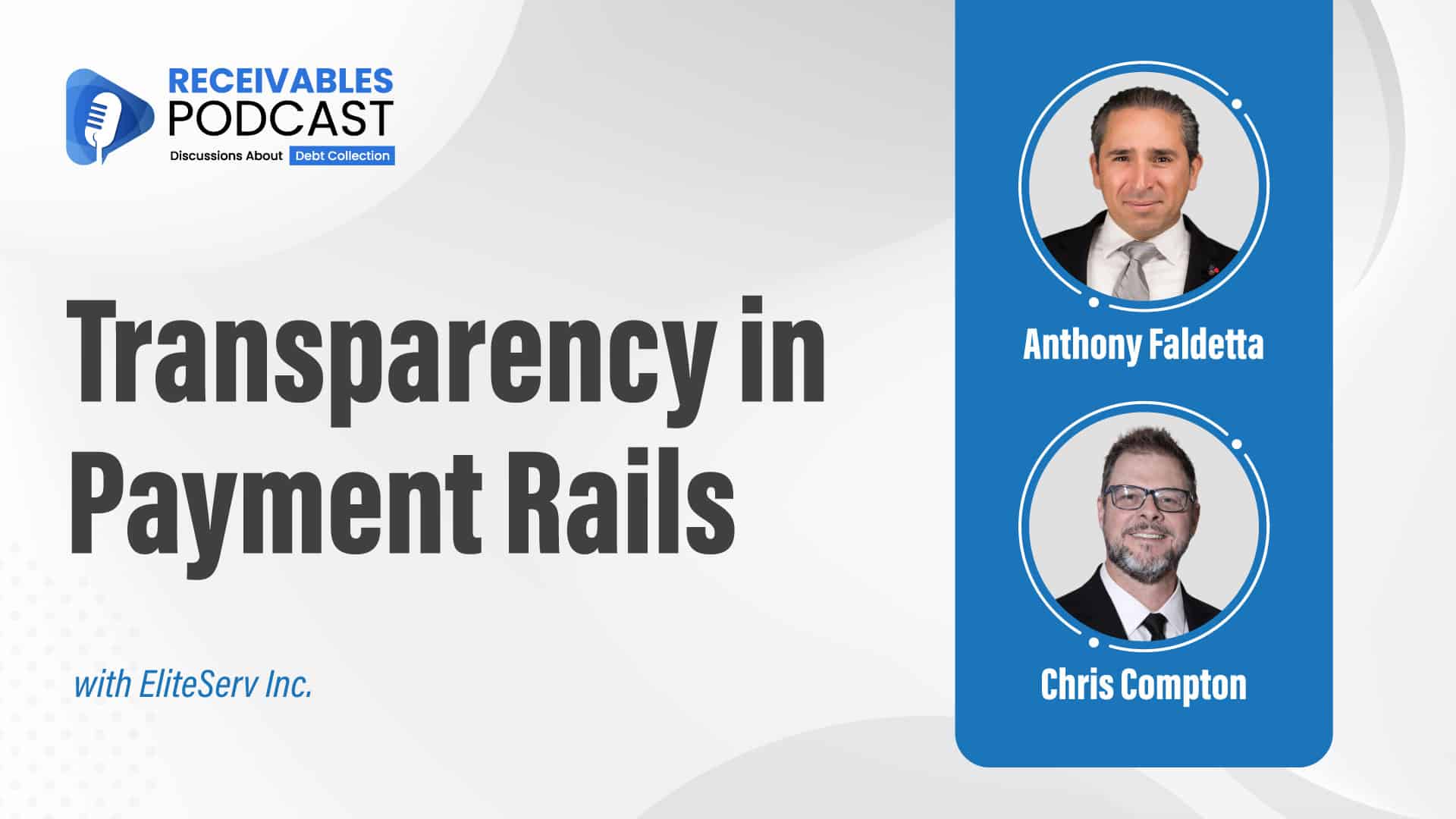
And I think it’s something that the industry has looked at as almost commoditized because of a lack of understanding of the level of complexity that goes into it and the types of options and the differences between the types of companies providing those services to our industry. So today I asked Chris Compton and Anthony Faldetta to join me here and kind of teach me a little bit about the payment rails and what needs to be happening in order to optimize my payment processing. So gentlemen, thank you so much for joining me today. I really appreciate you coming on and sharing your insights.
Anthony Faldetta (01:12)
Thank you very much for having us. Looking forward to this.
Chris Compton (01:13)
Thanks for having us, yes.
Adam Parks (01:14)
Of course, well Anthony, starting with you, could you tell everyone a little about yourself and how you got to the seat that you’re in today?
Anthony Faldetta (01:20)
sure. I’d love to. So I started working for the post office about 30 years ago in the mailing side of the business. From there, got recruited by Wall Street mail merger type of company. So we were fulfilling all of the merger and acquisitions that were happening and RIPOs that were happening through the proxy statements. Back then it was all paper. There was no digital. So we were hand fulfilling all that. Then met up with my previous employer who was there for 23 years selling direct mail to this industry specifically. Met a lot of great people, had created a lot of great relationships and through that met Chris Compton. A few years back I was going through some tumourliest, I’m gonna use that word, times with my previous employer and Chris Compton and I started talking about an opportunity and we quickly realized that the industry has a need for an honest, transparent payment processor. So we started the business and we started selling to people and we were able to scale pretty quickly and we did a great job in making sure that the clients got what they needed technology-wise. They got what they needed transparency-wise and we’ve been servicing close to 110 clients now for a few years and it’s been a great experience. I’m looking forward to continuing that growth to really help people because at the end of the day, we’re not looking to, I’ll give my sales pitch real quick, we’re not looking to make a home run for one client, right? So we can have clients that we’ve saved over eight to $10,000 a month and sometimes the conversation like, why do we need to save them so much? And the reality becomes is because we want them to stay with us forever. That’s just the reality. And I used that number, I should have used more of a percentage but it’s been close to 30 % savings up to 40 or 50 at times, as well as enhancing the technologies that people are currently using and things like that. So super excited to be here, super excited to be in my new skin, let’s call it. And it’s been a great run and I’m looking forward to grow this out of the world for me and Chris and our families.
Adam Parks (03:23)
Well, I’ve been learning a lot about this from you as we’ve been talking about over the last couple of years. So Chris, for anyone who has not been as lucky as me to get to know you a little bit, could you tell everyone a little about yourself and how you got to this?
Chris Compton (03:34)
I know if there’s a little, I’m 53 now, so there’s a lot. My path started in college. was a swimmer, University of Tennessee, All-American swimmer. Always wanted to be a swim coach, so that was what I kind of wanted to do. So I started a swim team right out of college, first business I ever owned. Did that for a long time and was teaching school at the same time. Went from tired of
Adam Parks (03:36)
Yeah.
Anthony Faldetta (03:36)
Yeah
Chris Compton (03:57)
I was having pruney hands to saying, you know, I’m going to make some real money. I want to do some things that give me a better opportunity, better family life. So I started in sales, started door knocking B2B sales for AT&T. That opportunity moved me down to South Florida where I ran all of South Florida of AT&T for the IT sales side of AT&T where I met my beautiful wife of 18 years now.
From that went through a company that did what I did that wanted me to kind of do the technology sales for them that own payment processors. So it got me into the kind of flow of, hey, they taught me the payment processing side, grew their business for a long time, worked in the payment processing field since like 2008, realized that like Anthony said, there are opportunities. Anthony and had very good conversations 10 years ago or eight years ago or however long it was ago that basically put us into the place we are today that where we can really help individuals understanding how payment processing works, not take advantage of individuals because they’re so-called high risk, which a payment’s a payment. We can talk about that at any time during the show. But that’s kind of like a nutshell of the 30 plus years I went from swimming to coaching to Eliteserv now.
Adam Parks (05:13)
Well, hey, look, sounds like you guys are doing something right over there from everybody that I’ve been talking to. When you say a payment is just a payment, I like that. Let’s dig into that for a minute. What do you mean by that? Because we’ve always been told that we’re high risk, right? We’ve always been looked down on from a payment processing standpoint. Many of us remember Operation Showpoint and some of the things that we’ve been through as an industry.
Chris Compton (05:26)
Yeah, well so. Well, yes, of course. And that’s kind of been the irony of everything, right? People like to use the word high risk because they can say, can charge you more. I get more profit if I charge you more. Let’s talk about that, right? So a payment that you call over the phone to make a debt payment, a moto, a mail order, telephone order kind of payment is the same payment as you calling a reservation for hotel. So are you telling me now the hotel industry is high risk? It’s not. It’s the same. So payment’s a payment, right? The way you take the payment, whether it’s in person or if it’s not in person, it’s the same. The industry dictates whether am I at risk or not at If you’re doing bad things, you’re at risk no matter what your industry is. If you’re doing everything compliant-wise, you’re not a high-risk client. And banks, and we have many, many banks that’ll see that and let us allow you to charge the low fees that you should be getting in the first place.
Adam Parks (06:30)
I don’t see collection agencies as being high risk from a payment perspective and you see charge off or you see charge back rates are significantly higher in other spaces, where the consumers making a decision. But so when we talk about payments and this is something that’s I think a lot of people are lacking in this space is an understanding of what happens from the time that the card is swiped or entered or taken over the phone, whatever that entry point is through the point of the of the money actually hitting the bank account of the merchant. We’ve seen all the diagrams, the flashing lights, but can you give us a simplified version of what that process really looks like?
Chris Compton (07:15)
Yeah. So it’s, it’s, there’s a lot of variables that go in between that. So a lot of it depends on kind of like who are you using, what gateway you’re using, what process are using all of those things that we kind of take into consideration, but a simplified version is really six things. You have an authorization, right? So the authorization says, Hey, let me authorize this, make sure this bank account is good. Let me make sure that there’s funds in the account. Then it’s an authentication, right? So once that happens, it says, okay, then I’m authenticate this and let me make sure that.
I’m holding the funds for that person. I capture that. So I capture those funds so these person can receive the payment that they just took and the capture makes it ready for release. Once it released in, there’s a clearing piece of it that clears the funds, the settlement piece of it that settles it into your account, the notification from your bank that you got it. Basically a simple step process. Now there’s a lot of components that go into that from the customer to the merchant, to the payment portal, the gateway, the processor, next day funding, three day funding, how much am I holding, who’s doing what, when, whenever. But the process in itself from the authorization, authentication, capture, releasing, settlement, notifying you, it’s the same no matter what payment you’re clicking, whether it’s a brick and mortar or e-commerce.
Anthony Faldetta (08:28)
Damn. Let me piggyback on that a little bit as well. So that goes back into these different steps that Chris had mentioned. And as we have these different steps, there’s different partners that could be used. And a lot of our vendors, a lot of our competitors, what they do is they kind of like, I’m going use the word a white label, all of these other products through these different steps, and they make it there. So as opposed to using a processor to do everything under one roof, as we do, they have many different like one gateway, one portal, one integrator. So you have three or four different partners for one transaction. So when there’s an issue with something, you have to make three or four phone calls, get three or four resolutions. Customer service teams are just constantly, you know, barreling down these teams and it’s causing time and time in this environment is complete money. So when you have a partner that has all of those systems and integrations in place, it streamlines those processes. So it’s very important that you take a look at that to see who’s white labeling, who’s not white labeling, and who’s being transparent with these processes to make sure that you have your money in the timely fashion, you have your questions answered in the timely fashion, and your customer service is also being handled in the timely fashion. That’s the biggest piece, right? We can all say and partner with 10 different companies, get something done, but when it’s an issue, it’s I gotta wait a week, two weeks for a resolution, because it’s gotta go bounce around five different ways. That could be a problem. Yep.
Adam Parks (09:54)
Well, time is money, right? Especially when we’re talking about something that’s a mission critical portion of our business, because if we can’t take the payment process and is not functioning correctly, right? Like support is of the essence because my entire operation is at a standstill. Everything from my digital efforts to my folks on the phone, everything’s at a standstill because that is really the lifeblood of their ability to work.
Anthony Faldetta (10:19)
Right. And then tack on some technologies to enhance that, right, by being able to accept other forms of payments, like digital payments, as opposed to the old fashion, just credit card, or ACH, or debit, right? There’s all these different, again, do you want to deal with one provider, or do you want to deal with multiple providers bolting on more customers and more things to manage for you as an agency, or using the processor that has multiple partners waiting for these answers to come across in a very lengthy time, as opposed to a short time?
Adam Parks (10:26)
You Well, being able to balance that, I think is interesting. So one of the things that a lot of organizations had to do during Operation Showpoint was they had to run redundancies. They had to have three or four different vendors running because all of a sudden, company X, which was very popular, can’t process today. And now where does that leave us? So what is a good diversification option for these folks, right? Is it in how you’re evaluating your payment processing vendor? or is it that you have to have multiple vendors? Like how should we be looking at that as an agency?
Chris Compton (11:22)
Well, I think we always promote redundancy. That’s my IT background, right? So my IT is about back. It’s redundant. You want redundant networks. You want redundant security, redundancy. The truth behind it is, you know, like you said, if you’re doing it right, you’re staying compliant. You’re keeping your charge backs down. You’re doing everything.
Anthony Faldetta (11:23)
Yes, you want that? I’m gonna dig it.
Adam Parks (11:32)
Yeah.
Chris Compton (11:45)
Your BBBs are good and all the things that they look at. You should never really be shut down. There are cases where a bank will say no more, you know, it’s not that you’re doing it. It’s that old saying that says, you know, one bad apple can ruin the bunch. Right. So you got, if a bank has a thousand agencies, collections, agencies, and one agency does something really bad, that bank could say.
I’m not going to take it, but that’s the beautiful, that’s the beauty kind of, of what we do is with the seven or eight different banks that we have all linked to us. So the switch is not a hard switch. It’s just changing the bank. If that happens, you know, but the,
Adam Parks (12:29)
But then the technology from the from the customer’s perspective doesn’t necessarily need to change. So by putting it into the hands of an organization who can make that switch for me, it seems like it makes it a little bit easier. The same reason when I’m running the websites for the industry, we run them on two different IP addresses. So then to call IT and move something, I can just handle that seamless load balance without additional needs. Because that’s why, mean, look, that’s why they hire us, right? Is so that they don’t have to do the things.
Chris Compton (12:37)
Has it changed?
Anthony Faldetta (12:37)
It doesn’t change.
Chris Compton (12:42)
Correct.
Anthony Faldetta (12:42)
Yeah. Exactly.
Chris Compton (12:51)
Yeah, that’s right. What is that?
Anthony Faldetta (12:56)
The rails of the thing. Yeah.
Chris Compton (13:01)
100 %
Anthony Faldetta (13:01)
Totally. And the rails are communicating with the CRMs, system of records, all these. So none of that changes. Tokenization doesn’t even change. All that, it’s just a different, pointing to a new bank kind of a thing. That’s really it. So can you do multiple banks on the background using the same rails, different rails? Absolutely. So we could accommodate any one of those sides, depending on what comfort level the client requires. But to Chris’s point, if you’re doing everything right, you don’t really need to. Because at the end of the day, it’s just all systemic and it’s automated.
Anthony Faldetta (13:30)
But if you feel like you have to appease a client to appease, absolutely. It’s a very simple thing to do.
Adam Parks (13:39)
Call me paranoid, two is one and one is none.
Anthony Faldetta (13:42)
Exactly. Yeah, exactly. Exactly. So you
Chris Compton (13:44)
We
Anthony Faldetta (13:44)
want to cover all bases.
Chris Compton (13:44)
promote that with everything that we do is, we want to make sure that you’re redundant. We want to make sure that you feel comfortable, just like you say, on your IP side, just like you say. I mean, if you can’t get into your data bank, because it’s sitting at a co-location in Miami, well, guess what? There’s one in Miami, there’s one in New York, there’s one in Texas, one, and they all ping each other. It’s the same thing on the payment side. We’re able to manipulate that technology of banks so that if one says, don’t want you,
Anthony Faldetta (13:50)
Right.
Chris Compton (14:12)
that’s okay. We’ll move you over to this one. That’s okay. Nothing changes. We’ll just move you.
Anthony Faldetta (14:14)
cycle it through.
Adam Parks (14:16)
Well, that’s a nice, simple, easy way for them to do it versus having to deal with an entire day or two days of downtime while you’re trying to get answers from an application stack that’s five organizations deep. I mean, that is the objective, right? Yeah.
Chris Compton (14:25)
Yeah, downtown doesn’t exist. Downtown does not exist.
Anthony Faldetta (14:26)
Yeah. In a perfect world. In a perfect world. Yeah, exactly.
Chris Compton (14:36)
Yeah, well you heard of the, I’m sure you’ve heard the five nines, right? We got the five nines. We’re going to be up, baby.
Adam Parks (14:42)
Yeah
Anthony Faldetta (14:43)
And we operated at 99.999 % rate of effectiveness.
Adam Parks (14:47)
Well, that’s generally the, for something that’s so mission critical, we really don’t have any options, right? Like being able to process payments shut down everything. There’s nothing that that business of collection agency can do without that in place. For a debt buyer, it’s slowing their investment repayments. mean, it’s slowing, it brings the entire business to a halt. Now, one of the things that you mentioned there was banks as we were kind of talking about how you can flex that technology. So we talk about the banks. I know a word that I hear a lot is ISOs. So, we’ve talked a little bit about what the natural process looks like. Can you tell me a little bit about who’s involved at each layer of that process that we discussed.
Anthony Faldetta (15:27)
You can take that Chris.
Chris Compton (15:31)
So if you’re a direct ISO, right? So an ISO is just basically an independent sales organization. So we are an independent sales organization of multiple banks, right? But to become a true ISO, then you’re taking on the liability. You’re taking on the risk. You’re taking on the things that honestly, there might be two out there, right?
Adam Parks (15:37)
Okay.
Anthony Faldetta (15:50)
Yeah, that’s like the white labeling piece that we talked about earlier.
Chris Compton (15:52)
You know, everybody else is kind of white labing like anything has talked about. So everybody else is kind of reselling a product. Everybody else is kind of, utilizing other technologies because you can’t own it all. I mean, there’s too many out there, right? So the key is, on our side is. We got me and Anthony and we have a support staff, but we have a, you know, hundreds of support staffs through our banking relationships that also sit on our side to help us. So. When we call, we don’t call 1-800-HELP-ME. We call the president of who we’re talking to. We make sure that we’re supporting you at a level that you’re not waiting in line at a queue, right? You’re not next in line. Hey, the call’s 10 minutes. Can I call you back? I need my money. You need to talk to me now. You know, so that’s the kind of support that we’re trying to bring in. And so we are basically, and I’ll let kind of Anthony tie into this, a direct partner, proprietary partner of many top tier kind of ISOs that allows us to bring a solution that is catered to you versus what I only have to sell. I’m not stuck to a product. I am kind of processor agnostic and customer focused is what we do.
Anthony Faldetta (17:13)
When we bring the customer to the best solution, obviously we have our main for this space and that’s the way it’s a single stop shop. We have our own rails, our own banks, a pool of banks to pick from, our own processes and that’s where we end up boarding the collection agencies, most of them, for some absurd reason that something pops up that they don’t want them but that hasn’t been the case yet.
All of the agencies get boarded here and they have all of this information. So you’re making one phone call. You’re not making six, seven, right? So again, having this proprietary process allows us to service the clients in a very good, timely fashion, which is important because like I said earlier, you have one gateway that you’re using, one bank that you’re using, one piece of technology, portal, whatever it is that you’re using. It may or may not accept digital payments. You have to add something else.
So you might have like five or six different vendors dealing with one processor and that processor’s gonna make those phone calls to try to get that done when they do this white label thing. So we’re very transparent about who we are. We’re ISOs, right? But our partners are direct. So we’re just making one phone call. So wherever we board you, we’re making that one phone call and that one phone call does the system integrations, has all of the rails, has all the information, and that’s what streamlines the processes and makes sure that you get the best technology for the same bang for the buck, if not less. Very key there, because that’s a key thing.
Adam Parks (18:36)
And so when we think about the challenges that our industry is facing as it relates to payment processing, what are you hearing as you’re talking to organizations in the space that are some of their current pain points that they’re struggling with?
Anthony Faldetta (18:49)
Yeah, today’s day, today’s time is everything is about digital payments. They want to, know, Apple Pay, Google Pay, PayPal, Venmo, you name it. They want to accept, you know, crypto is going to be down the road too, I’m sure at some point, right? So they want to be able to make sure that they can accept these digital payments along with the traditional ACH, debit, credit card, whatever it may be. So today’s, I’m going say today’s buzzword is digital payments. You know, do you have that in place? Are you accepting that?
Anthony Faldetta (19:16)
These new generations that are coming up. I mean, I have Apple Pay on my phone. I forgot my wallet the other day. And my girlfriend’s like, yeah, why don’t you just use your phone? I totally forgot that I could do that. And if I could leave my wallet in my car at home and go shopping and go do something else, everybody’s doing the same thing. You know what mean? So it’s going to keep going down that road. So to have to be able to accept these digital payments is key. Because if I get somebody on the phone, I could just send them the information that quick. and the payment’s done, it’s that quick. So you have to be able to be on board with that and make sure that have the technologies that can board that for you. And your partners need to be able to. Right now, a lot of system of records, unfortunately, have not caught up at the times yet. So there’s a lot of companies that are kind of being held hostage by their system of record. So they’re waiting for that to get caught up, to be able to add these digital payments. But I’m sure that in 2026, that they’ll make their they’ll make the digression to that. We’re ready. whenever anybody’s ready to accept them, we can provide it, which is key.
Adam Parks (20:17)
I think it’s an important one. I’m curious as we look into the future, do you think that crypto is going to be here as a payment methodology in the space in the next five years, 10 years? What do you see down the line?
Anthony Faldetta (20:25)
Yeah, I mean, it’s being regulated. You see it all day today this morning. I woke up and I saw Solana and another ETF coming out by Morgan Stanley. So it’s regulated. It’s being it’s being sold and they’re talking about Solana compared to Ethereum. know, Ethereum slow Solana is faster. So that’s going to get a big pick. It’s going to get a big pickup now. So that’s going to get stuck going to get subtraction. Bitcoin is kind of drawn out. So I think crypto is going to be in the space. And now you have to have that flexibility to be able to use a bank that can accept crypto and make sure you go down that road. Now, we’re not there yet, right? Nobody in the industry is really there yet for that. But I do definitely see it happening in time, right? That’s going to come from the the CFPB or president even down saying, hey, you guys can now accept this form of payment for a distressed debt, you know, which would be interesting to see if that legislation ever does pass. But I think it’s gonna.
Adam Parks (20:59)
No.
Anthony Faldetta (21:17)
I think within the next five years, I think you’re going to see it.
Adam Parks (21:17)
Even without legislation, I think within five years, we’re going to see it either way because whether or not they clear the way for it or we’re just going to have to figure out how to convert it fast enough. The exchanges aren’t fast enough and that split second at time differential in the marketplace could mean a penny and we know how Elizabeth Warren and others are going to feel about that penny. So we’ve got to be on point.
Anthony Faldetta (21:28)
Agreed, yeah. Right. Exactly. Yeah. But the key factor there, the key factor there is what blockchain do you use, which is going to be the faster one, which is going to the process is the cleanest, right? Because the faster the transaction happens, that penny differential is not going to be there. Right. That’s the key.
Adam Parks (21:49)
But what’s the consumer holding? This is where I think the crypto conversation starts to get interesting. I’m glad that you brought it up because I do think it’s an interesting discussion that our industry needs to continue to discuss into the future. But even looking at some of these other channels like Venmo, Cash App, everything else that we’re starting to see, I like I’ve put them down in South America right now and their little QR code system similar to the UPI payment system that they use in India down here is called PIX and it exceeded credit card transactions this year.
So I can walk up to the coconut man, get some coconut water, scan the QR code, make the payment directly from the bank account. Not a huge fan, I prefer the credit card and the protections that are ultimately afforded there, and I think the less transparency directly to the government on every receipt and purchase I think is also a good thing, but call me a Boston man, I feel like that’s probably just fine.
Anthony Faldetta (22:46)
I’m with you on that though, yeah yeah yeah, I’m with you on that.
Adam Parks (22:48)
My American root. But I think it’s interesting as to how that flows through. So you’ve seen a lot of organizations starting to move towards those digital payments and starting to evaluate it. I feel like merchant services for me in 2025, I wasn’t really looking at that expense line because it was just one of those things that just kind of existed in my world.
Anthony Faldetta (22:55)
Yes.
Adam Parks (23:05)
And it wasn’t until December as we were kind of going through our corporate restructuring and organizing ourselves that I went, man, like this is something that I really need to look at. So immediately reached out to you guys and started the conversation. But I feel like it’s one of those things that in our minds it’s become like it works now. We had so many problems a few years ago that it works now. So like people are just kind of leaving it there and not touch. Yeah, don’t touch it. It might notice that I’m here. Like I don’t want to wake the sleeping bear. And it feels like we’ve gotten so far past that now.
Anthony Faldetta (23:22)
Yeah, yeah. Why touch it? Yeah.
Adam Parks (23:34)
as an industry in terms of the technology that you’re able to deploy that it’s not really like that fear factor is gut instinct, but probably not best for us these days or best for our organizations.
Anthony Faldetta (23:46)
It’s definitely not the best practice. In the end, you have to look at it, even in my previous life. Hey, I’m selling this product. At the end of the day, when you’re a business owner, no matter what product that you need to look at, you need to keep your vendors in check. How do you do that? Every few years even, if you want to just prolong it, just check to see what’s out there, what’s available, what it should be costing you.
Can you bring in to streamline a process, give you more efficiencies, less headcount, things like this. So if you’re not doing that because you’re afraid using that language, because you don’t want to get wake the sleeping bear, then you’re losing an opportunity to potentially, like I said earlier, save 30, 40 % up to even. And that could be a big number. So if you could save 30, 40 % as well as AI technologies, streamline processes, now you’re ahead that much more. You know, so you really want to, I feel that you should always be doing a vendor checklist kind of thing every year, two years, three years, whatever the cadence may be. You should go through your processes, see what’s happening in the world, see what’s available, keep everybody on their toes and working for you. That’s the key factor. You want everybody to work for you.
And the one thing that I’ve always done in this industry, and I’m sure everybody that’s watching this will say, I’m an unpaid consultant. You want to bounce something off of me? Give me a call. We’ll talk about it. I’ve done it in every instance with portfolio sales, which I know nothing about, with other things that know nothing about. Introductions. Exactly. Exactly. Exactly. So you put people together and you get stuff done. And that’s basically what happens. Right? So give me a call. Give us a call and we’ll walk you through whatever it is that we see.
Adam Parks (25:19)
But you know the people involved and that’s the important part.
Anthony Faldetta (25:32)
You know, these analysis that we do for our customers are at no cost. And again, treat us as your unpaid consultants and we can sit back and really dig into your process, dig into your invoices, show you what it’s currently looking at and give you what we think it should be at. And then from there, you can make your decisions on, you know, at least beating up your current vendor or switching. That’s up to the business owner, but we’re always here and available for that. Because again, we’re looking at friendships. We’re looking at being in business, being here 25 years, you know, it’s about friendships. It’s not about like, you know, I want to walk through the trade show floor and have everybody shake my hand and say, hey, you did a great job. Thanks. Chris doesn’t want to get punched in the face by somebody either. We want to come in and you guys do a great job and they never leave us. And that’s the whole key, right? Because leaving could be an arduous process if handled incorrectly. If handled correctly.
Adam Parks (26:01)
One more thought.
Anthony Faldetta (26:26)
Leaving is not that difficult. The only thing that needs to be discussed during implementation is basically the tokenization of reoccurring payments. So if you’re going to go ahead and transfer your reoccurring payments over right away, most of the time, the gateways will release those old payments to the new gateway. Or we keep the same gateway and we just kind of roll it into the new situation. And it could be as simple as that. Is it always that simple? No. Do phone calls need to happen sometimes? Yes But we have overcome this in the past to make people aware that hey listen you are not stuck in the situation that you’re in because of whatever might have happened five years ago ten years ago. Three months, four months ago, six months ago. That’s where we live. We live in a short time. People have short memories. We’ll go through it, we’ll look at it for you and then we present that to the banks and they take it so if they say no you stay where you are, and you know, you know, you know, it’s they’re never gonna say no. But that’s a fact. So, yeah, that’s not.
Adam Parks (27:22)
Well, it sounds like
Chris Compton (27:24)
Yeah
Adam Parks (27:25)
an interesting or easier process than it used to be. Go ahead, Chris.
Anthony Faldetta (27:27)
Yeah. Now what
Chris Compton (27:27)
And now, here.
Anthony Faldetta (27:29)
I’m saying, yeah.
Chris Compton (27:30)
And I’ll add to like what he was saying is with the unpaid consultant is I feel like, and I’m not me personally, or Anthony personally, like we’re not geniuses, but we have a wealth of knowledge with relationships and the things and the partners that we have. We can bring anybody to the table. That’s going to answer your question. You just got to ask the question. Right. If you like, you’re sitting there and you’re going, say you’re looking at your end of year books, right? And you go, why in the world is it cost to me boom for processing? I’m going to call Chris and Anthony. We’ll show you why, whether you do anything about it or not, we’ll show you why. And that’s kind of what he’s talking about is that use us. Use us in that, in that forum, because, you know, that’s kind of what we do. And that’s kind of why we help our clients.
Anthony Faldetta (28:11)
Yeah. Compliance is a huge thing too. Agreed. Yeah.
Chris Compton (28:12)
God bless.
Adam Parks (28:12)
I think it helps you get to the bottom of things pretty quick, right?
Chris Compton (28:15)
Yeah, yeah, because we know what to look for where you don’t look at it every day. You look at it once a year. You go, I don’t even know what to look for. Really? You know what mean? We’re looking at it on a daily basis. We can dissect it in an hour and be like, man, yeah, this needs to change or nah, this is right. This is kind of where you are and they’re doing a good deal or whatever the deal is. We’ll go either way and just be honest.
Anthony Faldetta (28:35)
Hey, Adam, I also want to add that compliance is also a big part of this, right? So when you’re dealing with somebody that may not be industry specific or just kind of around the industry using that language, and then all of a sudden you see a bunch of information around convenience fees and adding fees and doing all these other things, there’s a lot of rules that are around that that can only happen a certain way that you’re allowed to do it. So if you’re doing it the Wild, Wild West way, good luck because those fines can be upwards of $50,000 per account. So you want to get a visa fine and then shut down and get blacklisted, you’re doing a great job because it’s a matter of when they catch you, not if they catch you. And using a compliant processor that has all of that information at their fingertips and able to implement a fee model without having to worry about if they’re to come knocking on your door.
That’s a huge piece as well, right? As well as just being overall SOC 1, SOC 2 and all the other information that goes along with being compliant with security. You want someone that’s tied into the CFPB, that’s tied into the FTC, that could come in and speak to the rules and regulations because they live and breathe it. And that’s who we bring to the table. You know what mean? And that’s a huge part of it. Cause I’ve had some, we’ve had some very interesting conversations in the last six months of law, they’re doing it this way. Why don’t you? I’m sorry. It’s not going to work that way. You have to use the processor to accept the payment. You can’t accept the payment, you know, and you can’t use, you can’t blend the convenience fee to cover other costs. It’s specific for that. There’s a lot of rules that are around that that we could get into at a later time or today. It doesn’t matter. But that’s a huge piece of where the industry is also kind of dabbling in clients are starting to loosen their belts with that.
Adam Parks (30:01)
yeah.
Anthony Faldetta (30:23)
So it’s a conversation piece, but not fully there yet with the banking side of things, or even Telco. It’s basically in the Telco world and some other worlds, some other verticals.
Adam Parks (30:35)
I think convenience fees themselves deserve their own episode. Like that’s something that I think we need to dig into and really have a deep conversation about because there’s so many different varying factors to it. And then what are the actual rules around and how is it being implemented through the technology platforms? And for those that are watching here today as well, you guys are gonna be at the RMAI conference here in just a couple of weeks.
Chris Compton (30:35)
It’s it’s true, it’s Yeah, that is, yeah.
Anthony Faldetta (30:52)
Yes, Feel free to tap us in, reach I’m going to be walking, not exhibiting. Chris will be there as well. So we’ll be there together. So if you have any questions, you want to have a quick little meeting or a cup of coffee or dinner or lunch, we’ll be more than available to you to help answer any questions you have. And again, being your consultant at no cost. So if you need an introduction to somebody else about something else too, reach out because I might be able to help you there too.
Chris Compton (30:58)
Absolutely. around.
Adam Parks (31:22)
Give Anthony a call. That’s true. Many times you’ve done that for me. I really appreciate it. Gentlemen, I appreciate you coming on and sharing your insights today. This has been a great conversation and helped me to understand a little bit more about what this process actually looks like behind the scenes and who some of the players are that fit into it. But I really appreciate you guys sharing your insights.
Anthony Faldetta (31:24)
I’d be happy to help as well. It’s always been my pleasure.
It’s awesome. Thank you for having us again, Adam. I look forward to the continued relationship as well. It’s going to be great.
Chris Compton (31:49)
with your own.
Adam Parks (31:53)
We’re gonna have a lot of fun together. For those of you that are watching, if you have additional questions you’d like to ask Anthony or Chris, you can leave those in the comments on LinkedIn and YouTube and we’ll be responding to those. Or if have additional topics you’d like to see us discuss, like convenience fees, you can leave those in the comments below as well. And hopefully I can get these gentlemen back at least one more time to help me continue to create great content for a great industry. But until next time, gentlemen, thank you so much for your time today. I appreciate all of your insights.
Chris Compton (31:53)
Definitely.
Anthony Faldetta (32:18)
Looking forward to seeing you at the RMA and crashing into you as well, because we’re going to have a nice race.
Chris Compton (32:19)
Thanks guys.
Adam Parks (32:22)
Yeah, we are. We are. I will see you on the go-karts.
And thank you everybody for watching today. We appreciate your time and attention. We’ll see you all again soon. Bye.
Anthony Faldetta (32:30)
Have a great day.