Adam Parks (00:08)
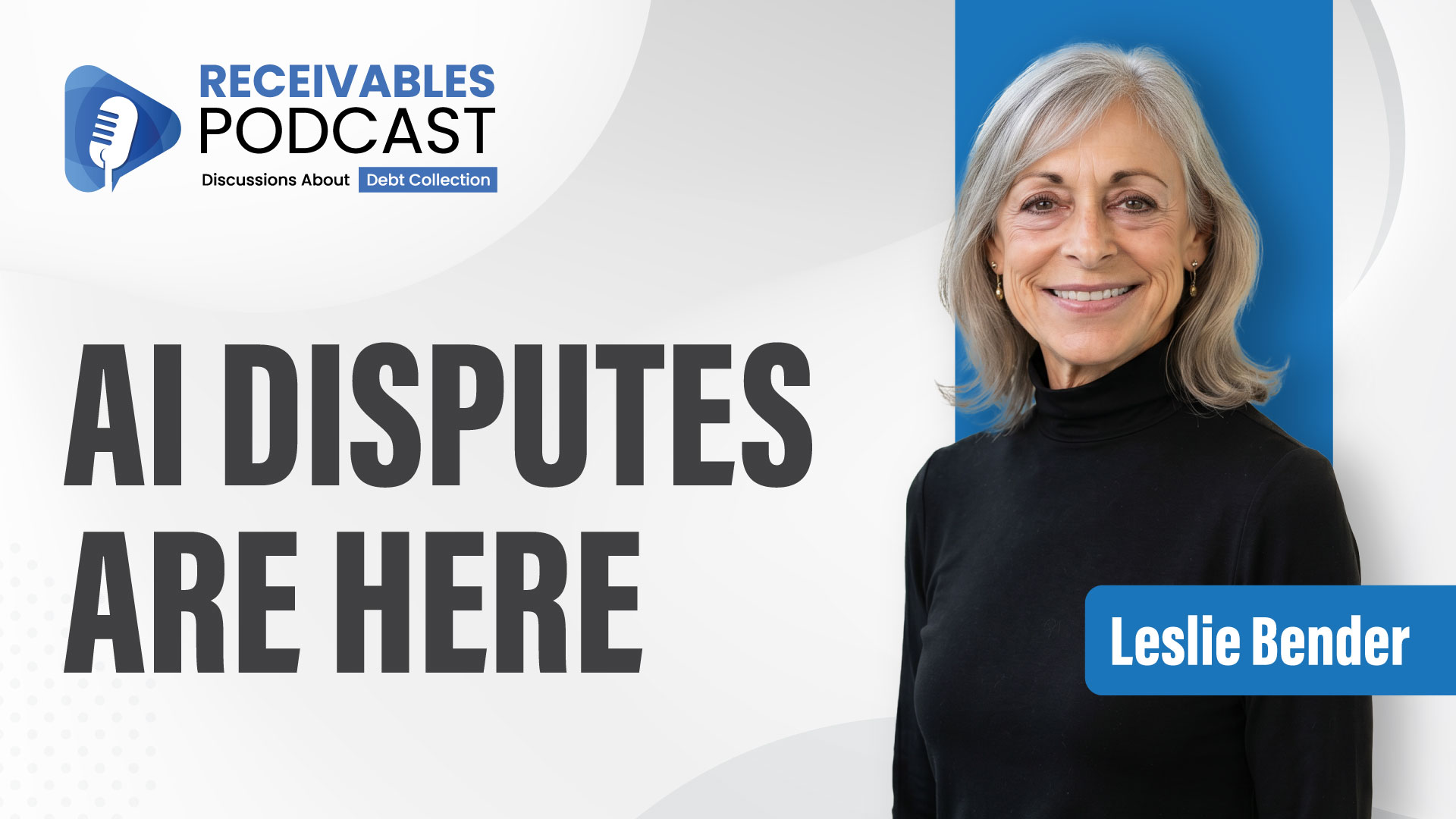
Hello everybody, Adam Parks here with another episode of Receivables podcast. And today I'm here with an industry legend, Leslie Bender, joining me to talk about artificial intelligence, but not from the B2B perspective that we hear about every day. Let's talk more about the consumers and the consumers' use of artificial intelligence as it relates to our world of receivables. So Leslie, thank you so much for coming on today. This has been long in the waiting, so excited to finally have you on an episode.
Leslie Bender (00:39)
I'm honored. I'm honored. I think it's a great podcast you do and I'm truly honored to be a guest.
Adam Parks (00:47)
I really do appreciate you. For those of our audience that have not been as lucky as me to get to know you through the years, could you tell everyone a little about yourself and how you got to the seat that you're in today?
Leslie Bender (00:57)
Okay, well, I am a lawyer, but I really like getting involved in the business side and taking very complicated laws and regulations and making them actionable. I mean, I do like to read them in the wee hours of the night. And I guess I kind of cut my teeth on the tens of thousands of pages of HIPAA regulations. And perhaps that's what I'm best known for.
But I was the girl that got out of law school about 40 years ago and went to a law firm that needed somebody low on the totem pole to go to court all the time and do debt collection basically for huge groups like the Archdiocese and some other groups you wouldn't think about. And I loved it. It was a great way to interact with consumers and to try to understand their perspective and to sort of see how courts view the whole debt collection process and
From there, one thing kind of leads to another. You say you have a plan, but everyone in the world laughs at you about that. And I've just kind of always been in the space of restructuring, doing due diligence for private equity to help them understand what risks might be of companies they're gonna acquire or combine. And sometimes helping people strategize what their litigation and complaint history means and how they can fix it, defending regulatory investigations. I kind of do a whole smattering of, you know, preventive and reactive compliance.
Adam Parks (02:30)
A lot of compliance work across this industry has been a changing and evolving process. so being able to follow you and kind of some of the things that you've been doing has been quite interesting in terms of keeping our finger on the pulse of what is changing across the industry itself, which leads us to today's discussion around artificial intelligence and the consumers, because when I reached out to you immediately, you had a topic on hand that you thought was a really big hit.
And I love the way that you are looking at the data behind how pro se litigants are starting to become a nuisance of the court, so to speak, and also a problem for debt collection organizations trying to operate legitimate businesses. But that leads to this larger overarching conversation around the bots, the agencies have bots, the consumers have bots, the debt settlement companies are building their bots and all these bots are gonna be coming together at some point.
But starting with the pro se litigation, because I think that's the more immediate threat to our industry right now. Can you tell us what you've been seeing and what you've been learning?
Leslie Bender (03:23)
Yeah, I think the data is pretty amazing. Like we all read the dramatic stories about a big law law firm. And I work for a big law law firm, but not that one that was in the stories. you can understand how it happens. Some of the AI technologies are just, it is amazing what you're able to do. And it can lull you into a false sense of security about what's going on, right?
I mean, we read about, you know, people who date their AI bot and, know, I think people get lulled into a sense that they see stuff in writing or maybe they have audio and they hear it and they think it's for real. And pro se litigants are no exception. There's a website now that tracks all these hallucination cases. And these are the cases where you would think it's attorneys that just have too much on their plate and they go to Westlaw AI or LexisNexis AI and they ask for help writing something.
But surprisingly, as of Friday, and I love data too, there were 1,394 reported decisions where a judge spanked somebody for filing something that included hallucinations. And the hallucinations aren't just made up cases. They might be real cases but they are quoted for propositions they don't say, and there's a mishmash from some blog that misunderstood the case or whatever. Now of those 1,394, as of Friday, 831 were decisions involving pro se litigants.
And interestingly also, the cases that are challenging some of the uses of AI and whether attorney-client privilege applies are also pro se litigants. So I get the feeling that people might think, you know, I get that you want to do a gut check, right? And you're going to check with AI, what does this mean?
Or, you know, you're sitting around and, you know, waiting for a meeting to start, and you ask Gemini to figure something out for you. You know, I've even done due diligence and M&A deals where somebody gave me what Claude said was a risk assessment. And I was supposed to give a second opinion.
You know, and so I think it's very, it's just an attractive, bright, shiny object that we all get a lot out of, but it has a dangerous side. And I think that if you are working in any consumer finance business and you have a support team that is reviewing complaints, letters, correspondence, you should assume that bots are writing some of that.
You know, in the healthcare space, there are bots that call the client a ca-tient. Not a consumer and not a patient, but a ca-tient. And they continue to interact with your support team over and over and over with their bot. And it's pretty frustrating because they are only as good as however they were set up. But somebody, some consumers are paying for that.
And how would they know if the bot is representing them well, not representing them well? And then to your point, you have a bot and then it's going to a call center and they have a bot because they want to categorize and detect any early warning systems and any incoming. And I'm not talking agent to agent right now. I'm talking about where I think maybe the biggest ROI is for some of the bots is the behind the scenes making sense of the voice analytics data or making sense of the correspondence that comes in and sort of right sizing some of the responses.
And I mean, are we going to come to a point where there's no real people? I mean, I guess the humans in the loop somewhere, right? But there aren't real people going to court. There aren't real people filing pleadings. There aren't real people filing disputes and complaints. And what, how much disruption is that going to be in the marketplace?
Adam Parks (07:59)
How much disruption is it right now thinking about that half of more than half of those cases that were cited as having some sort of a hallucination are coming from a consumer. And let's be honest, the consumers are generally using the free version of whatever tool it is that they're accessing. They're probably not double checking or running different models against this model to see where, where does the truth lie?
And they don't have the expertise to go through it. I recently did a, I guess was, at the beginning of the year, I did a consumer facing podcast where I was answering consumer questions and it helped remind me of what the least sophisticated consumer ultimately means. From an engagement standpoint and an understanding standpoint, I think they see these tools.
It's a replacement for Google for a lot of people. And because it responds in this format that sounds conversational, I think people are getting themselves a little bit more caught up in it or developing more trust. But I forget who it was. It told me that ChatGPT is basically like a drunken frat boy. It's going to be wrong. And it's going to be wrong with all of the authority that it can muster.
And that's a problem because that tone of understanding, that tone of expertise, I think comes across as more authoritative maybe than it should be. But now you've got the you've got the situation where the judges are getting upset, but how well could it possibly be representing the individual consumers and I get that they see the savings the savings of money by not hiring this lawyer for whatever the fee structure looks like but how could they possibly be appropriately represented or be getting good instructions or even being able to feed the AI model enough information to provide even directional guidance.
Leslie Bender (09:54)
Right. And if it is, if they are feeding it and then they get ensnared in litigation, there's a good chance that they could get a motion to compel or ChatGPT would or whoever would. And then that could all come into the record. And it could be that they put facts in that were damning about their circumstances.
Well, I don't want to tell the debt collector that I just got my tax refund and I'd rather tell them that I am at less than 400 % of the federal poverty level and I need an extended interest-free repayment period. I mean, there's a lot of things that could kind of go wrong. And I don't know that a lot of the case law so far is about debt collection so much as like employment disputes. But I wanted to go back to one of the things you said about ChatGPT.
A lot of the AI open source tools are meant to be pleasers. Now as a lifelong people pleaser, I can tell you there's nothing wrong with that. Okay. But you know, they're meant to be a pleaser. So if you get done, ask, asking Gemini something and Gemini is attached to Google. So if you think you're Googling and you want the AI response, it's going to be served up and it asks you, Hey, is this what you're looking for?
Thumb me up or thumb me down, you know, if this is what you wanted and maybe what you really are asking or your next question is going to be this. And it does give you more prompts and it makes you feel good. Hey, you know, I did your analysis and while it's thinking, it's thinking, processing, whatever, you know, and some of these tools are programmed to please you.
And that's why they're going to continue to try to find answers that you want. So if you key in, I have a bill I can't pay. I don't really qualify for, you know, any sort of hardship program that I know that this creditor has. What should I say or what should I do? It's going to give you some answers and then you're going to try those answers out and they either are or aren't going to be effective. But if they're not, they will be disruptive, don't you think?
Adam Parks (12:08)
Well, it's going to find an answer to serve. And if I tell it if I give it circumstances, it will do whatever it can to give me an answer that meets my circumstances, regardless of whether or not that's still based in reality. Now there's other models that are probably better at it. Perplexity and their SONAR model is probably a little better versed on those, but I wouldn't use that to write something either, right?
That's, there's different models for learning than there is for producing a new piece of content. And Claude, I think, is sounding more and more human as time has expanded. And so I think we're seeing a lot of that. The quality of its output is pretty significant.
Leslie Bender (12:43)
Yeah, yeah, and it's pretty darn good.
Adam Parks (12:51)
And now that you've got Coworker and some of these other tools that are starting to come into play, people are becoming more comfortable letting that machine take control of their computer and use Coworker, for example, to submit disputes to every account on my credit report. But with the larger task that this consumer is most likely going to request of the tool, the context window is not growing at the same rate.
Leslie Bender (13:03)
Right.
Adam Parks (13:17)
It doesn't really understand what it's doing and the more tasks that I ask it to accomplish within a particular run, the less likely it is to do it well.
Leslie Bender (13:27)
Yeah. And it's interesting, you know, I, what has been really an important thing in my career has been to spend a lot of time talking to regulators because I feel like if you listen to them tell you, you know, it's kind of like if you get to a concert early and you can hear the band warming up, you sort of know what might be in their set, right?
And so if you talk to regulators and you listen to them, you understand how they see consumer risk and consumer harm and the tools in their toolbox. And I think that they're very concerned with uses that are pretty damaging for consumers, you know, of AI that might get in the way of them getting the kind of help they need or raising issues they should raise or asking for forbearances if they need forbearances and I think they are quite concerned and they're concerned also about the cybersecurity issues.
You know, if a consumer is using AI to interact with a financial institution, did they give the AI their credentials? You know, their multifactor authenticator, like are they giving all that information? And then, you know, if call center people fall victim to vishing attacks, imagine Claude or Gemini or ChatGPT, they could be quite deadly.
Adam Parks (14:59)
I would think the consumer is gonna be more likely to trust at the probability of there being issues there or allowing access to more of these tools. I always go back to the statement, if you're not paying for the product, you are the product. And I don't know even a lot of my friends, that are paying for all of these models to be able to use them. And so like within our house, we shut down, like there is no ChatGPT running in our house, but we've got Google Workspace as a family account. So we use Gemini for certain things because that's the model that we're paying for. more comfortable in those models.
I don't think the average consumer is doing that and the risk level that's represented in the consumer is allowing these free tools, not at the highest model levels. They're kind of using lagging technology and trying to accomplish the same things. we've, as an industry, been so focused on bots. We've been so focused and bots being maybe even an understatement. We've all been, the industry's conversations have been very focused on the voice AI bots.
Is voice AI really the solution? You'd mentioned some of the other, you know, empowering of the agents and it's been through all the research I've been doing. It sounds like copilot is the most impactful AI use case studies right now, being able to make the agents more powerful and provide them with better information so that they can use their brain to engage with that consumer while being fed additional information.
But with that comes the consumers, and the consumers are going to have these bot tools if they're not already using them, which we're pretty sure they are. They will be using them soon. What do you think that engagement or interaction is going to look like between a professional creditor or debt collection organization and this unknown bot? Is it not third party disclosure potentially, like just even engaging with that bot to begin with? Like, I feel like there's a whole myriad of problems here.
Help me understand it from your perspective.
Leslie Bender (17:01)
From my perspective, wow, you just opened a Pandora's box of great ideas to talk about. The first thing that came in my head is that the FCC just issued a proposed rulemaking about on-shoring. So as somebody who has spent a lot of time supporting offshore, really credible BPO type organizations, the idea of on-shoring, how are you going to affordably on-shore if this comes to pass and they expand the scope of this to be any TCPA regulated communication? So it's almost going to force your hand to use AI more because I don't notice that there are great trends of Americans wanting to work in call centers.
I might live in a sequestered world, but I don't think the data supports that the US really wants those jobs back. So the first thing that comes to my head when you talk about this is that, okay, if you're gonna have an offshore call center, you might need a bot to make what your offshore agent say sound like a Midwest accent or sound, you know, like there's gonna be a middleman, like there will be a person, but there's gonna be a, translation so it stands sounds like standard American English whatever that means and so I think that that is a use case nobody's talking about right now but I'm confident that some of the BPOs have those bots already.
Adam Parks (18:26)
Fair. The Accent technology exists. It's not perfect yet. It's definitely something that's in development. But I think the I think that's been accelerated significantly since the FTC released that proposed rulemaking. It wasn't it was technology I knew existed, but I haven't really heard pressure being applied and people really pushing their interest in that direction until recently and how many both financial institutions and agencies have not only BPO services, but their own wholly owned facilities in other countries. And what's that start to look like as they've made that capital investment around the globe?
Leslie Bender (19:11)
Right. Yeah, no, I mean, I think that it will be very interesting what the comments look like that come back. And it's a short timeframe. I think that common periods up at the end of this month. So, you know, it'll be very interesting. But, you know, I think there could be market pressures like that that force people into AI tools. And I agree with you 100%.
Most people, when you say AI on the consumer finance side or the receivables management side, immediately think of AI agents. And my personal belief is that, wow, imagine how cool it would be because people on the consumer finance side have treasure troves of information about probably the very consumers that are their customers today.
Okay, Leslie Bender, this is her. you know, 10th house she's bought. This is her mortgage. She does this. She likes to pay by the seventh of the month, not at the end of the month. She likes to do this. You know, she usually, you know, pays off a mortgage in this number of years or that number of years. Like the really cool use cases I've seen for AI in call centers is to feed you information that isn't creepy, but about the financial health of the person you're talking to.
Hey, Adam, I see that last year we had an account placed for you and you wanted to pay it in six payments over the course of four months. Do you want to do that again? Have your circumstances changed or is that still best for your budget? That makes people feel, done right, not if done creepy, like they're appreciated and it could build trust. And maybe you know, instead of just pitching somebody you've got to pay it all today, if you know the person's going to pay in six, then why not start there and get the person in a payment arrangement?
Because you know that's where you're going to end up and why create the friction, right? I think there are some cool use cases on negotiation there. Or what if you saw that the person just took out a big student loan or their student loan just came due? Hey, Adam, I see your student loan just came due, you know, maybe if we gave you some relief on repaying this, you know, you could get, you know, regular payments consistently, knowing that once you're locked in to making those payments, you're not going to walk away from it. You know, I mean, to use higher levels of negotiation, I think is a really cool idea. And, you know, might be more helpful in a call center.
Adam Parks (21:57)
On the creditor side, we've seen the creditors have moved more towards communication, at least in the collection side. And I think their underwriting has moved more towards the technology. Debt buyers and specifically have really made their AI investments into being able to manage and understand the accounts within a given portfolio to be more predictable in those ways. then law firms focused on collection law firms focused more on that's called administrative process and the leveraging of those tools to improve their efficiency as humans, which I think is interesting as we look at all of these different use cases. It's been my experience, especially over the last couple of TransUnion surveys, that the use cases that an organization has for BPO service and the use cases that they view from an AI standpoint seem to be in sync.
So the types of organizations and the organizations that are looking at those things seem to be looking at them in a few different ways. Although I think organizations are still having trouble really isolating the measurement of return on investment as it relates to artificial intelligence, because they're not really sure how it's not. It's not a dollars. It's not a dollars for dollars comparison, in my opinion, I think we have to look at how which use cases are reusing for any particular organization, like which AI use cases are part of our repertoire.
And of that understanding of which use cases are we using, it's to the degree in which it's been integrated into our systems, right? Are we treating AI as a bolt on or are we treating AI as a new process flow and we're rethinking the way that we do things now that we have more tools at hand. This is where I think that consumer AI tool set is really going to kind of hit first is going to be on those inbound IVRs and on those inbound bot calling systems.
And we're going to have to start finding ways to identify is this a bot? Is this not a bot? And I hope it doesn't get to the point where we're adding more disclosures to our conversation because that's not helping the consumer anymore. Like we're, think we're, past the Peter principle point of diminishing returns when it comes to disclosures, but we are going to have to be able to identify those because I can imagine that some of these, I'm going to throw up the air quotes when I call them consumer attorneys are going to be using these outbound bots to try and trick the agent into saying something slightly wrong, especially in those situations where you're kind of damned if you do and you're damned if you don't, and you're just kind of stuck in the middle of it. And I think that's where we're going to start seeing that. But also in the consumer bots actively calling in and trying to negotiate a debt.
And I think the consumers feel overwhelmed when it comes to negotiating an outstanding balance. They're feeling overwhelmed. And I think that's why debt settlement and other things have become more popular as consumers have more accounts that they are struggling with. It's a big lift. mean, I went through a fraud incident myself not a year ago. And I mean, I would consider myself to be somewhat of an expert on the subject.
And it was time consuming. And if I was working at night, if I didn't have the ability to just stop what I was doing that day and try and execute on dealing with this, I'd probably still be dealing with it. So I can see that the consumers are going to be looking for that crutch. And I don't know what that's going to look like in the coming years for them, because there's a lot of problems that can come from their use of these tools in absence of appropriate representation, both from a pro se standpoint and even from a non litigation phone perspective. I just I see this going poorly for consumers.
Leslie Bender (25:38)
Yeah. And I want to mention something. It's a little adjacent, but, you know, I was at a credit risk conference last week and I was struck by all these beautiful, brilliant, colorful, attractive bot and other use cases and a challenge that a lot of organizations have that the people who may people, some of your senior leadership and decision and influencers in your company,
might not have a full understanding of how AI works and might not be as facile with it as we might need them to be. And I think that something that's holding organizations back is a talent issue and it isn't the consumer facing talent. It is needing to figure out how to not just get their you know, engineers and their IT guy and whatever up the curve, although those people need to, but you have to get your lawyer up the curve.
You have to get your ops guy up the curve, you know, otherwise you're going to have everybody going to conferences and finding a bright, shiny object and coming back. And so I think that it is very important for organizations to focus a little bit on the talent issue and if that means that you have to do the weird thing that you send your, you know, chief legal officer, your, you know, compliance officer or your call listening, you know, VP, whatever it is to some of these conferences to understand what the potential is of this technology.
Cause otherwise I think you could get yourself into some, some uncomfortable spots that as consumers ages are younger, your consumers are all digital natives, but some of your leadership are digital nomads and they won't have grown up using these things. You know, I have a great niece and a great nephew who are now four and six and they've been digital natives for well over a year now in the case even of my great nephew who just turned four. And it's like they can pick up your phone, they can use an iPad.
I mean, it's amazing, you know, and for those of us who are digital, I mean, I love digital stuff, but it isn't second nature to me, you know, and I think we have to think about that issue a little bit is, you know, how do we keep up so that we really understand when we're deploying some of these technologies? Who do we trust? You know, I mean, as I'm sure you see at these conferences, there's no shortage of equity investment in these companies. And there's lots and lots of startups, dozens of them that we never even saw a year ago, let alone, you know, longer. And they all seem very interested in the consumer finance space.
Adam Parks (28:48)
They're all very interested until they start digging into the compliance and I, I've been approached by probably 30 plus companies in the last year that have asked me for some consulting time or whatever. And I always ask the same first two questions. Who's your lawyer? And who's running compliance? Because that will eliminate the majority and you can tell who the serious players are because they've contemplated those things. And they've got a legal partnership or whatever. And I think that's an important thing for us to continue to look at.
Leslie Bender (29:09)
Right.
Adam Parks (29:16)
One of the things that you mentioned was kind of that age differential and how that behavior is different between those. And interestingly enough, I was reading a study, and I'm gonna have to go back and pull the study, but this particular one found that consumers that were contacted by the AI bots versus humans, and it was a comparison, I believe, in China, but it was actually the older folks that were more likely to engage with the AI voice bot than the younger population because the younger population required some second voice.
They required some verbal movement towards the responsibility to pay the debt and the older folks needed the reminder. And so this paper talked about that balance between not just which piece but the timeline of each one of those pieces.
Leslie Bender (30:01)
How interesting.
Adam Parks (30:08)
And how that impacted the gross collections of that portfolio of accounts. And it was multiple portfolios, it kind of, it blew my mind a little bit because it was not what I expected. I thought going into reading these research papers that the consumer wanted to be serviced through the same channel in which they originated the debt. So if it was online, it was online. If it was a, you know, physically signed to the car note.
And that had been my experience for many years. And it wasn't until I started looking at some of these, and I don't know exactly apples to apples, how that will translate to the US economy and the US consumer. But I think that reduction of the shame factor is still something that we have to consider as the AI tools are engaging directly with consumers. And really, what is that consumer's preference? And I, the information that's collected by the creditors upfront, during underwriting, during active portfolio servicing, all of that data, I think, gives us the breadcrumbs that we need, but we need to bring that data over to the collection side and be able to interpret it in order to better understand how we can meet the consumer where they want us to be and engage with them in, I guess, the correct way, the most optimal way.
Leslie Bender (31:24)
Right. And not overwhelm them. Like it seems like whoever is selling these tools to, you know, car dealers and your gas electric company and whatever. And, you know, they're saying, Oh yeah, you know, you know, text the person, email the person, whatever all they're doing is feeding the TCPA plaintiffs bar because it's insane. You know, the amount of it, you know, digital engagement, who would ever want that?
And I think you're absolutely, you hit the nail on the head. We still need to understand what the consumer wants. We need to understand what the consumer doesn't want. And then we need to figure out how do we balance the what's in it for us as a company versus the consumer and find middle ground.
Because if the consumer wants a reminder, like I like to get a reminder that such and such bill is gonna auto pay and whatever, you know, because maybe I want to pay it now. Maybe I want to pay it, you know, more. Maybe I want to pay off the balance. Maybe I want to do whatever. And I think that gives consumers control. And those are meaningful communications if they're done right. And if somebody is feeling a lot of economic pressure, then they might that communication might land with them differently than it would, you know, if you like getting those reminders, if you already made your payment and then you get a payment reminder, because the system's auto set to do that, that's not gonna land well with anybody.
I mean, nobody's gonna want that. So I think we have to spend some time thinking about what our objectives are and think about how things truly will land. And I know you were part of these conversations, when we used to have all these conversations with John McNamara, you know, about what is the consumer's experience? Exactly.
Adam Parks (33:19)
What is the consumer experience? What is the actual end experience that the consumer is going to live through?
Leslie Bender (33:27)
Exactly. And how is it landing for them? Because it doesn't matter what you meant. What matters is how they experience it. And if they experience it in a positive way, they're a lot less likely to sue you or to file complaints. Let's face it. You know, unless they have gone to one of the factory people that I will not mention who, you know.
Adam Parks (33:47)
And but this is also the problem of the pro se situation and leveraging this repetitiveness of ChatGPT because I mean, even thinking about the the CFPB is complaint database that database was full of duplication. And now it's full of AI slop and how and when where are we going to be able to actually clean that up and be able to view it through realistic lenses.
Leslie Bender (33:52)
Yes. Right.
And I mean, think it's interesting you mentioned that. I think about that with credit files a lot. Like if you manage e-OSCAR, or you've ever seen the feed for e-OSCAR, you know it is bots. You know it's just, okay, we're just gonna go down the list. Now I'm gonna say, this month I'm gonna say, I don't recognize the debt. Okay, next month I'm gonna say, you know, I paid the bill.
Next month I'm going to say, I was the victim of identity theft. And go through all the dispute reasons in the Metro2 format and then just start again times three. If you report to all three and you know, it's a shame that it has disrupted the value of a consumer's credit file. Because you know, I think that they, do they still present an accurate snapshot of a consumer? mean, does the AI bot who's disputing every month, does that really help?
Adam Parks (35:17)
No, but that's not the headline. And so I did a podcast with Dan Smith from CDIC talking about the value of a credit file and really its purpose. And then we did a separate episode talking about it from specifically the perspective of medical debt as the industry was going through kind of the changes related to it. And I think often that the congressional headlines get conflated with the real purpose of a credit file is to enable lending.
And I recently I do some industry training for my team internally, and we just went through a big hiring spree and brought new people on board. So I had to sit down and kind of go through it with everybody and some of the basics of how our industry functions and these tools. It's just not common knowledge out there. And I think it's important that we continue to do whatever we can to educate the people at large as to how this works, because if we can't tell in the credit file whether or not somebody is credit worthy, we either stop lending or we raise the interest rates.
But those are really the only two levers that the creditors hold in order for them to make a decision going forward. And when they stop lending, the government starts going, well, hey, what's the problem here? Why aren't you lending more? And if they lend too much, the government's there to say, well, why are you lending so much? you need to you need to tighten your underwriting standards. So it's a difficult balance.
But I do think that it's important that we continue to do what we can as the debt collection industry to keep that credit available and to keep interest rates in check as much as possible on consumer lending because this is a credit driven economy and we are an essential part of being able to keep that rolling.
Leslie Bender (36:58)
Yeah. And I think we, we're starting to see, speaking of AI applications, we're starting to see new people come in the marketplace or older people come in the marketplace who now have what they're calling alternative data. And they're using AI to spin up this alternative data because I think it has gotten sort of kaflooey with the credit file, right?
So we're seeing people in industry using AI to mix and match and come up with all sorts of algorithms and whatever to figure out, okay, if you vote for a Democrat and you drive a Volkswagen and you whatever, you know, and it's so funny. I remember, I don't know, maybe 20 years ago sitting in a conference and there was a data scientist there and like you, I love data.
And the scientist was saying, we know that people that have Apple phones are more likely to pay their bills than people that have Android phones. And then they went on and on and they started aggregating all these data attributes. And I thought, where are we going with this? Where is this going to take us?
And there's so much of our data that's you know, even if we don't think about it, we post a picture in LinkedIn because we spoke at a conference with Adam Parks and there's metadata in that picture. So if someone is taking that metadata and whatever, mean, I think you and I could, you know, write a thriller about all the stuff that people have put out there. Yeah.
Adam Parks (38:43)
The ability to extract the data is unbelievable, especially when it comes to pictures, if that metadata is not being skimmed or scanned or removed in some way, shape or form prior to posting. Now they know kind of phone you're using that you were at this particular location at this particular time, because all of that GPS data is incorporated to it. Leslie, now you're going to get me talking about Faraday bags and be able to stuff.
Which, you know, it's a whole other level. And I feel like that's going to be the topic for our next episode together. Leslie, I think we're going to start going down the privacy rabbit hole together and I will grab my tin foil hat and my Faraday bag. I think it'll be a really interesting conversation as we talk about the AI tools and ultimately the data that we have out there as consumers. As I go through the process of scraping myself from the internet yet again, I will document this a little bit so that we can come back together again for another episode.
Leslie Bender (39:19)
Yay! I love that rabbit hole!
I hope so because I have a lot of really interesting projects that are global, where other countries are ahead of us in some of this. So I would be thrilled to have a chance to talk about that.
Adam Parks (39:50)
We are. We're gonna come back for that one. Leslie, I can't thank you enough for joining me today. This has been a great conversation. I think we covered a lot of ground and we already found the topic for our next episode together.
Leslie Bender (40:08)
Hooray, and I always have gratitude to our dear departed friend Eric who brought together so many great minds. His influence has lived on and I don't know that I would have ever really gotten to meet you had it not been for him. And for that, I'm grateful.
Adam Parks (40:30)
I could not tell you how many people and how much influence Eric Faulk had on my life and how many relationships exist because one good person and I hope that I can embody some of that going forward and connecting good people into the future. Although I don't have the exactly 6 p.m. dog walk every day, I'm probably going to have to incorporate it into my life because that touch point for so many of us is something that I deeply miss.
Leslie Bender (40:49)
Yeah, me too.
Adam Parks (40:59)
For those of you that are watching today, if you have additional questions you'd like to ask Leslie or myself, you can leave those in the comments on LinkedIn and YouTube and we'll be responding to those. Or if you have additional topics you'd to see us discuss, you can leave those in the comments below as well. And I'm gonna get Leslie back here at least one more time to help me continue to create great content for a great industry. But until next time, Leslie, thank you so much. I really appreciate you. And thank you everybody for watching. We appreciate your time and attention. We'll see you all again soon. Bye everyone.
Leslie Bender (41:14)
Bye, thank you.