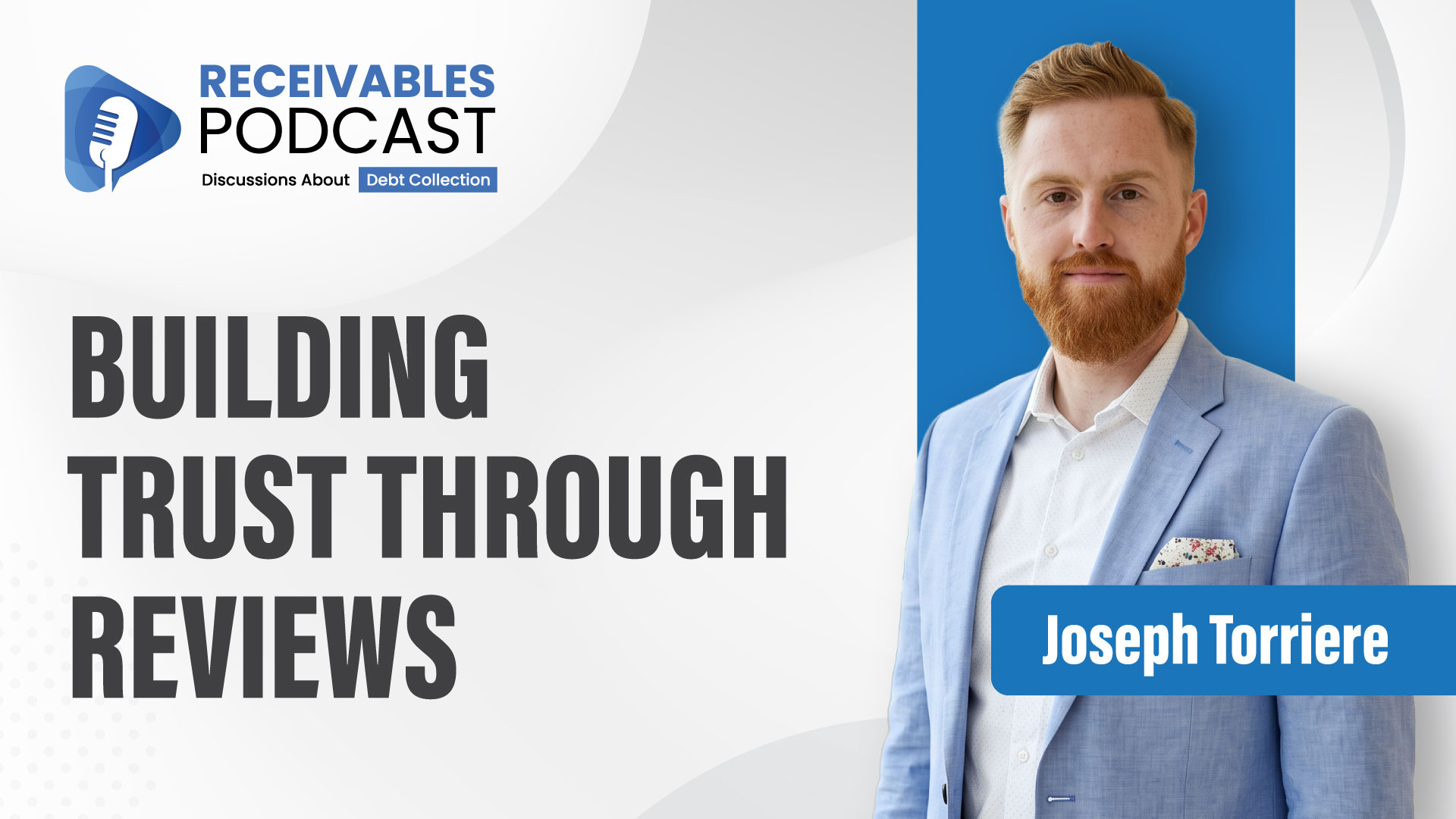
Joseph Torriere, President of Spire Recovery Solutions, explains how authentic consumer feedback strengthens digital trust in debt collection. He discusses incorporating review requests into daily workflows, building staff participation, and establishing the online credibility consumers look for before engaging.
Listen to Your Favorite Podcasts





Digital Trust in Debt Collection Through Authentic Consumer Reviews
Consumers do not always respond immediately when contacted by an unfamiliar collection agency. Before returning a call, opening a payment link, or discussing an account, many will search the company’s name online.
A professional website may confirm that the company exists. Accurate business listings can verify its phone number and address. Online reviews offer something different: accounts from people who have already interacted with the organization.
Together, these signals help consumers decide whether the communication appears credible enough to warrant a response.
In this Receivables Podcast episode, Adam Parks speaks with Joseph Torriere, President and Chief Operating Officer of Spire Recovery Solutions, about building online credibility through authentic consumer feedback. Spire’s experience provides a useful example, but the larger lesson applies across the receivables industry. A review strategy must connect consumer experience, employee participation, digital visibility, and daily operations.
What Consumers Look for When Verifying a Collection Agency
A consumer searching for a collection agency is often trying to answer a few basic questions. Is this a legitimate organization? Does the phone number match the company website? Have other consumers interacted with it? Is there enough reliable information to continue the conversation?
The answer rarely comes from one source. Consumers may look for:
- The company website and contact information
- Google reviews and business listings
- Better Business Bureau information
- Social media profiles
- Consumer resources and frequently asked questions
- Community involvement and company news
- Results generated by traditional or AI-powered search tools
These sources should present a consistent picture. If a business listing shows an outdated address, the website provides a different number, and reviews mention another company name, uncertainty increases. Agencies should therefore approach digital trust as an interconnected system.
Authentic Consumer Feedback Corrects an Incomplete Picture
Online review profiles can become unbalanced when companies leave feedback entirely to chance. Consumers who are frustrated may be more motivated to post publicly. Those who received help, reached an arrangement, or had a professional interaction may simply continue with their day.
This does not mean agencies should attempt to suppress critical feedback or manufacture positive reviews. It means they need an accessible process through which consumers who voluntarily want to share their experiences can do so.
Authentic consumer feedback in receivables provides context that a company cannot create through its own marketing. A website can explain how an agency intends to communicate, but reviews show how individual consumers describe those interactions.
A credible profile is not necessarily one containing only praise. A natural range of feedback, supported by professional responses and a sufficient number of reviews, may be more informative than a small collection of perfect ratings.
A Review Program Needs More Than a Request
Asking employees to “get more reviews” is not an operational strategy. Agencies need to determine when a request is appropriate, who can make it, how the review link is delivered, and how the activity fits into existing consumer communications.
Joseph describes the importance of creating an internal structure around the objective:
“Like anything else, I think that you need to cultivate an environment that’s conducive to your objectives. So you can do that through incentives or procedures, but we did that through incentivization and creating a mechanism whereby the staff can capture the reviews from the consumer.”
The mechanism matters because additional friction reduces participation for both employees and consumers. If collectors need to open a separate system, copy a long URL, record the request manually, and complete several administrative steps, the process is unlikely to remain consistent.
A better workflow gives employees a simple, approved way to share the review opportunity when the interaction supports it. Depending on the agency’s communication channels, that could happen after a telephone conversation, text exchange, online chat, payment arrangement, or account update.
Choosing the Right Moment to Request a Review
Timing affects whether a review request feels natural or intrusive. A request made before the consumer’s question has been answered may appear premature. One introduced after a constructive interaction is more closely connected to an experience the consumer can evaluate.
The request should remain voluntary and should not interrupt the reason the consumer contacted the agency. Employees also need guidance for situations where a request would be inappropriate, including unresolved complaints, active disputes, or interactions in which the consumer remains confused about the account.
The wording matters as well. Employees do not need an elaborate pitch. A short explanation that the consumer may share feedback about the service experience is usually easier to understand than a request focused on helping the agency improve its rating.
Staff Incentives Cannot Replace a Simple Process
Some agencies may use internal incentives to encourage employees to identify appropriate review opportunities. Incentives can introduce the program and maintain awareness, but they need careful design.
Joseph explains:
“I don’t think it’s something that you need to budget a ton of capital for, but it should be very easy for the agent to deliver whatever mechanism for the consumer to get them to provide that review and just make it part of the workflow.”
The appropriate incentive will depend on the agency’s workforce, review goals, compensation structure, and internal policies. Regardless of its value, the incentive should reward the correct process rather than pressure employees to pursue only positive ratings.
Training should reinforce that employees are inviting honest feedback. They should not tell consumers what rating to leave, suggest language for the review, or create the impression that account treatment depends on participation.
Management should also watch for unintended behavior. If performance is measured only by the number of completed reviews, employees may focus too heavily on the request. A balanced program considers whether staff members follow the approved process and whether consumers receive a consistent experience.
How Reviews Can Support Collector Conversations
The value of reviews becomes clearest when consumers question whether the agency contacting them is legitimate.
A collector can direct a skeptical consumer to independently verifiable information, including the agency’s website, business profile, public reviews, and other established credentials. This does not replace account validation or required disclosures. It addresses a different concern: whether the organization itself appears credible.
Visible information can help employees move the conversation beyond the initial uncertainty surrounding an unfamiliar company. It may also reduce reliance on claims made by the collector alone because the consumer can conduct an independent search.
For that reason, review performance should not be evaluated only as a marketing metric. Agencies can also consider whether their digital presence helps employees answer legitimacy questions, whether consumers mention online research during calls, and whether staff members use public information appropriately.
A Practical Framework for Building Digital Trust
Collection agencies can begin with the following steps:
- Audit the current search results: Search the company name, common variations, phone numbers, and office locations.
- Correct inconsistent information: Confirm that the website and public listings show accurate names, addresses, hours, and contact details.
- Review the consumer journey: Identify where constructive interactions occur and where a voluntary feedback request would fit naturally.
- Create one simple request method: Give authorized employees an easy way to send consumers directly to the correct review page.
- Develop clear staff guidance: Explain when to ask, when not to ask, and how to introduce the request without influencing the feedback.
- Include relevant departments: Positive consumer interactions may occur through collections, customer service, chat, administrative support, or payment assistance.
- Monitor the feedback: Look for recurring themes that may reveal effective practices, confusing processes, or training needs.
- Measure consistency over time: Track whether the workflow remains active instead of judging the strategy solely by short-term review volume.
Make Reviews Part of a Larger Trust Strategy
A collection agency cannot build digital trust through reviews alone. Credibility develops when consumer experiences, employee behavior, public information, and communication practices support the same message.
Reviews make those experiences visible. A well-designed program gives consumers a straightforward opportunity to provide feedback while giving agencies information they can use to strengthen their operations.
When handled thoughtfully, authentic feedback can help consumers verify an agency, support collector conversations, and reveal where the organization is delivering on its promises.
Watch the full Receivables Podcast episode with Joseph Torriere to hear how Spire Recovery Solutions developed its approach over time.
Key Moments Based on this Episode
00:00 – Introduction to Joseph Torriere and Spire Recovery Solutions
02:18 – Why online reviews matter for collection agencies
03:00 – Achieving a strong Google rating in debt collection
03:33 – Building consumer reviews into company culture
09:49 – How consumers verify collection agencies
11:48 – Using digital trust to counter negative outside advice
14:36 – Why collection agency credibility takes time to build
16:00 – Closing thoughts and key takeaways
FAQs on Digital Trust in Debt Collection
Q1: What is digital trust in debt collection?
A: Digital trust is the credibility an agency establishes through accurate public information, consumer reviews, its website, business listings, social activity, and other sources consumers can verify online.
Q2: Why are online reviews important for collection agencies?
A: Reviews give consumers access to experiences shared by other people. They can help consumers evaluate an unfamiliar agency and give collectors a public credibility signal to reference when legitimacy questions arise.
Q3: When should an agency request a consumer review?
A: A request may be appropriate after a constructive service interaction, once the consumer’s immediate question or need has been addressed. The request should be voluntary and fit naturally into the communication.
Q4: Should agencies ask only satisfied consumers for reviews?
A: Agencies should establish a fair process for requesting honest feedback without telling consumers what to write or what rating to provide. Internal procedures should be reviewed against applicable platform requirements and company policies.
Q5: How quickly can an agency improve its online credibility?
A: There is no standard timeline. Building online credibility takes consistent effort over time, supported by clear internal goals, reliable processes, and a company culture focused on positive consumer experiences.
About Company

Spire Recovery Solutions
Spire Recovery Solutions is a nationally licensed collection agency founded by U.S. military veterans Joseph and Jacob Torriere. The company represents creditors in collecting outstanding account balances and works to connect creditors and consumers through transparent communication and accessible resolution options.
About The Guest

Joseph Torriere
Joseph Torriere is the President of Spire Recovery Solutions and a founding member of the company. He co-founded Spire with his twin brother, Jacob, in 2014. Joseph creates, communicates, and implements the organization’s vision, mission, and overall direction. He also oversees the company’s financials and contributes to both external and internal opportunities for expansion and growth.