Adam Parks (00:01)
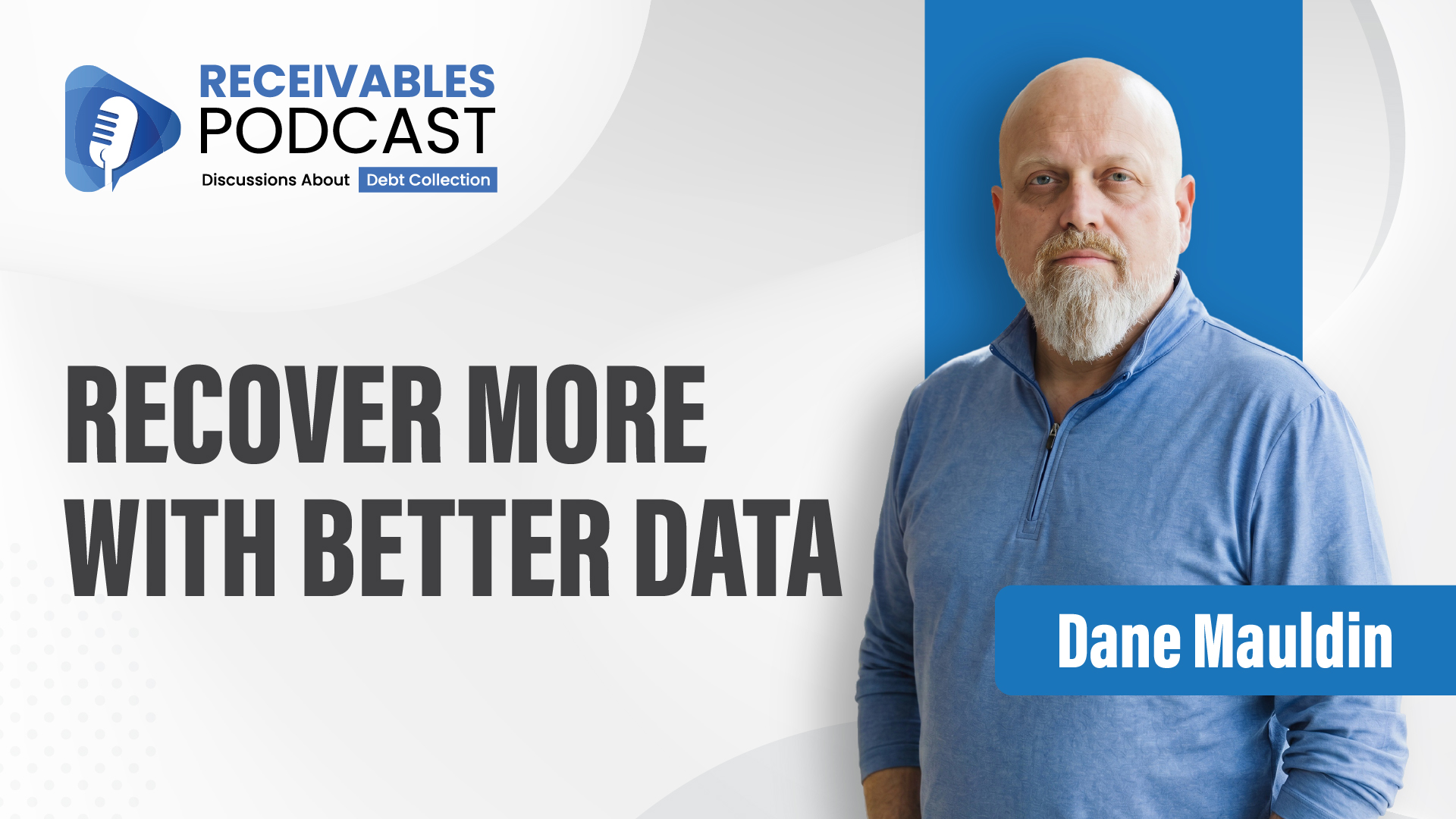
Hello, everybody. Adam Parks here with another episode of the Receivables Podcast. Today I’m here with my new friend Dane, who is now the president of RNN Group. Very excited to have a conversation about the data, its value, and how to activate more accounts in our portfolio. So, Dane, thank you so much for joining me today. I really appreciate you coming on and sharing your insights.
Dane Mauldin (00:25)
Hey, thanks for having me back. I appreciate it.
Adam Parks (00:28)
Absolutely. For anyone who hasn’t seen the other episode or been as lucky as me to get to do some work with you, can you tell everyone a little about yourself and how you got to the seat that you’re in today?
Dane Mauldin (00:37)
Yeah, sure. I have been in basically the information solution provider space for the last thirty years, centered around data and analytics with companies like LexisNexis and TransUnion and now at RNN Group. Generally, I kind of find myself at the intersection of data and strategy, and then how do you ultimately kind of apply that in an operational environment to achieve an objective or an initiative that exists? So been around that space, worn many hats, but it’s an excellent space, and really my focus has always been on how do we take that data, how do you take that information, and how do you actually make it meaningful.
Adam Parks (01:20)
Well, activating the data, I think, is the objective of every debt collection organization. And one of our larger challenges as an industry is that we send through the litigation the channel goes through litigation, comes out the other side as a judgment, and now I’ve got a big dormant population, which I know has been one of your passions as you’ve taken the helm at RNN Group. Talk to me a little about how you’re focusing on the ability to activate these dormant judgments.
Dane Mauldin (01:54)
Yeah, so RNN Group is a strong information provider, really focused deep in the recovery chain, and you know the organization was founded on kind of difficult-to-capture information, meaning verified employment, verified bank information, so post-judgment recovery to really kind of get to that information. It’s really kind of the hardest of the hard stuff, if you will. But in order to kind of get there, you’ve got to really kind of master everything that goes along with it, and RNN’s great reputation, good organization.
I think where we’ve continued to identify and really see that there’s an opportunity within the space is to my earlier point. How do you kind of take that information, and as we have this kind of evolving application at the customer level, really tie that directly and succinctly in terms of what their objectives are? And so by understanding that workflow and understanding those treatment strategies. Being an information solution provider is fine; it’s great. I’ve been in the space forever, right? But it’s well beyond just appending data, right? The question is: is it actionable? What do I do with it? How do I turn that into either something to ensure that I’m compliant, something that’s going to increase my recovery rate, something that’s going to save me money, or something that’s going to make me more efficient. So the overall health and vitality of that business is more effective. And so at RNN, it’s really been a focus of continuing to kind of expand our capabilities in a much more directed way that aligns us very tightly with our customers.
Adam Parks (03:31)
So you’re finding these new opportunities, but it sounds like you’re also putting together, let’s call it new data streams in order to be able to activate some of these pieces and then looking at the timing of how you’re engaging with those customers to be able to bring those right accounts to the forefront because it’s not that easy, right? Like, it’s after it’s been forgotten, it’s not, or after the judgment’s been filed, it’s not always at the top of the law firm’s agenda to be chasing it because they’re law firms, not, you know, data management organizations in a lot of cases. So what does that start to look like as you are able to inject that new or those new data streams into that business process?
Dane Mauldin (04:13)
Well, it’s interesting, and while obviously very applicable within that kind of legal collection, legal recovery space, it’s actually true throughout that life cycle. So you know, when you think about a traditional approach, I get a new placement, I buy a new portfolio, I’ve got a waterfall that’s established, I go capture data and then I work the data. You know, generally how that progresses and everyone in the industry and every one of those customers understands what that implication is to them. But it’s interesting if you start dissecting that process or that approach because even through a normal waterfall, there’s still an exorbitant population where I couldn’t find information. And then, as that information is worked, and most companies obviously have, you know, they have processes to reprocess or try to go find some more information. But a lot of times it’s static and it’s kind of point in time and so as you start dissecting that and understanding the treatment strategies, it’s interesting as the industry has matured and really gotten more sophisticated because it’s not a question of give me more data, I’m going to try it. I’m gonna throw bodies at it, I’m gonna run it through the dialer a lot more and so there’s this evolution to me, if you will. Listen, data presence is important. How many hits did I get? How many phone numbers did I get? How many new addresses did I get? Data quality is really important. Is it accurate? What’s my hit rate? What’s my return mail rate? Etc. But the reality is that it’s not always, oddly enough, about presence and accuracy. There’s another vector around what data is available and what action I can ultimately take as a result of that data? And so as that evolves, it’s as silly as it sounds, but it does kind of open one’s eyes a little bit. And where, it’s you know, sometimes a lower hit rate can actually be valuable if the data is very high quality.
Adam Parks (06:10)
If the penetration is higher, right? Like the accuracy versus penetration.
Dane Mauldin (06:33)
That’s exactly right. And if that information’s there means I, as an operator or I within that company, now can attempt either a different treatment strategy or move my legal recovery a step further. Now I’ve got something that’s actionable, that’s meaningful and so there’s always this balance in terms of, you know, what’s my expense or my outlay? What do I do in terms of personnel costs? What does this mean in terms of my letter production or whatever, whatever the component may be?
If the fundamental question is, is this information that is going to enable me to take action or to be able to operationally execute and the flip side works as well. Is this enough to for me to identify so I don’t work it or that I identify a potential compliance-related issue so that I’ve got a clean bill of health, if you will, in terms of the portfolio I’m working on? So there’s this vector, this variable of time applicability that is very material if you look over the lifetime or the life cycle of an account while it’s placed or while you own it or while it’s still you know in the compliance window, if you will, that I can take action. And I don’t know that there’s an immense amount of time spent with that lens. I think there could be more, and I think that the net result of that turns into efficiency, more profitability, more revenue, more efficient operational expense management.
Adam Parks (08:01)
When I start thinking about the dormant populations, my mind immediately goes to the judgment populations. But from what I’m hearing, that’s not the only place, time, and point at which the newly injected data can add value. Because if we look at portfolios that we’ve purchased where you know the phone number wasn’t good, being able to go back and get another phone number after a period of time, after the consumer has had enough time for some sort of life change, whether that means finding a job. Getting themselves back on track, and that’s when their phone gets turned back on. That’s when all of these other things start to happen. But that seems to be one of those opportunities that maybe we’re not giving the same level of focus to as we are the dormant judgments because those feel like the low-hanging fruit, considering now we, you know, it doesn’t require the consumers’ engagement or approval in order to move it forward. They’re not choosing to pay at that point. So that data adds a different angle of power to the negotiation.
Dane Mauldin (09:06)
A hundred percent. And you know, the reality is it’s all point in time, and it’s all dynamic. So you can have the highest quality piece of data today, and they are, you know, kind of the law of large numbers. The fact of the matter is that data may become less contactable or less verifiable the next day, the next week, the next month. So even within those active populations, there’s kind of a point in time. And generally speaking, it’s the same thing when you kind of think about the debt lifecycle. You think about the delinquency life cycle, right? Bad things happen to good people. It happens, and ultimately, there’s a recovery stage in terms of whether they’re resettled. Can they get a new job? And so, trying to define program systems network capability so that when those things start emerging, how can I identify that most efficiently and fast?
So I can actually get in contact with that individual consumer. So there is kind of this symbiotic nature relative to the circumstance of the consumer relative to why they’re there, the frequency of information and when it’s updated, how nomadic is that population, and can you somehow identify that? Can you use that as a leading indicator? And then, as a result, the efforts that we would apply would be slightly different.
Right. So even when you think about the exercise of where, how, and when I apply data to help a customer execute, there’s a lot of really interesting nuance and meaty bits, right, within that where you can really start refining that approach. And what’s beautiful about it from my perspective, and why I love what I’m doing, is that We’re deeply engaged with customers talking about it. And we’re able to kind of demonstrate what that treatment was able to accomplish. And we get a lot of things right, and we get things wrong. And it’s like, great, we got that one wrong. What do you think we should do? So it becomes an A/B testing experiment. You’re saying, you know what, let’s try these two things with this population.
Let’s see what those result sets look like in terms of whether you were able to make contact? Were you able to get an agreement? Were you able to get a settlement? Were you able to find an employment? Were you, you know, so you can play each of these in these little swim lanes, if you will, and really start making a material difference because of our ability to do that and do it simply for our customers.
Is a huge value add from my perspective because they don’t have to okay, so I don’t need to go spend $250,000 to buy a tech guy and an analytics guy, and a data scientist, right? And we try to marry those things together in a very digestible, easy-to-understand way, and be able to kind of demonstrate how action A resulted in result B.
Adam Parks (12:04)
But where does that process start for an organization that has not been activating its data? So they’re, you know, they’re a portfolio owner. The time has come. They know that they have to make a move. Account volumes are rising, liquidity is decreasing. I gotta do more with less. I feel like that’s the story of the industry for the last couple of years. How do you go from not having those data tools? And what is that journey? What’s that first step in the journey of a thousand miles?
Dane Mauldin (12:23)
Well, I can tell you what our approach is, and I think it’s a valid and valuable one, and it’s not as complex as one would think, right? So our approach, particularly in your example, if we’re talking to a customer, I know I need to do something here, but you know, I’ve got my whatever it may be, I’ve got my employment and kind of garnishment program in place, I’ve got my bank levy program in place.
I think I should be doing something with this other stuff. What does that look like? And frankly, we have a, you know, kind of an introductory call, if you will, a discovery call. It’s like, help me understand what happens, what works well, what doesn’t. And as we understand that and understand their process, it enables us to start exploring and kind of peeling the layers of the onion back.
You know, what are you doing from a compliance perspective? What are you doing from a monitoring perspective? What are the implications here? What is that? What does that paper flow look like? If they’re doing it on a contract basis, what is your customer expecting? And it enables us to understand the workflow, and as I tell many of my customers, I’m a one-page guy. So, as we had that kind of conversation, if we can’t simply articulate what we heard for them to validate on one page, then we probably miss something because I think that it’s digestible. I think it’s easy. Now, there might be depth certainly within that one page, but that kind of opens the door. So we start structuring our customers’ business honestly in a way that’s probably more data-centric, but it’s very bespoke to that customer. And then the next call is an exploration of that. And we say, okay, well, I’ll tell you what, let’s test this population, then let’s test this population, and then let’s test that population, and then we formulate how that could work, what a data exchange looks like. And if they need us to handle everything from tip to tail, we’re more than happy to do that. If they’ve already got an established process, we do that. But it really helps us pinpoint it and ensure alignment.
Between one another about what we are doing, what’s the expected outcome, and how we’re performing. And for those co customers that are open to doing it, we love performance data back because then we can refine and we keep everything really isolated at the customer level. So whatever’s working for you, Adam, might not work for Jim or Frank or whoever it may be. And so we try to isolate it, make it very specific. And then our infrastructure at RNN enables us in a very flexible way to maintain that customer rule set, the distinct applicability and then to leverage our deep kind of data network to be able to deliver effectively.
Adam Parks (15:16)
Well, being able to see those results when you can, I would think would be that refining tool set that allows you to continue to bring the products to a more finite conclusion, right? You’re able to get more laser-specific in your answers when you have an understanding of what the feedback is and when you can do that at a rapid pace. I think that’s where these learning models are gonna really start developing around the data sets that we’re using because one of the big six use cases for artificial intelligence in our space are specifically related to data sourcing and appending. And what does that start to look like? And when we say that, I don’t just mean like appending the data, like let me merge these two spreadsheets, right? There’s a lot more that goes into building those people profiles, right? Being able to understand who this underlying consumer is. And I would think, from your perspective, you probably see the same consumers fairly often, because if a consumer owes one agency or one law firm, they very rarely owe only one. There are multiple layers there, as you talk about. And being able to bring that data together and shortcut some of the challenges in finding gold every time, I would think, would be a differentiator in being able to help clients achieve the end objective quickly and effectively.
Dane Mauldin (16:23)
A hundred percent. And you know, my belief is that the closer we can get to and help our customers with how it impacts their PNO, the better off we are. So, in doing that and trying to do that as efficiently as possible, the outcomes become very measurable and very clear. And as long as the organizations that you work with are committed to that effort, then everything is an incremental gain. I mean, you know, people on our team always laugh at me. It’s like, guys, we need to do 10% more with 10% less. So how do we kind of strive and consistently push for it, and it’s around kind of efficiency, and how do you apply analytics and how do you apply data science to really pinpoint what’s important for this customer?
So it’s this translation of raw data or raw data elements. And I just think of it as raw material. And so, the question is: how do we take this raw material? And then, how do you take that information and truly apply it to the challenge at hand? And if you can tie that directly to revenue, expense reduction, efficiency, then all the better? And everybody wins.
Adam Parks (17:48)
Well, we definitely want to tie it back to the impact that these decisions are having on the business itself. And I think a lot of that’s going to be driven by that data quality. What kind of measurements can you look at from a data quality perspective? Because if it feels like in order to go further, you gotta think further. You can’t just execute using the rule of thumb, you know, which way is the wind blowing things that we’ve been using for such a long time. What does that look like as you start taking all of these different data sources, trying to organize them strategically to be able to get the most from them? Because, in order of operations, I mean, there are just so many different pieces and variables to what you’re trying to accomplish. Where do you even begin to start with that? How do you begin to measure the quality of this data in ways that are not being done by everybody?
Dane Mauldin (18:45)
Nice, easy Adam Park’s question. It’s right. Well, it’s like, and I’ll attempt to make this as short as possible. There are multiple vectors that exist, right? And so on one plane, you can think about identity resolution.
What is the intelligence around the specific identity, the specific consumer, everything that you can identify about that consumer that exists. So there’s this foundational element of, okay, have I resolved the appropriate entity, identity? And can I then appropriately ensure that the information that I find is appropriately linked to that individual? Right? That’s a vector that’s critically important.
From our perspective there’s a number of other considerations. Right? What’s the nuance relative to that address? Sometimes it can be geographic. Sometimes it can be What’s the implication of that phone number? What type of phone number is it? How long has it been in service? Is it active? Is it disconnected? Has it been disconnected, then reactivated, then disconnected, then reactivated? So it’s like even within any of the data elements tied to that consumer, there can be significant variance that exists over time.
And then furthermore, and what’s really interesting are the connection, the conclusions that you can base the connection and how those connections of different pieces of data content resolved to that individual, which can be indicative of probability, a greater probability to contact them, a greater probability of response, and a greater probability of liquidation.
What is the appropriate treatment strategy here, right? You can start tying together these various data elements. So when you talk about data quality, it starts with kind of the core data identification information and ensuring that passes what we believe to be the right benchmark in terms of linking it to the correct individual, but then also the currency of the data itself, the frequency of update, and how much granular can we get to ensure that what we believe to be the best answer.
But then the real beauty is in the connective tissue that exists. And not to be silly, but it’s the connective tissue that exists based on that customer’s treatment approach. Do you use email or a digital approach? Well, that’s a little bit different than what would happen if you use a traditional telephone or a dialer-related approach versus a mail series or a mail letter, or if you know what I mean? So, depending on the treatment. Some of those variables look a little bit different, and they have different weights associated with them. So it’s a very intriguing approach. And again, I get back to what’s the net operational outcome? What’s the net treatment decision you’re going to make? And does this information provide me with intelligence so that I can make a different or a better decision to optimize either contact, recovery, exclusion for compliance reasons, or what have you?
Adam Parks (21:41)
A lot of the systems of record in our space are not capable of capturing, communicating, storing, and calculating these types of behavioral metrics. Their systems are just not built for it. And I think a lot of the individuals and organizations at some of the law firms, step buyers, etcetera, also would struggle to ingest this information in any way into their organization to not only make it actionable, but even just to get it in.
Then they’re gonna have to actively activate it. But there are all kinds of new fields that we’re talking about. There are all kinds of new variables in the calculation. What does that partnership start to look like? Are you providing them with those next actions and feeding it to them based on how their system flows? Because you’ve got a much more granular visibility into the entire data ecosystem. But like, what does that start to look like from a partnership perspective for the non-technical law firm that wants to be able to activate this type of data.
Dane Mauldin (23:08)
So I’m glad you called out that segment because it is very dynamic and it’s very dependent on the customer. We have some extremely sophisticated customers. We’ve got other customers who are like What next? And so you know, with that understanding of where they are and frankly what they aspire to be, but because some customers really want to understand the depth and want to understand, well, how does that variable tie to this variable and what’s the coefficient of those related? What’s the KS on? You know, you can get into some pretty deep conversations, but most, not to be silly, are like, I want a file that says do treatment strategy A, and I know when I get that file, I’m gonna do X, Y, and Z. It’s probably the simplest explanation.
Even within those, we start trying to pick off things that make their lives easier. So as long as we understand where the customer is and what their ideal state is, I think all of us would say, I want to send you the file and you send me back the stuff that kind of distinctly tells me what it’s gonna do. And you tell me I’m gonna send you your performance, and then you tell me how I’m performing. And I want you to continuously update and tell me where that can get better or where there might be opportunities, right?
That’s an ideal state. Much easier said than done. You got data control, you know, and what goes where and when is it, and what’s the currency? And it can be a little bit overwhelming. So we very seldom go down that path because it can be a little bit overwhelming and challenging. We really try to bring it up a level.
Happy to talk as deeply as any customer would want, but really, what’s the net result? I’m getting stuff; I need to enhance it with whether it’s contact information or asset-based information, whatever it may be. And then with that result, what’s my appropriate treatment strategy? And as long as we’re kind of clear on those things, we feel very strongly about the solutions that we provide and the accuracy of what we provide. As you know, when we provide verified employment and verified bank, we mean it. And if it ends up being inaccurate, we refund the money. And so our accuracy rate right now runs at about ninety-eight point six percent. And so when it comes to those high-dollar kind of assets that are required, we stand behind what we sell.
It’s not as easy when you get to a lot of the contact-related information, but we take the same level of diligence to ensure that we’re putting out a good product, a high-quality product. And I tell customers all the time, while I can provide it, I’m like, I’m not your five-cent phone guy. You know what I mean? It’s like not, you know, I’m happy to provide that to you if you want, but the reality is do that. Give me all the stuff that they couldn’t do anything with, and let me help you there.
We’ve got customers that we do everything tip to tell. We’ve got others that kind of plug us in at the appropriate way, but there does become something within that life cycle where they’ve run through their waterfall, they’ve kind of processed it. I typically call it a dormant population. We really play very well there because we have the capability. We take in that file, we can monitor it, and we can put any kind of rule sets associated with it. And so then it’s not, you know, just dormant dead money that’s sitting on the sidelines. And you know something’s happening, and when it’s actionable, we notify you, and now I’ve got treatment, I can go take action on that.
Adam Parks (26:32)
That’s where there’s opportunity to go after accounts that aren’t being activated today, leveraging the data sets to create new cash flows. The cash flow you can generate by identifying those opportunities in the right account should more than exceed the cost of the data. But I think a lot of organizations struggle with well, I’m just gonna test it. And then they don’t test a large enough sample, and then they don’t get an accurate readout.
And they’re making a decision saying this either worked or didn’t work based on a flawed premise test. And I will constantly stand on my soapbox and suggest that you write an eighth-grade science experiment document. Tell me your hypothesis, right? What experiment are you performing, and define success before you even start? Because I feel like that’s one of the biggest points of failure for an organization that wants to start activating their data is that they miss the entire opportunity.
Dane Mauldin (27:31)
Yeah, but the reality is, and you know this, Adam, you’re a bit of a science nerd when it comes to this stuff, right? But the reality is we do that, and we don’t even maybe formally call it this. I always think of it as a test design call. You know, it’s like we’re identifying where these areas may exist, we supply, and we say, we think this is the population, we think this is the appropriate amount, and we think these are the things that you should measure us against.
In terms of hit rate and quality, etcetera. So you know, we provide probably I’ve seen some of your science experiments- so probably not as extensively as you would like, but we always provide back kind of the approach, the measure, how they should contemplate or think about that.
And we’re fluid. You know what I mean? So even when those results get back, sometimes maybe we got it a little bit wrong. But I can tell you, we’re the first ones to raise our hands and say, Great, no problem. Help us understand how that can be better for you or more effective for you. And frankly, I think that’s where the biggest gap exists within the industry. Is that it’s here’s my stuff, here it is, here’s my score, here’s my data, here’s my information. You know, buy it. And so we really try to take a very kind of bespoke approach because we think customers appreciate it, and we think it’s a big gap within the space.
Adam Parks (28:46)
Well, Dane, it sounds like you’re solving a lot of problems for organisations and giving them some of the tools that they’re gonna need to survive in the environment in 2026 and going into 2027 as we continue to see this increase in the volume of accounts and the decrease in the liquidity of those accounts, finding our ways to do more with less is exactly what I think what every organization is out there trying to solve right now. So I appreciate you coming on. And sharing your insights today on how organizations can start to activate more of that data.
Dane Mauldin (29:27)
Well, as always, I appreciate you having me. And again, thanks for all that you’re doing for the industry, Adam. Appreciate it. And flattered to be invited. So thank you very much.
Adam Parks (29:36)
Well, I look forward to continuing to create more content with you. For those of you who are watching, if you have additional questions you’d like to ask Dane or myself, you can leave those in the comments on LinkedIn and YouTube. We’ll be responding to those. Or if you have additional topics you’d like to see us discuss, you can leave those in the comments below as well. And I’m willing to bet that I can get Dane back at least one more time to help me continue to create great content for a great industry. But until next time, Dane, I really appreciate all your insights. Looking forward to spending some time together in the near future.
Dane Mauldin (30:02)
Great. Thanks, Adam. Take care.
Adam Parks (30:04)
And thank you, everybody, for watching. We appreciate your time and attention. We’ll see you all again soon. Bye everyone.