Adam Parks (00:01)
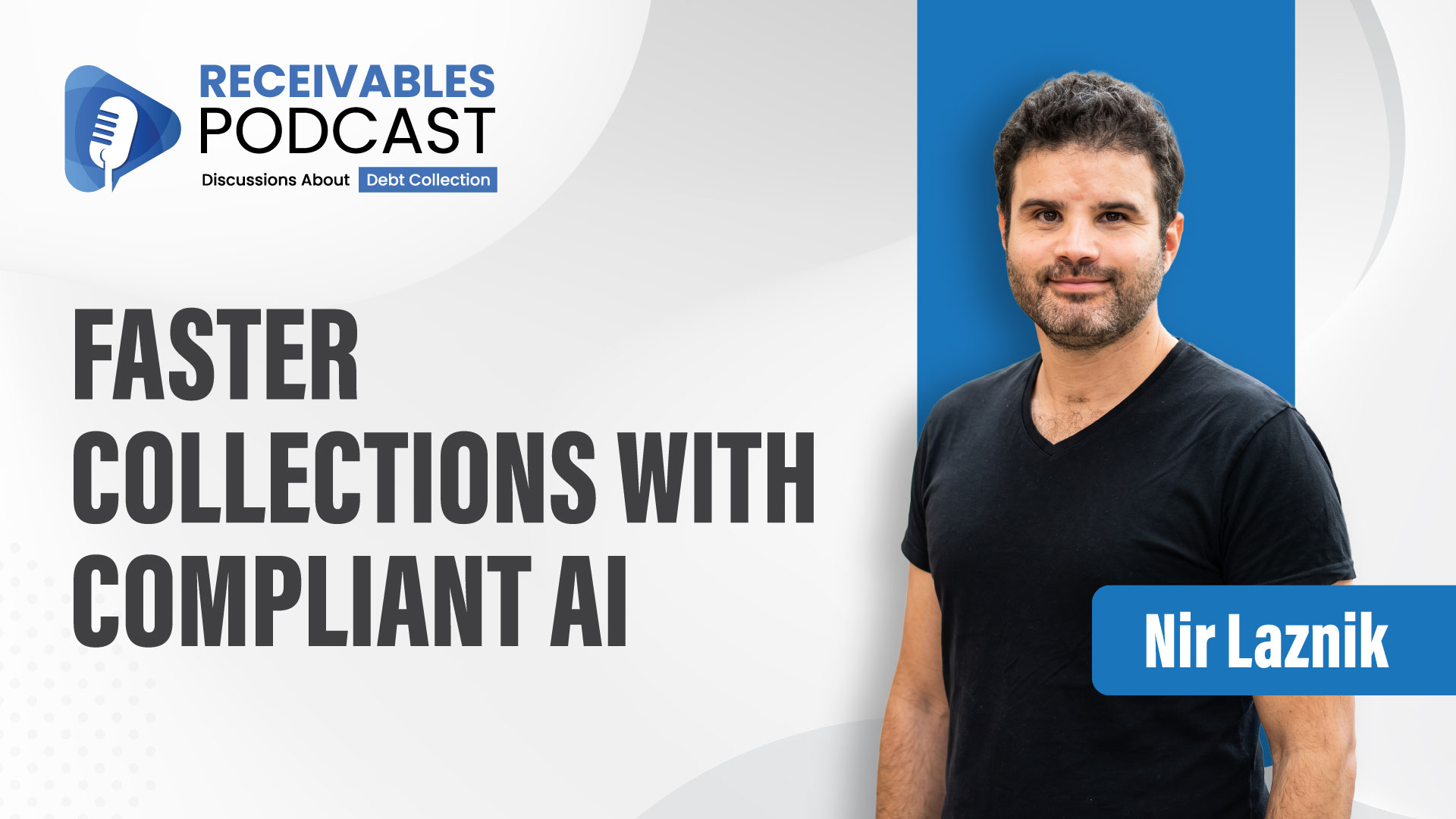
Hello, everybody, Adam Parks here with another episode of Receivables Podcast. Today I’m here with a great guest and a great topic, here with Nir Laznik from Sedric here to talk to me about well, keeping an eye on the bots, keeping the guardrails around those let’s call it shiny new voice AI bots that everybody’s talking about and how to build that governance guardrail framework around those tools because I still struggle with understanding why we would ever watch our phone calls differently whether they were generated by a human or they were being generated through an AI technology.
So Nir, thank you so much for coming on, sharing your insights with me today. I look forward to learning.
Nir Laznik (00:50)
Thank you for hosting me, Adam. It’s been a while, and we’ve been trying to plan it, so I’m excited to already have it.
Adam Parks (00:57)
Well, I appreciate you joining me today. Nir, for anyone who hasn’t been as lucky as me to get to know you through the years, can you tell everyone a little about yourself and how you got to the seat you’re in today?
Nir Laznik (01:07)
Yes, I always like to start with a personal introduction. So Nir, I’m a father; that always comes first. After that, after my daddy’s duties, I’m an information system engineer. And a few years ago, my talented co-founder, who is one of the leading data scientists back in Tel Aviv, identified a few macro trends that are now playing a big part in the story of what we do.
And the first one was the fragmentation of the financial services sector, which basically got us to the conclusion that financial services, in specific consumer finance, are coming in different shapes and forms. Alongside traditional banking, we now have fintechs; we have embedded finance that creates different shapes and forms of those consumer products.
Another one was the increasing complexity around compliance. And together we realized that there is disproportionate pressure being made on compliance. It was already slowing down business, and we wanted to unlock compliance and turn it into a business enabler. So, with that conclusion in mind, we incepted the first AI compliance officer we called our Sedric, and we are here really to enable financial institutions to grow faster without breaking things.
And on the collection side, it’s really to unlock productivity without the burden and the risk that compliance involves.
Adam Parks (02:37)
Well, prior to these kinds of tools, we maybe listened to two percent of the calls. And, you know, that was the sample size that we were able to get to using live folks to listen to those calls. And through the deployment of artificial intelligence, we’ve seen that increase to a hundred percent. And now the two percent that’s being reviewed is the two percent of exceptions that were found systematically, which has changed the face of compliance for debt collection and for what’s called call center customer service environments as well.
And you’ve been on the leading edge of creating that technology through the years. It’s been interesting to see how this has, you know, started to play out. Now, where you guys are even beyond the debt collection space and looking at the creditor space as well, where the debt is actually originated.
What are some of the biggest concerns that these organizations have related to the deployment of artificial intelligence in general?
Nir Laznik (03:38)
It’s a great question, and I think that if we really observe what’s happening right now in the market, we are currently in the middle of the second phase of AI adoption. The first one included a lot of pressure from board members to introduce AI solutions to increase productivity and leverage those capabilities.
The problem with that first adoption cycle is that the technology was not mature enough. We saw a very large number of POCs with a very high failure rate, above 90%. Now, what we’re seeing in the second phase of adoption, which we’re in the middle of right now, is that the technology has matured into a posture where it can deliver production at large scale in different areas of the business.
But the problem that we sometimes see, especially in more conservative institutions, is that it’s still being blocked. And in many cases, that’s by compliance. One reason is that compliance needs to make sure they have the right controls on those solutions. They do want to support the business, but if they don’t know enough and if they have blind spots, they’d rather just stop rather than take the risk if they cannot quantify it.
One of the things that we are trying to do is to really rethink compliance as the enabler of the business by enabling all of that supervision and oversight across all of the different channels, including some of those innovative ones like the AI solutions, that really matured into a stage where they can serve the different operations, even the conservative ones.
Adam Parks (05:34)
So as you think about the type of technology that you’re deploying for those organizations and the things that they’re trying to accomplish now. So you’ve mastered your craft on those live human calls. And now these financial institutions are pushing and saying, We want to start using bots because we think it’s going to service consumers in this way or that way.
Have you had some of those conversations with them around how your tool set creates guardrails not just for those live callers, but also for let’s call it the new shiny object in the room, the voice AI outbound call?
Nir Laznik (06:15)
Of course. And then maybe we can travel back in time, probably two, three years together. And Sedric was at a crossroads when we realized that from a technology perspective, the gap between what we do right now and actually enabling those as a first line is actually not that big. But the reason why we’ve decided to stay on the compliance side is that when you think about risk and compliance, it has to be a separate line of defense.
Just like a very experienced collector cannot claim that they know everything and they don’t need to be monitored because they’ve been doing it for a while. Similarly, even the most compliance-oriented AI solution cannot just evaluate itself.
You need to have a separate line of defense that can orchestrate the different channels, including those Gen AI-related ones. So, what Sedric provides is an orchestration layer. Where you can basically take all of your policies that include all the different complexities, jurisdiction considerations, different product nuances, and so forth, and codify them into the control system that is serving as the infrastructure for any future agentic workflow that you want to run on top of it.
So that can be listening to voice calls, listening to chat threads or email threads, and so forth. And in other verticals, we actually support different mediums as well, which are less relevant to the account recovery space. But this is part of the stack that enables financial institutions, or regulated ones, to basically follow detailed, complex policies in different mediums where they interact with their consumers.
Adam Parks (08:03)
So you’ve actually pivoted slightly from being a call monitoring or call compliance quality type operation to looking at all channels, both written and spoken.
Nir Laznik (08:16)
Yes, we expanded the offering, and we always like to take a very broad approach about what we do, like thinking about the entire workflow in specific verticals so we can really represent all the nuances and the complexities of this vertical and really deeply understand the persona that we’re serving.
In that case, that’s compliance and risk, and to really help them to take over the entire workflow. And while phone calls used to be the channel that took over most of the volume, we now see omnichannel, and the number of channels is only increasing. So that was a natural expansion for the product offering, basically.
Adam Parks (09:02)
Well, it makes me think about how people are stacking bots into workflows now. And rather than trying to be everything to everybody, you said, let me just be the master of this piece. But that piece carries across all touch points with the consumer in all channels. Because if you’re doing the written, the email, the text messages, right? God knows what kind of communication we’re going to come up with in the future.
But you know, looking at how we’ve focused over the last couple of years. It seems like you guys have kind of well-positioned yourselves to be that check-and-balance system against those communications.
Have you started looking, and I’m sure you’re doing it with, let’s call it the prefixed consumer journeys, but how does that technology play into, let’s say, on-the-fly generated content to consumers? Is it watching it the same way that it was watching the live human, or how does that change over time?
Nir Laznik (09:58)
It’s a great question. You did mention a comment that was spot on at the beginning, basically: this is my philosophy about venture building, right? Especially in an era where the tech mode cannot be the only mode you have for your business.
And you know, in the past you had like many horizontal solutions that served many organizations well, where today it’s actually getting a lot of challenge in the build versus buy discussion that you have.
But when you go deep in a specific vertical, in a complex problem, that requires you to have domain expertise alongside your tech acumen as a firm. This is where you create a lot of value that’s hard to replicate. And when we get partners on board, they’re not only subscribing to the solution; they are subscribing to the roadmap, they are subscribing to the talent, they are subscribing to their potential to stay at the edge of technology every time.
Adam Parks (11:05)
No, it’s interesting. I like the approach to it. Do you think the primary fear of these financial institutions is the regulatory risk, the brand risk? Is it operational, or is everything just blended together into one layer of anxiety for these compliance projects?
Nir Laznik (11:27)
It’s a great question, and it’s actually an interesting point in time to ask it because, as we all understand, the climate around what risk is, how regulation is being enforced these days with the attempted dismantling of the CFPB, and maybe the only constant is the change right now in that landscape. But yeah, I think that, look, we need to remember that risk and being conservative is rooted in the DNA of some of those firms.
And even if the macro changes right now, everyone understands that this is a string, right?
It can be flexed, but it can be loosened. Nobody thinks that regulation is gone forever. We understand that it’s changing. We also understand that it’s not the same. We have different Attorneys general that are behaving slightly differently, which actually adds another layer of complexity for some jurisdictions, for some states.
So one thing is clear: you do need to have a more flexible system that you can orchestrate either to loosen or to stress your controls. So this is something that Sedric provides and not just Sedric but other platforms as well. And I think that it’s a hard question because it is rooted in the DNA of those organizations.
Some would take those opportunities to maybe loosen some of the controls. Some would understand that the change management has so much friction and potential risk that you don’t know what the regulator’s perspective would be on whatever control change management you went through throughout that.
Adam Parks (13:13)
I think each one of those comes in ebbs and flows. So when we think about regulatory risk, you know, I think who’s in power in the US government and how powerful is the CFPB at that moment in time, who’s the director, all play into, or all signal that we look at to measure the level of regulatory risk. At the same time, I think we’ve got privacy concerns and a patchwork of information, a patchwork of requirements that are starting to bloom around the country that are requiring us to take new steps that haven’t been taken before, right?
To organize ourselves in different ways. And being on the forefront of a lot of that requirement and staying at, let’s say, staying on that wave is a full-time job in and of itself. As a reformed compliance professional myself, you know, I know how much time, effort, and energy went into maintaining that level of sophistication flexibility to be able to deploy the different solutions as these requirements changed and the and really the the reactionary time periods to be able to respond to these changes in a reasonable time period because you’re not always given a reasonable time period when something new is being deployed.
But you know, so we start thinking about how the technology has changed over time. And now we’re starting to talk about not just getting a human on the phone, but getting this bot on the phone. And it reminds me of the movie Casino where, you know, the pit boss is watching the dealer and the, the floor manager is watching the pit boss and the eye in the sky is watching us all. And I think it’s a great analogy for what you guys have been able to do, kind of circling up all of these solutions together.
And what has been your experience as you’ve been able to put some guardrails in place? Is that helping to enable those financial institutions to take that calculated risk and try something new? Or are they still maintaining kind of those tight reins and not venturing into the new technology that’s available?
Nir Laznik (15:30)
What I can only testify from our portfolio, I believe it does represent a trend. And for us it’s a tailwind, right? Because, as I mentioned before, we are in the middle of the second adoption cycle where the technology has matured into a state where it can actually deliver, not only promise. And one of the things that we’re seeing again is that there is friction coming from compliance that doesn’t feel comfortable introducing and rolling out some of those programs to larger scales because of the blind spots.
So we did see how Sedric basically plays a role in enabling those programs moving from a pilot stage into production, large-scale programs. So to your question, the answer is definitely yes.
Adam Parks (16:26)
So from your perspective, when organizations are rolling out a new piece of AI technology, are they generally talking to the financial institution and saying, well, look, our bot is watching our other bot, or how comfortable do they become as a service provider knowing that there’s an overwatch of their technology from another compliance tool set? What do those relationships start to look like? And does it enable them to actively move forward?
Nir Laznik (16:59)
Are you asking about the relationship between the creditor and the collector?
Adam Parks (17:05)
So from your perspective, when you roll out, a financial institution is going to roll out this new tool set. It’s been my experience that a lot of organizations are saying,
Hey, I have this AI bot, and I’ve got this judge LLM that’s gonna watch the bot, right? But as you said at the beginning, that generally falls within the same environment and isn’t necessarily a third-party check-and-balance system. What has that relationship been like for you guys coming in as kind of a compliance umbrella that’s sitting over not only their voice bot but their judge LLM, and how has that worked in reality?
Like I could see it conceptually, but like what’s the reality of that situation?
Nir Laznik (17:47)
Yeah, so let’s map out the different players in that ecosystem that you just outlined. So we would have the AICX solution. Sedric would be an enabler for a production rollout for them. We have the agency that would potentially like to get better allocation, and by demonstrating better compliance posture with high confidence, that would help them to do so.
For the creditor, it would give them the comfort that a solution is trained to do that specific job, not a generic AI solution that is also doing compliance. This is not something that you would just trust a generic solution, just like you probably won’t trust a generic LLM to review the contract before you buy a house, right? You want to make sure that it’s nailed and that you’re not missing a bit because you are basically jeopardizing your firm.
By going after a generic solution. So you want to feel confident. So yeah, if we think about the voice AI solution, this is an enabler for them, for the agency, that would give them more confidence and hopefully get them better business with the creditor. And for the creditor, that reduces their exposure from both regulatory and brand. As you climb up the ladder, the larger creditors sometimes care way more about brand and compliance rather than the collection rate. And they want to make sure that they are protected.
Adam Parks (19:21)
Sure, right. Debt collection is an afterthought for an originating creditor or major financial institution. They’re making their money on lending money, and this is a byproduct of it. But you do get me thinking here as I start working my way through, you know, is there a fundamental difference between watching an AI bot and monitoring its activity versus monitoring a live collector? Is there anything fundamentally different between those two scenarios? Or are we basically treating everything as equal?
Nir Laznik (19:55)
Yeah, it’s not the same for sure. First off, if done right, and it’s not always the case, you do have a good sense of control on the Gen AI side, right? There are really good firms that are doing the right thing; they are educated about compliance, and the initial output would generally be good, right? other side, which is the consumer, you don’t get to control.
Sometimes it can drag the conversation into edge cases that were not trained, or are just impossible to train at the technology stage right now. And this is where the risk would potentially surface. So basically, those nuances, those edge cases, and this is where it’s going to be treated differently. amount of control that you’re gonna have on one side versus the other would also be a difference between a human-to-human versus an AI agent to a human. And there are other considerations that are more technical, but high-level speaking, there is a difference.
Adam Parks (21:05)
So as we think about the differences there, it’s, you know, from the conversations that I’ve been having, for those of us that use ChatGPT, Claude, right, like the general kind of use case, LLMs across the space, we’ve all been subject to and seen hallucinations, degradation of a session, right? Canary in the coal mine, there are all different kinds of ways that those of us that engineer on a regular basis are kind of building those things out and trying to understand that degradation.
From your perspective, as someone having oversight for all of these different types of technologies, is that a real risk in the AI voice space? Or have we come far enough over the last, let’s say, two years or so to where the hallucinations are really minimal to almost non-existent in that voice space? Or are we still seeing slips of the models versus ironing out of the campaigns and programs?
Nir Laznik (22:07)
There is no straight answer to that, but there is a trade-off, right? If you would narrow the degrees of freedom of your solution, you would potentially have fewer hallucinations. But the trade-off would be that they won’t be able to cover some of the edge cases, and then you’re gonna have to escalate maybe a higher percentage to a human.
On the other side, you can increase the degrees of freedom, and you cannot completely avoid having hallucinations. There are a lot of best practices, and I would leave those best practices to the ones implementing them for Gen AI solutions that can really improve and get this technology to a very high maturity. And this is why we do see large-scale adoptions taking place right now for AICX solutions. Like the tech is there. They were able to reduce the amount of hallucinations to a minimal amount.
Adam Parks (23:09)
So as we think about Monitoring calls and solutions for the financial institutions, how much are they monitoring their downstream placement? So the financial institution either sells the accounts, they place the accounts with a collection agency, a law firm, whatever the case or strategy may be, how much of that oversight is being carried down that stream over time?
And it was an individual from a major bank who recently mentioned to me at one of the conferences that the better they got with AI, the more difficult the debt collector’s life was going to become because the low-hanging fruit wasn’t going to be there. They were going to work out those solutions. They were going to be able to kind of resolve that. But as you’re looking at it from a monitoring perspective, and you’re thinking about as these accounts start to flow into the collections lifecycle.
How much of that monitoring continues to flow downstream, and what are the expectations being set by those financial institutions today?
Nir Laznik (24:19)
I think that the bar is just higher. I mean, if you could avoid patterns and the cycle from event to remediation used to take months, sometimes quarters. Now the expectation is to adopt and to close the feedback loop much faster. I can tell you that the similar trend of the sample-based to 100% exception-based, based on risk trend, that you had mentioned before.
This is the exact same trend that we see. Like, I can refer to one of the maybe larger banks that we’re serving. We basically helped them oversee 100% of the communication with all of the outsourced agencies that are serving them. Right?
It wasn’t the case. It used to be probably less than one percent in the past.
Adam Parks (25:11)
It used to be submit these twelve call recordings, and now you’re saying it’s 100%. Is that a direct connection, or are they kicking over those calls every month? Or now you’re just directly connected into that process from a monitoring and compliance standpoint?
Nir Laznik (25:24)
It would it would vary it would vary between one agency and another. Like one agency can be a direct integration into the dialers; another can be just an SFTP that they’re gonna push the data towards Sedric, and we’re gonna analyze that.
Adam Parks (25:39)
Interesting. So regardless of the let’s say the technology connection between that creditor and that service provider, you’ve got a mechanism to hook into that for that monitoring, which I would think from a even from an agency perspective would be preferential because now they don’t have to manage this process so much as just kind of open the doors and allow you to see, you know, what you need to see, which which makes sense.
Nir Laznik (26:07)
True, although it’s like redefining the relationship, right? To some extent. I mean, you are very exposed, transparent. We always believed in the firm that we’re serving and their intention, but it’s slightly harder when everything is flowing that fast and the expectation to fix is also basically being redefined as part of this change in the process.
Adam Parks (26:34)
Well, reaction and response times change as information moves faster. Right. If I’m sending you twelve calls and you’re reviewing them and sending them back later this month, now I can, you know, instigate or begin my retraining of whatever individual and kind of work my way through it. But that’s like a month-long cycle. And you’re saying that the feedback cycle and the expectation to implement is being shrunk, I’m assuming, to hours at this point based on the flow of information and capabilities, if not real time.
How much of this is starting to happen in real time when we think about call monitoring and keeping an eye on the agents or the bots? You know, how much of the compliance is being done as, let’s say, part of a process and how much of it is being done in the moment?
Nir Laznik (27:23)
So if we think about Different types of controls in compliance, and the way we structured it is that you can have preventive, detective, or corrective controls. The real-time that you’re referring to would be considered a preventive control because we would connect into your system of record, into your GRC or the policy instance that we uploaded alongside the live stream of the interaction.
We will ingest that and fuse it into the model in real time and basically suggest those remediations live. But back to our previous example, we didn’t see any live integration or expectation from the creditor to have live preventive monitoring on the outsourced agencies. This is something we haven’t seen to date, although it’s technically possible.
But on the other side, whether it’s the agencies themselves as a client, we see it a lot, and usually that’s gonna be a fusion of productivity, increased collection rate alongside compliance and not compliance as a standalone.
We see a similar trend for the creditor when they are doing it for their internal servicing teams, right? Whether it’s for the performing stage or the delinquent stage before they are placing it with their first- or third-party partners. They are using those real-time solutions.
Adam Parks (28:53)
That are actively using those solutions. That’s interesting. You know, when we start thinking about how the organizations are coming together and how quickly things are changing right now. I mean, even just in the last couple of years as people have started to deploy artificial intelligence in all kinds of new and interesting places around their organization, what’s the most surprising use case that you’ve seen for an organization to deploy a new piece of technology that you’ve then had to go monitor?
Nir Laznik (29:23)
Do you mean in general?
Adam Parks (29:25)
Yeah, and any curveballs that you’ve received and I mean, I’ve received a hundred curveballs, I feel like, in the last twelve to eighteen months. But has anybody actually put a piece of technology in front of you to where you had to say, “All right, I gotta think through how I’m actively gonna monitor this”? Or have you been able to get everything into let’s call it the buckets that you’re comfortable with?
Nir Laznik (29:49)
It’s a great question. Let me think if I have an exotic example to share.
I think one of the most exotic ones is maybe it’s a similar crossroads that we had with the call monitoring piece. Sedric also has other offerings related to marketing compliance. So we basically take over the entire consumer journey, starting with marketing and ending with servicing after underwriting, and then delinquency, collection, and the rest we know.
And one of the things that we’ve been asked recently is, instead of just identifying what’s wrong in the promotion or the ad, can we already fix it? Now theoretically we can, but again, are we the ones creating the marketing in a compliant way?
Or are we the ones doing the compliance oversight for that content creation? And we made a similar decision of sticking to our practice of being that separate line of defense, basically reflecting the compliance.
Adam Parks (31:07)
That’s a really interesting use case on the marketing side leading into it, right? Finding that consumer, getting them in, getting them underwritten in the application process, that whole thing, and thinking about the compliance guardrails that are necessary there. And I guess that, I mean, it really is similar from a mechanical standpoint to collecting. It’s not that right. Like loan servicing and collecting from a mechanics perspective is not that different. Intent, drive, motivation, and all that is where the differentiation falls in.
But that’s an interesting use case. And not even that crazy or exotic, but it makes a lot of sense as to why you would move into that space. Again, you’re already servicing that financial institution. You’re already providing that compliance team with that oversight. So adding another channel in which you’re monitoring, I think, makes a lot of sense. It’s, you know, it’s economies of scope. It’s the same reason McDonald’s sells breakfast, right?
They already had a restaurant, and they already had a kitchen and everything else they needed to do that. That’s an interesting approach. Now, as you look at how you are engaging with those financial institutions, what’s the biggest misconception that they have about monitoring their compliance using artificial intelligence?
Like what’s the biggest challenge that you have to overcome in their mind to get them comfortable with this being the right solution for their financial institution?
Nir Laznik (32:43)
My answer will be consistent between what we see in those larger FIs, smaller FIs, and regulators alike. There is a very common bias and misconception about comparing AI to perfection, where suddenly people forget that you need to compare AI to the current state.
And the current state in many cases is not that shiny and not that good. Even the most fancy compliance and risk programs are missing a lot. And sometimes you would see regulators, you would see the modern risk governance teams in those large organizations picking up on those mistakes that the AI makes, and then when you’re trying to ask them for the benchmarks of humans, you hear silence.
Sometimes they’re very proud of those programs, but they are missing the same analytical approach to the existing operating system, and they’re trying to compare or to find those like issues with the AI. Like, it’s something that you need to prove. AI is not perfect, but neither are humans, and neither are the processes that we have set in the past. We knew we needed to think about this implementation of the new solutions as an opportunity because there is a risk of implementing it, but there is a bigger risk of not implementing them.
And you need to do it in a thoughtful way and to take an analytical approach to each individual use case and workflow. And if you’re really thinking about risk, in a risk-based approach, you would probably get different answers than sometimes people get to just by, you know, trying to compare AI to perfection.
Adam Parks (34:34)
That’s really interesting. Instead of comparing a Ford to a Ford, they’re comparing a Ford to a Ferrari and saying, I don’t know why it doesn’t go so fast. That’s it’s interesting.
And I, you know, I hadn’t really thought about it in that perspective, but I feel like I’ve had a lot of those conversations myself, where for whatever reason the comparison is not to what they’re doing today. It’s to the dream future state. And they’re comparing AI to the dream future state instead of where the technology exists today.
But even if we look at where the technology exists today compared to where it was six months ago, compared to where it was six months before that, I mean, we are moving faster than I’ve ever seen anything move. I mean, we’re faster than the data storage growth curve right now, and that’s exponential growth since 2009.
And we’re seeing all of that happen so fast that they have to start shutting down models because they’re entirely too powerful at this point, according to the US government. And I’m kind of curious: as you’ve gone through these processes, have you seen the technology start to outpace? And how do you, as a leader of an AI company, stop yourself from chasing the next shiny object? How have you stayed so true and tried to the original objective of the organization?
Nir Laznik (35:58)
First off, I think it’s one of the hardest challenges: deciding what not to do, especially when you have such a talented group around you that can basically chase any crazy idea and potentially even make it. But if you try to chase them all, you probably won’t. I think that one of our observations early on was that we had to give up a lot of pride and realize that some of the hard work that we did is no longer our IP.
And one of our observations led us to the conclusion that AI is probably outpacing any other trend that we’ve seen in history. We won’t be able to beat it. We won’t be able to beat those foundation models. And we need to create an observability layer that basically orchestrates the best solution for every problem that we’re trying to solve.
For some, it’s gonna be proprietary models that we retrained. For others, that’s gonna be only on the prompt layer with the perfect foundation model that comes on top that would always take into consideration latency, accuracy, and the economic factor as well. Right?
So we basically decided to take an approach that would let us introduce those latest and greatest technologies into production in a safe way, rather than trying to beat the race by developing everything ourselves all the time. So it was a change in our approach a few years ago after we started.
Adam Parks (37:42)
Well, it’s a change in your organizational DNA to be able to say, Hey, I’m not going to chase that next thing. And look, I’ve even struggled with it in the marketing firm and saying, okay, so is Perplexity the right solution? Is it Claude? Is it ChatGPT?
And what I’ve realized is there is no right solution. And it’s about the ability to carry context across the solutions based on the use case of each individual person within the organization. And it wasn’t until recently that I figured out kind of how that contextual carryover could actually function, how it could work, and how I could use that to more finitely empower the people around me to leverage the tools, even though they may not have that same depth of prompt engineering experience. Right?
Because I’m not an engineer by trade. I just sat at the computer for three, four hundred hours until I could make it do the things that I wanted it to do. So I’m not suggesting that everybody take that approach, but for me it had to be brute force, right? I’m sure for you it was probably a little bit- I’d say more graceful than me running into the wall.
Nir Laznik (38:50)
Adam we share that brute force. Those are the only two options.
Adam Parks (38:53)
Was it? Right. If I can’t find it, if I can’t finesse it, I have to brute force it, and I’m gonna figure it out one way or the other. And you know, I went from- I’m almost embarrassed to tell you- but I went from 2024 basically telling my organization Do not use artificial intelligence in the marketing process; that’s bad. You know, I frown upon this until the beginning of twenty twenty-five, rolling out a series of tools to help us better understand the clients, build better profiles, find that voice.
Right. And to really be able to leverage some of these tools in new and creative ways, because I’ve realized that if you ask a ChatGPT to give you something, it gives you trash. If you ask it the right way and you ask it to ask you questions about the intent and you take a structured and thoughtful approach to the instructions that you’re giving to the machine, you can get a thoughtful response back. But it took me a long time to realize that, that was the reality of it.
So kind of a new question for you, Nir, that I want to start asking folks as we, you know, conduct this receivables podcast series: what’s your go-to model these days? Where are you going as an executive, not in your deployment across your organization, but as another from one executive to another? What’s the kind of go-to models for you these days for your kind of day-to-day?
Nir Laznik (40:23)
Mostly Claude. That would be like 90% of the tasks. Sometimes when it involves visuals, I’ll do Gemini, but mostly Claude. Yeah, simple, straightforward.
Adam Parks (40:32)
Mostly Claude. Fair.
I look, and I feel like you were one of those early movers on Claude, because you were talking to me about this like over a year ago, and I’m just starting to kind of move in that direction since co-work came out and trying to become more comfortable, confident with that, you know, tool set. Although my partner will keep me out of Claude Code at any expense so that I don’t break things.
So I’ve started playing around with Perplexity Computer to visualize some of the things that are in my head without torturing the developers, and then organize that in a way that I can put it back in their hands, and they can do what they need to do with it to turn it into reality.
Like you, I’m surrounded by some great people. They just have to kind of manage me a little bit so that I do the right things for them.
Nir Laznik (41:18)
Yeah.
Adam Parks (41:23)
Nir, this was a really incredible discussion. I learned a lot from this talk today. Is there anything that we didn’t cover that you wanted to include in our conversation today?
Nir Laznik (41:35)
Of course, but we need to have, like, another series just for that. For the things we didn’t cover.
Adam Parks (41:38)
You know, and that actually sounds like a good idea. We should probably talk about that. I feel like we’re gonna have to do this more often.
Nir Laznik (41:46)
We definitely got the gist, and I enjoyed it. Thank you for hosting me today. It was a lot of fun, and I got to learn a lot as well.
Adam Parks (41:57)
Well, I really do appreciate your insights. For those of you that are watching, if you have additional questions you’d like to ask Nir or me, you can leave those in the comments on LinkedIn and YouTube. We’ll be responding to those. Or if you have additional topics you’d like to see us discuss, you can leave those in the comments below as well. And hopefully I can get Nir back at least one more time to help me continue to create great content for a great industry. But until next time, Nir, thank you so much. I really appreciate all your insights.
Nir Laznik (42:22)
Thank you, Adam.
Adam Parks (42:24)
And thank you, everybody, for watching. We appreciate your time and attention. We’ll see you all again soon. Bye.