Adam Parks (00:07)
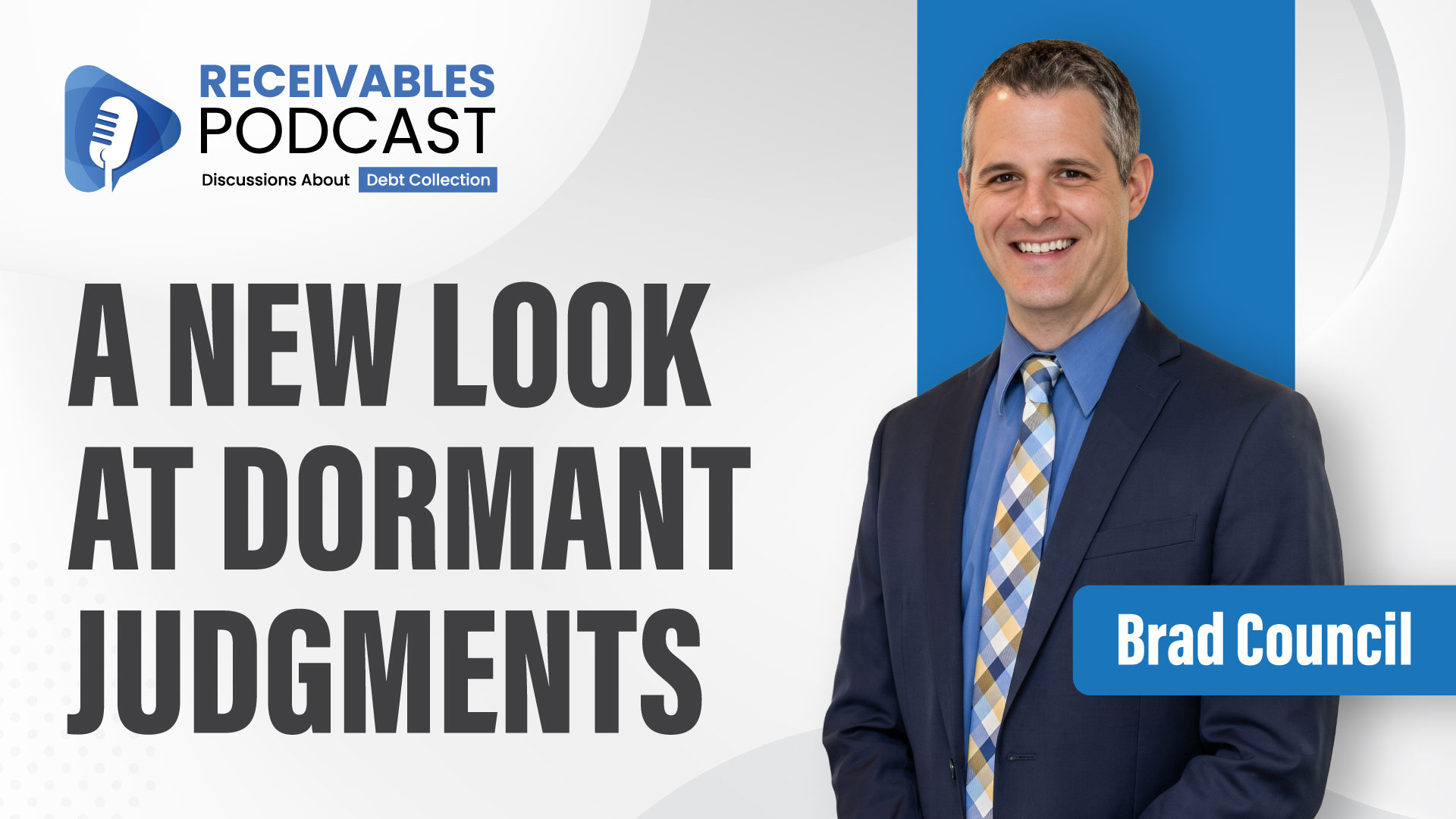
Hello everybody, Adam Parks here with another episode of Receivables Podcast. Today I’m here with my good friend and someone that I like to learn from Mr. Brad Council, joining us from Slovin and Council. How are you doing today, Brad?
Brad Council (00:22)
Doing pretty good. How are you doing, Adam? It’s always good to be with you.
Adam Parks (00:24)
I’m doing fine.
I’m doing fantastic. It was great to see you at the NCBA conference not that long ago. Always enjoy spending time together because I’m gonna learn something from every interaction with you. Just like today, where I really wanted to talk more about dormant judgments and try to provide our audience with a little bit of a how-to guide for them to look at their judgments, understand the difference between the judgments and the accounts, and ultimately talk about.
How they can enforce those dormant judgments and bring cash flow back to their business from these dormant assets. So, but Brad, before we jump into all of that, could you tell everyone a little about yourself and how you got to the seat that you’re in today?
Brad Council (01:05)
Yeah, my name’s Brad. I am here in Cincinnati, Ohio. We’ve got a beautiful day here. Nice fall weather in the Cincinnati area. I work for Slovin and Council, which is a creditors’ rights and collection firm here in Cincinnati. We practice in the states of Ohio, Kentucky, and Indiana, and I am the managing partner here at the firm.
Adam Parks (01:24)
Fantastic. Can you tell everyone a little bit about how you got into the role that you’re in today?
Brad Council (01:27)
Yeah, I’ve actually been with the firm for twenty years now. So I started straight out of law school with our founding partner, Randy Slovin, who is well known in the industry and throughout this space. A great man who started the firm, and I started right out of law school with him and never left. So definitely found a home and a great place to be and to learn from the industry. I feel like I’ve learned from some of the greats over time, and we’ve got great people here at the firm that have been doing this for a very long time, so I was able to grow and develop and hopefully keep things expanding and keep things growing.
Adam Parks (01:58)
You do have a really fantastic team. I love spending time with your whole organization. So Brad, you know, we talk about judgments, and we talk about accounts, and obviously the objective of most collection attorneys is to go through the lawsuit process, file a judgment, and put the asset owner or investor, original creditor, whoever owns that account, in a position to be able to execute or to leverage different judgment execution techniques depending on the individual state.
Can you talk to me a little bit about what that process looks like, you know, from identifying an account and starting that suit process so that you can create a judgment to enforce?
Brad Council (02:38)
Yeah, typically our clients will send us various accounts, and we will obviously scrub through those for various things. We’re gonna sort out anyone who’s deceased or who filed bankruptcy, or we’re going to just go through that different process. Some of our clients score those on our own. Some of them we evaluate.
You’re gonna look at someone’s age, the age of the account, the asset class, those kinds of things, just to get your different levels of collectibility and where you wanna go. Litigation can be expensive. Court costs are not cheap in some states. So you want to make sure you’re putting your money towards the right accounts first. So those will get evaluated, and the suit will get filed. Obviously, we’re gonna take that through to judgment and then run through some of our different asset waterfalls to try and collect on those.
Adam Parks (03:19)
So let’s talk a little bit about that litigation process because from a data perspective, I’m assuming one of the first things you have to do is find them. You’re gonna have to be able to serve them, so you’re gonna have to find them.
So I’m assuming that you’re doing some, let’s call it, some data supplementation beyond what you just received from the originating creditor in order to identify them, find them. And I know from a scoring and selection standpoint, it’s one piece, but you gotta start finding some of that contactability information in order to be able to get that suit served and get the process rolling.
Brad Council (03:51)
Well, yeah, not only important to get them served, but you gotta get them served correctly. For example, here in Ohio, we have eighty-eight different counties. There are a minimum of two courts in every county. Some of our larger counties, like Cuyahoga, are a great example up in the Cleveland area.
I believe there are something like thirteen different municipal courts, and they zigzag back and forth. And you could be in one court if you’re on this side of the street, and another court if you’re on that side of the street. And as you and I both know you sue somebody in the wrong court, and that’s not good.
You’re looking at FTCPA violations and other things that you don’t want to do. So make sure you have that great contact information. And exactly where that person is and what they’re doing is vital. And you can’t always trust things like, fortunately, the United States Post Office; you go to their website, you type in an address, and it tells you where it is.
They’re not always exactly accurate about where that county is and where that city is. Just because it’s on the postal address doesn’t mean that’s what it is. So we use various resources to confirm addresses, to make sure we’ve got people, to make sure that they are the right person in the right place.
You get juniors, seniors sometimes who live at the same address; making sure you’ve got the right person in the right spot before you even get started will save you a lot of headaches when it comes to compliance.
Adam Parks (05:08)
And I’m sure you’re going through a process of collecting and organizing the documentation related to that account in advance. How much of the accuracy of addresses that you find comes from those original creditor files versus your supplemental data waterfalls?
Brad Council (05:26)
It varies definitely from client to client, depending on where they are in the process and the age of the account. You know, we’ve seen some as bad as sixty percent, where forty percent of their information is not correct. And so we’ve got to go through and re-verify; that’s a huge expense that the firm undertakes and a lot of manpower on that front end.
Some of our better clients, though, it’s upwards of, more like 85%, is usually kind of a standard rate where they’re having that information corrected. So there’s a range there, but we do that work on the back end to make sure we’ve got things going. And we always say if you get the work done on the front end, it makes the rest of the process so much smoother.
Adam Parks (06:02)
Well, data decays at roughly thirty-six percent a year. So honestly, I’m surprised that the numbers are even that high, right? Sixty to eighty-five percent sounds like they have already gone through some supplemental data and provided or done some scrubbing and some additional data supplementation for you prior to even sending you the account, because at thirty-six percent a year, assuming an account has already gone to judgment, it’s usually already been through some collection stages, et cetera. So I would have expected a deeper level of data decay.
Brad Council (06:34)
Well, and that may be one thing that’s unique to us. I don’t like clients who just don’t buy and dump on me. Don’t buy your accounts and then just dump them on me and expect me to do all the stuff. We expect that if you want to come to us, we’re coming; we’re litigation; we’re strictly a back-end litigation firm.
We don’t do a lot of that pre-collection work. So if it’s coming to me, it’s gonna be ready for litigation. So a lot of our clients do a little heavier lift on the front end than maybe some of the other firms would do because we wanna be ready to go. We wanna be ready to go. When we’re talking about the suit process or the judgment process, we wanna hit the ground running and get it out the door quickly.
Adam Parks (07:04)
That’s always been our strategy as a debt buyer. I’ve always looked to provide that information because of my ability to build waterfalls and to learn from across my entire portfolio versus you looking at a small subset, right? The data sample that I have available to me as a creditor, as a debt buyer, I think is a little bit more significant and probably provides deeper opportunities for that type of analysis so that I can provide you with that higher level of data upfront.
And it probably is somewhat unique to you. I know different firms manage it differently, but very few firms out there have become true data science experts, right? The objective is to go and litigate and go through that legal process and to be a lawyer, not a data scientist. And I think that’s kind of an important distinction when we think about how our judgments are being processed.
Brad Council (07:53)
Exactly. We’re pretty good with the data and pretty sophisticated and a lot of that, but no, we’re lawyers, and that’s what we like to do, and that’s what we’re here for. So, fair statement. And so once we go through the judgment process, right, and we’ve got a judgment in hand, we are now going out to execute it. In your state, what are some of the more popular options for judgment execution?
So, of course, everyone’s gonna look right away at a lot of these two, those wage garnishments. We do have wage garnishments in all three of our states. I know some across the country don’t provide for that. That is typically gonna be your fastest and easiest way to go. Get that employment hit, get the wage garnishment out the door. Bank levies, obviously, our exemptions aren’t too bad in the three states we’re in. So, a lot of times, just when you got people that we’re dealing with at the stage of life they’re in, some of those exemptions, just the funds aren’t in the bank accounts.
So bank garnishments can be more expensive on the cost side. Locating the assets is more expensive; filing with the court is more expensive. And if you’re gonna have someone who’s just not carrying the cash flow in the bank, because honestly, if they had it, they would have paid you. So it doesn’t always make sense. So that’s usually more of a second-tier kind of thing. Obviously, we can do executions.
Typically, we don’t do those writs as much because I’ve found that by the time you pay the bailiff, he goes out, he tags everything, you auction it off, you sell it off, you’re barely covering your fees. It’s not even that you’re not making any money on those. And then obviously liens on the real estate put out that judgment lien’s a big thing too.
Adam Parks (09:23)
Well, let’s talk about those liens for a minute because I think that, especially in our current real estate market, that’s probably a little bit overinflated. I’m wondering how those liens are kind of panning out, as we’ve seen a significant slowing of the real estate market as rates continue to rise. And I, at least in Florida, am not seeing the same transaction volume that I was seeing six to twelve months ago. You know, how does that impact, or that real estate market change, impact the collectibility of those liens?
Brad Council (09:50)
A 100%. So three, four, five years ago, those liens were paying out left and right. People were refinancing, people were selling because prices were through the roof, and it was great because we were just getting calls left and right from title companies just wanting to hand us money on these liens, which is wonderful.
Well, I mean, you did all the work on the front end, so it’s great to finally get paid on that. But in the last twelve months, maybe give or take, there has definitely been a huge slowdown.
Just with the way that the real estate market is right now, people are not refinancing, the rates aren’t good, people are not selling, it’s definitely a buyer’s market. So a lot of the people who had those judgments, they got all those liens, they’re just sitting. They’re just sitting and waiting for the economy to turn.
So we’ve seen a huge slowdown. Which is fine. That’s why we have these things in place. We can sit and wait. The economy is cyclical. It’s gonna come back around eventually. So they might not be hitting as much right now. We’ll just wait it out, and someday it will.
Adam Parks (10:44)
And what are some of the strategies or actions that a creditor or the firm needs to take to keep those judgments active into the future? Right. That’s nothing permanent. So what kind of strategies are we using while we wait for an economic turn or even a change in the life situation of the underlying consumer that may motivate them to pay down a judgment or account?
Brad Council (11:09)
Yeah, obviously there are different things you can do to keep a judgment active, to keep it going forward and not go dormant; some states call it dormant. There are other phrases that other states use. In Ohio, we have dormant judgments.
So the different strategies you want to take to keep these during the life cycle, when you are waiting for those different events to play out. It’s gonna depend on where the person was to start with. If you’ve got a younger person when the judgment took effect, chances are they may be seeking new income. They may get a new job.
They’re going to be promoted as they go. They haven’t reached that potential that they have for their earning potential. They haven’t hit the age where their maximum potential is reached yet. It may take some time. Right now, they are living paycheck to paycheck. And some people unfortunately never get out of that situation, but some have the ability to grow and advance, and they’re going to be able to pay at a later date.
So you want to make sure you keep that judgment active. You’ve got to watch, too, if you’ve got someone who’s going into retirement age or something like that. Maybe those wages are going to go away.
But that real estate’s probably getting close to getting paid off, then, if they’ve been in that house for thirty years. So you wanna make sure your judgment and your lien are active. So as people start having kids, they start going through those different life cycles; their ability to pay may change from where it was when you took the judgment to five, seven, ten years later. So you wanna make sure.
You still got that enforcement mechanism in place for when the timing hits, and they have that life event, you’re ready to go.
Adam Parks (12:28)
Yeah, I think that makes a lot of sense. And it’s, we’re waiting for the change, I think, is also difficult because it’s hard to time that out unless you’re thinking about it in terms of a, you know, larger portfolio, but you’re kind of tasked with watching these individual accounts. Are there some specific triggers that you’ve identified that an account or criteria that an account might meet to say, like, okay, I need to start applying effort to this particular account or set of accounts again?
Brad Council (12:58)
I don’t know; there’s nothing in particular. As you said, some of those life cycles, you hit certain ages; there are certain milestone ages. Someone in their 20s is obviously doing different than someone in their 40s and someone in their sixties. So you want to recycle through those when they hit certain events there. Get a lot of tags with the property sales and back and forth, new jobs.
Maybe that means someone moved, so you can kind of relocate; then they’ve moved back through, they’ve hit another job cycle. So there are certain things, but I wouldn’t say there’s one in particular that we’ve seen that’s really triggered that hard look. So you’ve got to make sure you’re really cycling through these on a regular interval. So we’ve got different triggers and different things set up in the firm to make sure we are cycling through them on a regular basis.
Adam Parks (13:36)
So we’re finding segments and saying, okay, this segment we’re gonna run every six, twelve months and try and hit an asset search or an employment search and see if we’re coming up with something new and different. Whether that is it, more of a, let’s call it, a trigger, right? Like, I know with some of the credit bureaus, like TransUnion, I can set up a trigger, and that way when a new job is added to the credit report, now I’m going to get an alert that I should probably go look into this one. What’s the balance look like between those types of strategies?
Brad Council (14:08)
Yeah, you definitely want to have those triggers set up so you know to come back to, but you’re gonna want some timing triggers on those too as well. You don’t want something sitting three or four years without someone looking at it, without someone taking a look and just seeing, Hey, has anything changed?
Is there anything in here that we need to run back through and look at again? So there are definite timing issues, as well as the triggers that hit on those for your ones that are sitting without the normal flow and performance.
Adam Parks (14:34)
Okay. Well, yeah. if it’s a if it’s a non-performing and it’s sitting there dormant, because now I’m hearing a lot more conversations in the marketplace about people looking to acquire judgment specifically, whether they’re reaching out to debt buyers, creditors, law firms, and trying to identify those portfolio segments that might make for you know, a good judgment investment because they’re gonna whatever apply more resources to the ability to collect. Are you seeing the same thing kinda on your side of the world?
Brad Council (15:03)
Yeah. Clients are always asking me if we know about judgment accounts that are up for sale. It’s a great asset to buy. The hard work is done. You’re not getting the counterclaims; you’re not getting the disputes as heavy. The judgment’s in place. So as long as you’re past some of your vacate and appeal periods, there’s very little a defendant can do to undo that judgment. So the hard work has really been done. Well, the hard work has been done in essence of obtaining that judgment. You now have the court order; you have the power of the state behind it.
Your collection efforts. So those are very powerful once you can get a judgment portfolio. So it’s something people are always looking for, but I feel like it’s something that gets neglected a lot too. There are obviously not as many in our space, but there are a lot of firms out there. People hire attorneys who are great attorneys and do great work. You may go to big law because you’ve got a complex case and they do a great job getting you that judgment. And then they go, now what?
I had- they don’t know what to do; they don’t know how to file a garnishment. They don’t know how to find assets. They know how to take a judgment, and they did it, and they may have done a great job. But they’ll then turn to our office and say, You gotta go call Brad now because I can’t help you get your money. I it was a I saw a defendant, it was a plaintiff was working pro se in a case. I was in a small claims case.
So we were sitting in court, and the person was representing themselves. They went through, and they did a great job, and they won the case. So you can win the case, but then they looked at the judge, and they said, So do I go down to the clerk’s office and pick up my check?
And so people just have no clue that that’s great that you’ve got a court order that says you win all this money, but if you can’t get it, it doesn’t really matter. It’s not worth any more than that piece of paper unless you’ve got strategies to keep that and enforce it,t and waste sometimes, as you said, sometimes that takes time.
And so sometimes you’ve got to be able. to keep that piece of paper alive and active so that when the time is right, you’re right there. So those portfolios are definitely in demand because a lot of the sticking points are done, as long as you know how to keep them active and how to keep them moving.
Adam Parks (16:58)
Well, it seems like there’s a significant amount of opportunity there, but for the groups that are going to apply data science, right? For those groups that are going to be able to identify the opportunities within those accounts to automate or streamline the execution processes, and the ability to watch and monitor the individual accounts and portfolio segments to make it work. Right. And I think that’s where the investment groups are coming in and saying,
Here’s an opportunity for me to buy an asset that’s not, although it’s a charged-off asset, it’s got a significantly higher trade value or resale value than before when it was before it was a judgment when it was just an account. And I know I saw that as a debt broker quite often, you know, at Stirling Capital and in other places that I’ve been through the years, and kind of looking at those accounts and saying, okay, we had clients that would buy accounts, go through the litigation process, and part of their exit strategy was to look at the net present value of those individual judgments and then make a determination as to whether or not the market price would exceed that.
So they would go through the process, they would give me the net present value, and they would say, Here, whatever you can get above my current net present value, right?
Like, I’ll sell those segments of the portfolio. And, you know, we were able to create a marketplace for judgments. I mean, at one point we had a group that had about three billion in judgments that we brought into the marketplace, and it got gobbled up by the law firms that have investment arms, by the debt buyers that were buying on a state basis. It became a very hyper-focused type of transaction.
Now, that particular company was looking to exit the US market and to bring their capital to debt buying in other countries. They were very successful with it. But when I look at the judgment sale process, that’s when it really kind of hit me.
There’s a significant difference in the perceived value of a straight charged-off credit card account, and that account after a judgment has been executed. Any comments related to that world, or what your experience is, or what you’ve seen in that regard?
Brad Council (19:07)
No, I would a hundred percent agree that the rates that we see on those that our clients are buying those portfolios at are definitely much higher than they would buy off just the charged-off account.
As we said, there is a greater value in that. There is more that you can do. You have already gone that extra step to obtain that judgment and the enforcement power behind it. So it’s definitely a higher class of asset. But you do have to watch out for some of those. I’ve seen judgments that have sat.
That have gone through the ring, or if you’ve got a good firm that knows what they’re doing and has been working them for years and years and years, there is a time where it’s time to say uncle; it’s time to give up and move on. That there is nothing; we’ve all those triggers that we talked about before; they’ve all been past this.
It’s just not going to perform at any point worth the effort. So you have to be willing to let some of them go too. But I’ve definitely seen some that I didn’t think were as valuable, and I’ve seen them perform pretty well too. So there’s definitely, if you’ve got the data, if you’ve got the ability to dig into that, there’s money there. There’s money to be had in judgments.
Adam Parks (20:07)
Of those judgment accounts that are ultimately not collectible, have you found ways to learn from that process to help you better identify similar accounts in the future, whether it be characteristics or whatever the case may be? But are you finding an education in those accounts that fail to collect?
Brad Council (20:26)
I don’t know that we’ve put that in as much as we should into that data because I, I see the flows when they hit certain ages, when they hit certain account classes, when you’re looking at different things. You get a feel for it over time, but I would love to see some hard numbers on some of that and see where it’s gone to, put in some of the ones that we’ve closed out as just uncollectible, those judgments that we’ve worked for years, and see if we can find commonalities in age groups and regions, in just different areas of the people to put a harder number on that. I don’t know if anyone’s out there selling that data too. I’m sure that’s something that would be very valuable to quite a few of us.
Adam Parks (21:01)
I’m coming at it, Brad, from a different perspective, right? I’ve got I’ll give you a perfect example, right? Like, we’re a media house; we’re creating media on a regular basis. If I have one LinkedIn post that performs really, really well and one that is a total failure with the same guest and similar messaging. Well, I gotta, I better figure out what happened, right? Like, there’s gotta be something. Was it time of day? Was it day of week? Was it the channel that I dropped it on? Was it what else was being published that day? Was it the news cycle outside of the industry distracting folks that particular day?
So you know, we see a lot of these different things. And I’m just curious about how law firms and debt buyers are kind of attacking that same learning methodology. Cause I learn significantly more from my failures than I learn from my successes. And what kinds of not that it’s a failure when we don’t. collect on an account that the expectation has never been a hundred percent. But I’m curious about what that learning style and learning process ultimately looks like.
Brad Council (22:03)
Yeah, I think there would be a lot there to kind of look at those different portfolios and put them together and kind of find those commonalities because they’re definitely gonna be there, but I have a feeling they’re not gonna be what I’m thinking. I have some thoughts in my head, but they usually go a little sideways on some of this.
There are always those one or two things that you’re just not looking at that pop up, and that’s usually where you can get that extra bit of information that can really change you from, you know, where you are here to way over in the future, to bring that extra little boost that you need to make that difference between you and someone else. It’s usually that little thing that you’re not thinking of because chances are if I’m not thinking of it, that means eighty-five percent of everyone else isn’t thinking of it either. So if you find that little kernel, sometimes that can differentiate you from someone else.
Adam Parks (22:47)
I think those little nuggets are infinitely important. There’s just so much value in those little pieces and our ability to bring them together, you know, for a larger learning experience. And one of the challenges that I’ve had is: how do you build a learning model, right? Or how are you going to develop your organizational learning in a way that you can actually capture data to learn from it in the future? And I think with the application of artificial intelligence across a lot of organizations these days, that data structure has become infinitely more important. We’re just seeing so much more value there.
And so my mind starts going down. Well, how am I going to store that data? What am I going to be able to do with it? How am I going to be able to use this to better determine, you know, solutions for the future? So, Brad, as we think about judgments in general, what advice do you have for debt buyers and creditors regarding their judgment strategies and things that they need to consider when they are selecting internally which accounts really should be part of their litigation strategy?
Brad Council (23:55)
One of the key things they need to do is make sure they’re partnering with a good firm that’s gonna give them good advice in their area. What you can do with the judgment, how you know, South Carolina, Texas, there are no wage garnishments. All three of my states, we have them. You go up to Michigan, and they can garnish tax returns, and all of a sudden Michigan attorneys make their entire year’s worth of profit in one month on those tax returns. So there is a widespread need. So find a good person to partner with. Find that good attorney, you know, reach out to NCBA, to RMAI, to ACA.
Find the firms that are in there that are learning, that are educated, that are in the know on these, and start with partnering with one of them because they’ll be able to get you the information you need for your particular area and that particular portfolio, because it’s gonna differ from one region to the next.
Adam Parks (24:39)
Localized expertise, I think that is a great perspective. Look, from a debt sales perspective, and going back to my own experiences when we had the CreditMax debt sales system, we were selling on a zip code basis; we were selling on a state basis. And what we identified and realized is that local expertise was a big differentiator in driving the value of portfolios because of the local expertise, the understanding of which side of the street.
That person lives on and how that impacts the appropriate court of filing. I think is a really big part of the success of organizations in the space. And a lot of debt buyers that I’ve worked with through the years are using those smaller localized firms, three, four, five states, so that they have some economies of scale in terms of their engagement with the firms, but also maintaining that level of detail. expertise on a local level, which I think is instrumental to the success.
Brad Council (25:40)
Yeah, we’ve had just an example in the state of Indiana we were in. So the judgment liens in Indiana are good for 10 years. The only way to get a lien is to have it be statutory. So when you get a judgment, you get the lien automatically. There are no process fees that need to be filed, no other motions, no notices. When a judgment is entered, you get a lien. It’s good for 10 years from the date of judgment within that county that the judgment’s in. Any real estate the person owns, you now have a lien on that property.
Well, once the tenure, the thing is, in Indiana, judgments are good for 20 years, but the lien’s only good for 1,0 for half of that lifetime. You know, we don’t need to get into all the nuances, but people were filing motions to renew their liens, asking the court, Hey, can you please renew my lien? And I had a back-and-forth with a very astute client who was like, Well, wait, this is statutory. It says that the judgment is created by the lien is created by the judgment entry.
This isn’t a judgment entry. This is a motion. This is an order from the court. That is not the same thing as the entry of judgment. How, why does that work? And so we went around, we came up with the strategy, and we actually looked at a couple of cases and found that that was not the way to do it. You can’t actually just renew the judgment. It’s a little weird, but you have to file a new suit on the old judgment. So you take your old judgment; it’s a debt record, just like a promissory note, just like an account, and you go to the court and say This is unpaid.
I would like a judgment on this unpaid debt record. The court then enters your judgment. You now have a new judgment. So I know I have a new 10-year period from the date of that judgment. There weren’t very many people doing it that way. We got a lot of pushback when we started doing that. I had judges saying, No, you can’t file this.
Luckily, as I said, I had a very astute client who wanted to make sure they did this the right way and that those judgments held up. So when they executed on them, when they tried to sell them off, they had a good product that they could go through. I probably went through four or five different appeals in the state.
Hundred percent want them all, like to say. And that is now the known way of doing this in the state, because we had a client who was willing to put that forward and was willing to say, ” No, this is the right way to do it, and it’s paid off. And now there’s a way to not only have that 10-year lien, but if you continue to file that process within every 10 years before the expiration, you can’t wait till after the 10 years. You can get a new lien, a new lien, a new lien. If you’ve got that property you’re waiting on and you’re just waiting on that performance, as we said before, there are triggers that you’re coming up on.
You can now make sure that judgment extends beyond those ten years to that period when it’s actually gonna pay off in the future.
Adam Parks (28:06)
I love the way that you think about it. It brings me right back to that local expertise, understanding the local jurisdictions, understanding the mechanisms of an individual state, and the level of detail that’s required to make that successful.
Brad Council (28:20)
Yeah, and that’s what someone can provide to their client. that’s that like I said, you ask me to do that same thing in South Carolina, and I’m gonna be miserable. I’m not gonna be able to help you in the slightest. I can read the statutes, I can ask the AI, and do everything.
Else, but there, it does take some of that local level. It takes that knowledge in the industry and in the region to put it together and actually be successful for the client.
Adam Parks (28:43)
Well, Brad, as always, you share so many insights with me that I now have to go back and rethink my own judgment strategies. I really do appreciate you coming on and sharing all of your insights. As always, just a great discussion. I learned so much every time we sit down to talk.
Brad Council (28:59)
I really appreciate it. It’s always good to talk to you, and I love hanging out with you. Hope we’ll see you again soon.
Adam Parks (29:04)
I look forward to it. I will definitely see you at RMAI. I’ll be flying back in from Brazil for the conference again this year. For those of you who are watching, if you have additional questions you’d like to ask Brad or me, you can leave those in the comments on LinkedIn and YouTube. We’ll be responding to those. Or if you have additional topics you’d like to see us discuss, you can leave those in the comments below. And I’m pretty sure I can get Brad back at least one more time to help me continue to create great content for a great industry.
But until next time, Brad, I really look forward to seeing you. Thank you so much for all your insights.
Brad Council (29:35)
Thank you; it’s good to see you, Adam.
Adam Parks (29:37)
And thank you, everybody, for watching today. We appreciate your time and attention. We’ll see you all again soon.