Adam Parks (00:06)
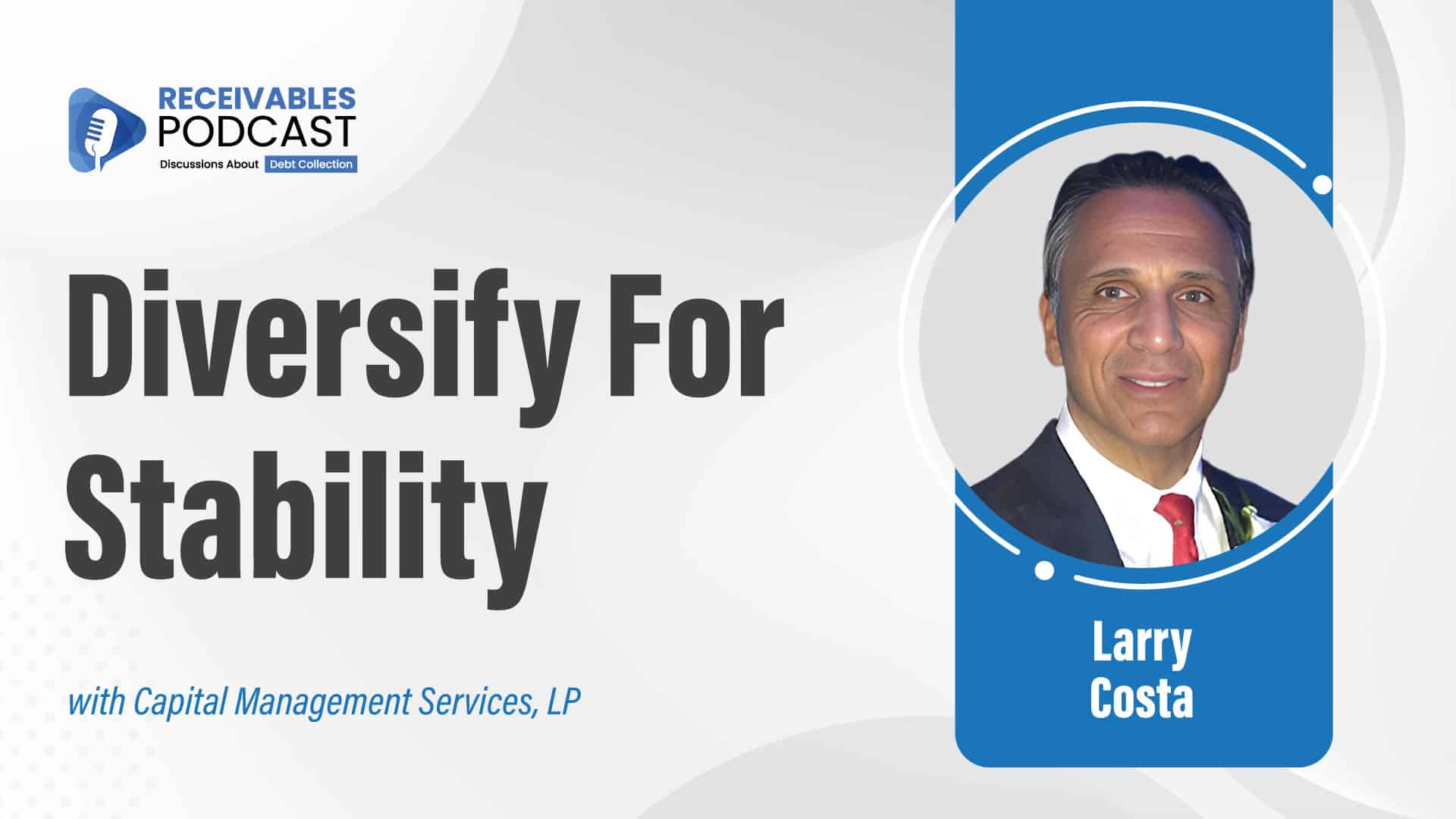
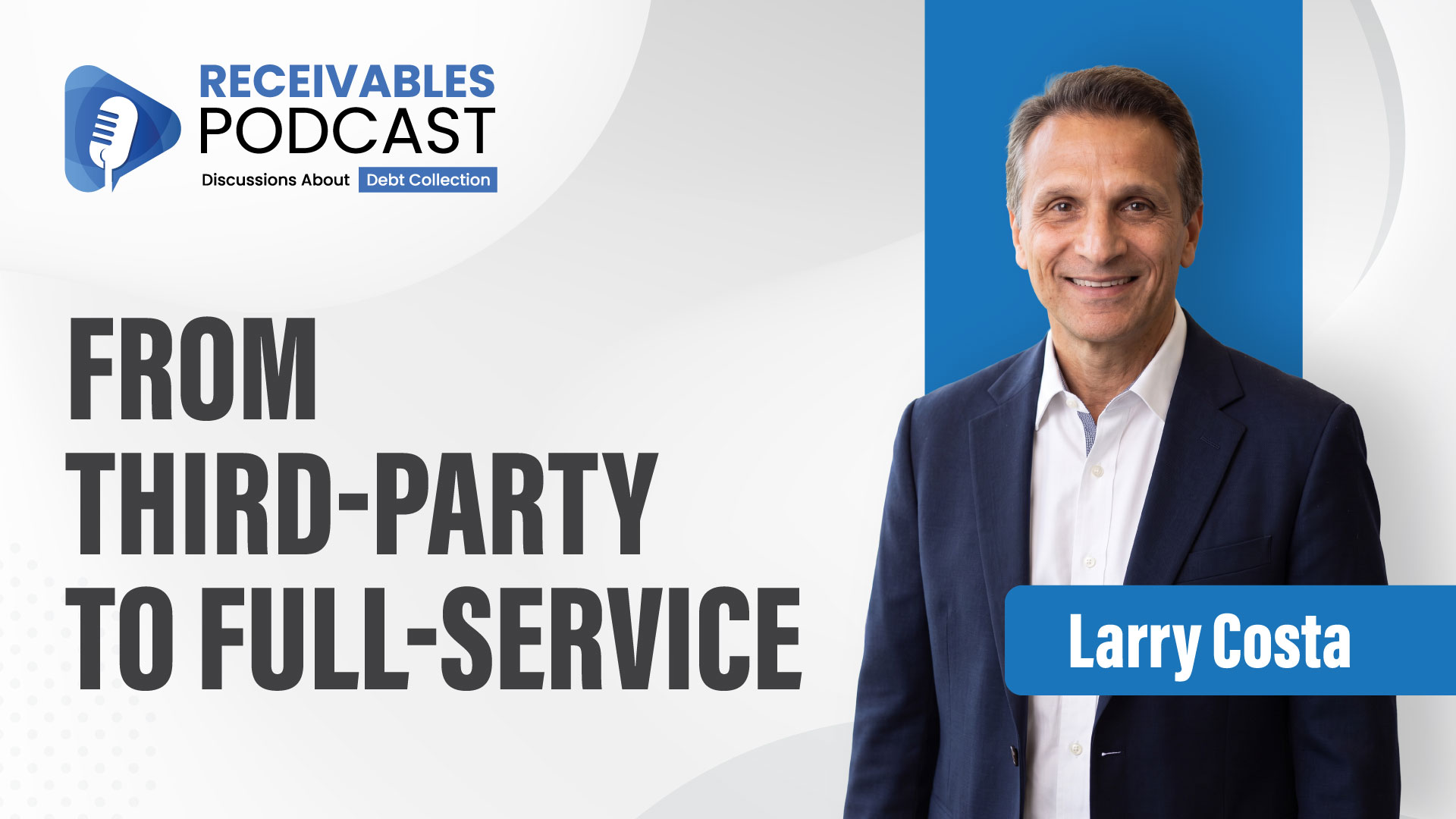
Hello, everybody, Adam Parks here with another episode of Receivables Podcast. And today I’ve got someone who’s been a frequent guest with me through the years, Mr. Larry Costa with Capital Management Services. And last year we had a very interesting conversation about diversification of the debt collection business into customer service roles, being a better partner for your clients, and being able to expand your business at the same time.
And Larry is the kind of guy who practices exactly what he preached. So I thought it would be interesting to have him come back on Receivables Podcast and talk to us about the last year, how that diversification has been beneficial, and really what the results of all of the advice we’ve been giving have been. So Larry, thank you so much for joining me today. I appreciate you coming on and sharing your insights.
Larry Costa (00:59)
Always a pleasure, and you know, trying to be humble yet insightful, it did work.
Adam Parks (01:09)
We’ve been talking throughout the year. This isn’t my first update just for the audience’s sake. We’ve been talking about this pretty regularly throughout the year, which is why I thought it was going to be such an interesting conversation. Diversification is something that comes up very strongly as a need in the TransUnion debt collection industry survey. So we know that the industry has identified this need, but how many people are actively taking the steps to achieve it? And you’ve got a little bit of a cheat code going on.
Larry Costa (01:37)
Look, it’s not a layup, okay guys. I mean you gotta you gotta position yourself correctly. And I’m not just trying to plug Adam, but he really helps us get our message out, especially in some of these segments where we think diversification’s possible. Because by working with Adam, working on our social messaging, getting us out there, getting some messages out there, it really keeps us relevant.
But I think it’s just like I told you guys last year, you’ve got to work with your existing client base and demonstrate your ability to do things that they’re gonna outsource to somebody else. And this has been very successful for us. And some of it is episodic work, which I didn’t spend too much time talking about last year, Adam, but the episodic work’s not fun.
We have banks come to us, we have a mortgage servicing company come to us, and they’re gonna want a hundred people for 120 days. And that’s not easy, okay. First thing you gotta do is you gotta get them to agree to have remote work. Because getting a hundred people to come to your office is gonna be a logistical nightmare.
So you gotta get them to agree to remote work. Once they agree to have remote agents, it really becomes an opportunity for you to demonstrate your capabilities to them and have some additional long-term relationship. For example, there’s this one loan service, and I don’t mention my client’s name. They need a hundred people between January and April of this year. We delivered.
We’re able to take those people; another bank came to us with the exact same need, the exact same type of opportunity, transitioned those people to that other bank for a hundred twenty days, and now those people, the original loan servicing company, came back to us and they want forty-five of those people. So that’s what I mean. By being able to do this episodic work and go from customer to customer, you say to your bank, hey, look, I’m doing this sub-servicing for this mortgage service provider. It’s the exact same thing you guys do. What do you have coming up? We’re acquiring some loans. We can use you. Wait. Okay, do it after April.
I got people that are already trained. Transition them in there. Go back to the other service. Hey, these guys are coming off this project at the end of August. You want them in September? I really don’t need them. Take them in September now because you need them in December, January. So they took them now. So that’s what you do. You leverage that capability. And everybody wants somewhat experienced people, especially in doing episodic work, because you’re gonna hire people that have experience. You can deliver people who have done this for eight, nine months on the same type of product.
It really hits a home run for you. Plus, it’s additional revenue. It’s revenue that you didn’t anticipate. And that’s been a success for us this year, success for us last year. That’s what I mean. You gotta go to your organizations with your familiar to say, we can do this. And if you can’t learn how to do it. It’s not that hard.
Adam Parks (04:25)
Well, from a collection agency standpoint, I think organizations have been less likely to break into new products because it is such a differentiator. And you’ve established kind of two sets of train tracks within your organization, one that’s third-party debt collection and one that can basically solve whatever problem my client has right now that we can throw bodies and technology at. Like we’re here to provide that solution. What kind of mechanisms do you have to build into your organization to enable that type of flexibility and, let’s say, motion between projects?
Larry Costa (04:58)
Well, first of all, we have a phenomenal operational leader. Stan Moore is our president of operations.
You gotta have a Stanley Moore, okay? None of this works without Stanley Moore. Because he has such a tremendous skill set in all aspects of this business, he knows how to train people, and so you have to have a strong training department. Okay, you gotta keep these people trained. You gotta obviously have a good recruiting team because you gotta count.
Always have that net out there. From a technology perspective, these first-party episodic works, you’re on the client’s technology. So you don’t necessarily have to have strong technology, but you have to have a good technology team to do these integrations. Or you gotta have good help desk support and good background technology teams to do this because you’re just connecting their systems. So, you’re gonna need strong internet pipes and a good telecommunications platform, which most guys have.
But I mean, the real key is having this operational excellence; that’s really what you need. You need a strong telecommunications background; you need decent systems, a good recruiting team. But again, having that operational excellence is what’s gonna get you there. So they believe in your collections team, and they see the results, and they believe in your leadership team.
Adam Parks (06:17)
Well, it sounds like there’s a lot of opportunity that exists out there as you start to connect with the client and actually have a discussion. I’m here to solve problems, and you’re able to leverage some of the ingredients to your success already. Right. Your success as a third-party debt collection operation has been your ability to service those clients, technology, your recruiting capabilities, and the apparatus that you’ve constructed to be able to manage that process.
I mean, to bring in a hundred people in a short period of time for short-period work, that’s gotta be a lot of stress on the HR department. How have you increased the, let’s say, resiliency structure of that department?
Larry Costa (07:02)
It has been our model for a while. I mean, we’ve been doing episodic work for a long time. So we’ve got that built-in capability. So as you build your HR and recruiting team, you gotta make sure that challenge. Okay, it’s absolutely a challenge. But again, if you want to remember, we also do a lot of first-party work too.
So we got third-party collections, we got first-party collections, and I’ve got this episodic customer service work. That’s the key. So let’s say I’m talking to a third-party agency guy; all you’re doing is third-party. Obviously, you want to get in the first party. Yeah, we had this discussion last year because you proved you’re claiming out a client. So you want to get in the first-party work.
Then from the first-party work, you move into the episodic work or the other customer service work. Because if you can build that rapport with your client, they don’t want to manage extra vendors.
It’s more cost and more strain on them. So That’s really the key. I’ll give you another example. We did first product work for a fintech, and we’re doing their credit card work. First-party collections, pre-charge. Did such a good job with them; now they’re giving us a personal loan project. That’s what I mean by showing the expertise in whatever segment you’re in; you’re gonna get additional work. And again, because why wouldn’t they give you the business if you have the expertise? And that comes from, again, gotta go back to our operations guy. He’s phenomenal.
But he keeps his agency; he watches the productivity. Stanley manages outlier behavior. If you got it, it’s easier to bring outliers up, right? If you got a couple of outliers, bring them up. That that’s gonna certainly impact your results tremendously. So it comes down to operational excellence. Now you gotta do some marketing; you gotta get in front of your client and prove your value.
Adam Parks (08:51)
You communicate with them. And I like your approach, Larry, as you talk about the operational excellence and being able to, I mean, success breeds success. So if you’re operating well for somebody and you’re getting something done and you’re already cleared through procurement and they’ve already got all the headaches out of the way, because the larger the organization, the more difficult it is for them to go through any of those processes, RFIs, RFPs, etc.
So they’re looking for the lowest common denominator, the fastest solution that gets them an acceptable or a high-quality result. As you look at, like, the HR piece, and we’ve talked a little bit about the technology. So you just have to connect those systems. Are a lot of those projects similar for the same client, or are you dealing with so many different systems, meaning if I already work for a bank, a third-party collections, is it easier for me to connect for the first-party work? Is it easier for me to connect for the episodic work? How does that look? What does that technical strain look like on your organization?
Larry Costa (09:51)
Well, most banks are Fiserv, TSYS; there aren’t that many origination systems out there, right? Black Knight for mortgage work, right? So again, you’re just gonna connect. Okay, and it’s usually a desktop application. They’re gonna go down here; everybody’s gonna be a piece; they download this application in this trade. So that’s what I say.
You have a strong telecommunications network, redundant big internet pipes, right? So again, everybody has that out there. So that’s not the challenge. Here’s the challenge.
Communicating to your client, getting in front of your client, showing the operational expertise, and then convincing them that you can handle more. And then you gotta you gotta deliver. And that’s what makes us different. We delivered. We delivered, right?
Adam Parks (10:31)
Isn’t that the key?
Larry Costa (10:33)
You know, we had a really good year last year; we’re having a really good year this year. Last year and a half, we had responded to five of our fears; we won every one. So we had a bank that we were doing personal loans with; they sent an RP for a credit card, and we won that bid. There’s another bank we weren’t doing business with; they heard of our reputation; they’ve heard of the different things we can do.
We showed the RP; we showed all of our capabilities; we won that bid. We picked up a couple of FinTech clients, same thing. So, success for success, but when you can show a bank that you can do more than just third-party collections, you add value for that. Okay, that again, that’s one less vendor they gotta they gotta put on. That you can do multiple things for that bank; it just creates more and more revenue. It makes you more valuable. I mean, let’s face it, differentiate yourself from a third party.
Adam Parks (11:22)
Well, then that goes back to your point of being a good partner.
Larry Costa (11:25)
But how do you differentiate yourself from a non-third party, right? You know, technology, right? You guys know more digital are doing pretty well.
Adam Parks (11:32)
But let me ask you that. Is that really the solution that everybody is making it out to be? Is the technology going to be the only answer, or is the technology mostly going to be used in its most valuable way to empower those live people? So you still need these folks, exception management and all of this. And to be perfectly frank, if the banks were capable of putting up and deploying AI fast enough, then they might start looking in that direction, but they can’t. They can’t accept that level of risk. They still need those live people to manage these processes.
Larry Costa (12:04)
Look, but you need technology. You have to have a strong digital platform. Every one of my banks asks me What are we doing with AI? And a lot of people talk about AI. Look, agent, assist, that’s gonna be big. Bots are gonna be big. Okay, I see those. But really what you need AI for is you get all this data, right? You get it from your dialing platform, from your system of record.
From your email platform, from your text platform, you get all this data, right? Then you need AI to say, okay, on this group of customers, what do I do next? This responds to not only this type of text, but also this type of text. Is it MMS? Is it RMS, right? This group responds to this kind of email with this kind of offer. That’s the next step for AI, right? And then agent assist, I think, is big because it helps document the notes. It gives you more productive time. So we’ve been able to do, on the third-party side, we were deploying technology, but we’re able to collect more money with the same number of people.
That’s what digital’s done for us, right? People want to self-service; they can self-service. People want to respond to their text; they can respond to their text. We still got a lot of people calling in. Of course, it’s still a significant portion of our payments. But so it’s the balance, right? But look, there are digital agencies out there that are doing really, really well. So I’m not here to say that digital isn’t the way, because there are guys out there that are doing really well.
Adam Parks (13:28)
There are groups that are doing really well, but I think they’re doing it in a mix. Right? I don’t think that digital only is the solution.
Larry Costa (13:28)
The issuers are slow to adapt. Right. But that’s the key. If you’re working with the big issuers, as we do, they’re slow to adapt. They’re not letting us do a lot of the stuff yet. Okay. That’s why you gotta have the balance. Right.
Adam Parks (13:44)
No, but they want to know how you’re looking at it, and they want to better understand for themselves how maybe they need to be looking at it. Because driving a bank’s collections department and driving a collection agency are two different things. It’s like a speedboat vs. a giant cruise liner. You have to prepare to turn left. You can’t just turn left like we can as more nimble, smaller, privately owned businesses. The world is just a little different for us.
Larry Costa (14:12)
But again, this is not a new message. Everybody out there knows this. I’m just reiterating what you and I have been talking about for years: you gotta have a digital component; it’s gotta be a strong component, but you better have skilled people. When an inbound call comes in, you gotta close that call.
Adam Parks (14:26)
Agreed. I think that incoming piece is extremely important. And as you’re transitioning, I think a lot of the same skill sets apply as you start looking at these other types of work that you’re doing. The skill sets remain the same. I start thinking about it as the economies of scope here. Right. It’s the same reason McDonald sells breakfast. Not because they set out to be a breakfast restaurant, but because they had the real estate, the kitchen, the people, the hiring, the supply line, and all the other things they needed to be successful. So why not move into that space, leveraging that economy’s scope and the assets and resources already at play? I think you’ve looked at this very much the same way.
Larry Costa (15:05)
Yeah, I want to throw a question back at you, though, because you got the industry. So I think there’s also a component where people are afraid of the internet. People are afraid of getting hacked. And so I think that’s another reason why you gotta have that skilled agent. How do you find that? ‘Cause I don’t know, I’m not as close to it as you are yet. Is that fear factor out there?
Adam Parks (15:23)
Fraud is up significantly. Like, fraud is up there, and so fear is up there. And if we look at the last couple of years, one of the number one or top two every year in terms of concerns, even for the organizations themselves, is data security. Like, that is at the forefront, and consumers are being bombarded with fake calls all day. I know I’ve got three different spam blockers on my phone, and my office line doesn’t even ring to me anymore. It forces a voicemail.
That I get via text message that I can listen to and read. Right. But that’s what it’s turned into. You’ve had to put up these levels of walls around you because of the sheer volume of bad communications, which means that we have to do more to stand out as good communicators. It’s working with our carriers to make sure that we’re flagged appropriately, right? And that we’re appropriately tagged on all of our communication channels.
It’s looking at our domain reputation scores and managing that process so that our emails are actively being delivered. I think organizations over the last 10 years, a lot of them have built the same rails. They can send emails, they can send text messages, but it’s that orchestration piece that you were talking about that is, I’m gonna call it the secret sauce. Like, that’s where the next thing is coming. And you also mentioned the agent assist. And I think that is one of the biggest values from an artificial intelligence usage standpoint across customer experience and collections. I mean, really the whole spectrum. I think that’s a very important part for us to continue to look at because the more that we can, it’s funny. I was having this conversation with a friend this morning where I said, lawyers and LLMs are kind of similar.
Right. Like they charge you by the word, and you’re feeding them. If you don’t feed them the right context, you’re not going to get the right answer. Well, I think it’s kind of the same thing when you’re thinking about how we’re operating on the floor. Like how much context can we give to that agent so that they can make real-time smart decisions that are beneficial to them, the organization, and the consumer. Cause that live person there managing that negotiation is where we can add so much more value as an industry to the process and overall to the credit ecosystem. So I realize that might be a little bit of a roundabout way to answer it, but that’s kind of what I’m seeing from my seat right now. And there’s some really good research out there to support the idea of the super agent, right?
You had mentioned reducing the amount of time it takes to take notes. Right. You can wrap up a call a lot faster, and you can do it systematically in a way in which those notes are now more searchable, retrievable. You’re creating a series or a data set of actions and intelligence that are now being collected. And it doesn’t have to be done manually where everybody sitting in this row of collectors has their own shorthand for follow-up and whatever the terminology is. But even at that, the terminology that’s used across the industry in different shops can be wildly different, even just down the street.
Larry Costa (18:34)
No doubt about it. So yeah, that’s the thing we’re looking at. But like everybody else, we’ve got to keep our eye on what’s developing digitally. Stay in step. But again, having skilled agents is really, really important. Because, like I said, I hate doing anything online. I do ’cause I have to and it’s efficient. But I triple-check everything I do. I make sure my investment it’s fully authenticating all that stuff. But you know, people get hacked all the time. All the time. So I think there’s always gonna be a place for that skilled agent. And like I said, issuers issues, issuers are again slow. I think they’re moving more rapidly now. But there’s still a couple of issuers out there that don’t let you email or text. I mean, they don’t let us. There’s still a couple of them out there.
Adam Parks (19:27)
It’s crazy to me because that’s what the customer ultimately wants, right? Like that is what they’re looking for. And I don’t know if it’s the bank saying, I’ve already sent enough texts and emails, and they didn’t respond. Like why would they respond to yours? But that also comes back to the orchestration engine and being able to orchestrate that series of collection letters because we are hyper focused on one piece..
Larry Costa (19:46)
I think some of the problems are that banks have some of these banks have really old systems. I mean, some of these mortgages, right, they’re twenty years old. They’re twenty-five years old. They’re originated on systems like three generations ago.
Adam Parks (20:00)
Yeah, they’re on windows ninety-five on a back server sitting in there. I’ve done those audits. I’ve done some of those consulting projects and got to see behind the curtain there.
Larry Costa (20:10)
But I think we kind of beat this topic up, but again the message is really clear. Look, you gotta have a digital platform; you gotta continue to evolve it, but you also gotta be full service. You gotta have skilled agents to handle these inbound calls. And they make good outbound calls. You’re still gonna generate revenue from inbound calls.
Adam Parks (20:27)
Let me ask you this. What do the next five years look like? We’ve been talking about kind of the culmination of this for the past couple of years, and this, I feel like, is the result of what we’ve been talking about and you implementing your own strategies. What do you think the next five years start to look like?
Larry Costa (20:45)
That’s really hard for me to say. I used to be able to confidently predict five years. I’m down to 2-3 year windows now. I think the next two years, I think you said you continue to see a digital evolution, right? You gotta continue to see that.
Adam Parks (20:57)
Well, you gotta go more than two years cause you gotta break at least one political cycle. You have to cross at least one political cycle in your prediction.
Larry Costa (21:03)
Yeah, well, in the next two years, I think regulatory is gonna be okay, right? Unless these states have their own, like California has its own CFPB. I think from regulators’ standpoint, you gotta be compliant regardless. But we’re seeing some breaks. Some of these Circuits have ruled that the text is not considered a phone call. So that opens you up for more than 7/7. I think regulatory it’s gonna be okay for us. But again, different states; there’s always states that are gonna be more zealous.
But it really just depends on the technology, right? I mean, and how fast the issuers deploy. I mean, it depends on who you collect for. If you’re issuer-centric like we are, then, I think the next 2-3 years is okay. But if you’re collecting just for debt buyers or fintechs, and you’re not collecting for big-time issuers, it’s gonna be all technology-driven. All technology. If you apply for a loan at FinTech, right? You never talk to a human being. Never.
The first call you get is from either the fintech internal collection team or from one of our first-party collection teams for the fintech. That’s the first time you talk to a human being. You haven’t stepped into a branch, right? You never met anybody. First time you talk to a human being. No relationship. So if you know you’re working for fintechs, you gotta be technology-forward, but you’re still gonna be able to be a smart collector. Because, this is the first time they talk to a human.
Adam Parks (22:31)
So you think the needs of the creditor will continue to evolve as well? Do you think that creditors are going to find themselves? We’re gonna see this increase in charge-offs; we’re seeing a shift to where that increase is coming into that subprime market. So I think we’re gonna see some changes in the way that origination happens, and we might see some tightening just based on the numbers that I’ve been seeing.
But how do you think the creditors do you think that they’ll start to accelerate that technology adoption pace over the next five years? Or do you think they’re still going to look for the human aspect and element to be handled? What do you think, is it still a hybrid approach?
Larry Costa (23:07)
I think it’s a very hybrid approach. That’s just my best educated guess. I mean, look, issuers want to drive technology. They want they’re gonna be using bots, they’re gonna want to drive technology. But again, there’s always a situation where you just don’t understand why you’re being called. You don’t understand,, they remember the VOD, the validation of debt. Well, I thought I paid this. I thought I did. There’s always going to be a human component to this.
Because similarly, people want to talk to a human being. And that’s where it’s really important to make it easy to get to one of your agents. Right? You can’t have these prolonged hold times; you can’t have it all of a sudden just get the call to the agent. That look, there’s, and you have experienced, obviously, there’s nothing more frustrating than being put on hold and being transferred to two or three different people. Like, I mean, just pick up the phone, answer the call.
Adam Parks (23:59)
or even being dropped, right? But the company that answers immediately, you have a lot more respect for because it’s such a rare occurrence these days.
Larry Costa (24:06)
Absolutely. That’s a rare occurrence. I don’t know what the moves are in the industry because we don’t really touch a lot of clients that are interested in black club service, but like I tell you, there’s a need for it. There’s an absolute need for it. I know some of the airlines; American Airlines has the platinum 800 number. Dude, you dial that number, you talk to somebody fast. And that, you know, what’s the value add? That makes you come back to that airline.
Adam Parks (24:31)
It is the loyalty program, right? Like, that is why we stick to one airline is because you’re hoping to get that level of service. When the flight gets canceled and everybody’s standing around yelling in a line, it’s easier to jump on the phone.
Larry Costa (24:44)
You’re not. You’re on the next flight.
Adam Parks (24:46)
Yeah. I’m already boarded on the next flight out of there.
Larry Costa (24:52)
I don’t know how we get there.
Adam Parks (24:53)
I think that’s what the creditor is ultimately looking for, right? The creditor is looking to improve the customer experience. I think there’s going to be some level of that that happens with technology, as you think about the fintechs, and consumers tend to want to have their loan service through similar or the same channels in which they originated the loan. If I went into the bank and filled out a credit card application, I might still be going into the bank once a month to physically make that payment on that card, right? It’s different.
Larry Costa (25:23)
It’s rare, but it happens.
Adam Parks (25:25)
Look, its maybe it’s just because I live here in Port St. Lucie, Florida, but I see that almost every Friday at the bank, I walk in there. There are people standing there waiting to make it.
Larry Costa (25:33)
Yeah, that’s true. A little different demographic.
Adam Parks (25:37)
A little different demographic, but it’s also those folks that are not comfortable making that online payment. They don’t want to do it by phone. They like to have that personal interaction. So the point that I’m making there is that I think each segment of the marketplace or each segment of consumers has a different way that they want to be serviced, but ultimately the creditor is looking at how I can best service. If that’s the use of technology, if that’s the use of people, if that’s that continued hybrid approach between it, I think that’s their underlying control there, control those costs and provide the best experience they can for a customer. Because even a charged-off customer, especially in those earlier stages, may still be a customer next month. We can still work through this and get this back to current.
Larry Costa (26:20)
Everybody thought all these branches for banks were gonna close. And some of them did close. There’s a lot of branches out there. A lot of branches, man. Like, I’m in Delray; I’m on Federal Highway. There’s like five banks right next to each other. Right on Federal. So, you know, I’m talking about US one. Lots of branches on US one.
Adam Parks (26:32)
Exactly. I know exactly what you’re talking about, Larry. Well, that was really what I wanted to cover with you today. I appreciate you coming on and sharing your insights because it sounds like you’ve gone through this process, you’ve kind of come out the other side, you’ve continued to see that success, you’re continuing to run that same playbook. And I just appreciate you coming on and sharing it.
Larry Costa (27:02)
Appreciate it, I know we talked briefly, but the numbers did play out. You know, the third party is still the more profitable end, but the first party covers your fixed cost. The episodic work was 47% first, 53% third. But the third party generated a higher percentage of the profit. Because there’s less labor in third party. But just to let you know the numbers do work. The numbers work, man. I told you they would, and they did it.
Adam Parks (27:31)
And that’s why I wanted to close out this conversation, Larry. I can’t thank you enough for joining me today. For those of you who are watching, if you have additional questions you’d like to ask Larry or me, you can leave those in the comments on LinkedIn and YouTube. We’ll be responding to those. Or if you have additional topics you’d like to see us discuss, I bet you I can get Larry back here at least one more time to help me continue to create great content for a great industry. But until next time, Larry, thank you so much.
Larry Costa (27:54)
Come down to Delray; I’ll be there in October, brother. I’ll see you down there.
Adam Parks (27:57)
I look forward to it. I’ll see you there before we head back to Brazil. And thank you, everybody, for your time and attention today. We’ll see you all again soon. Bye everybody.