Mark Naiman (00:06)
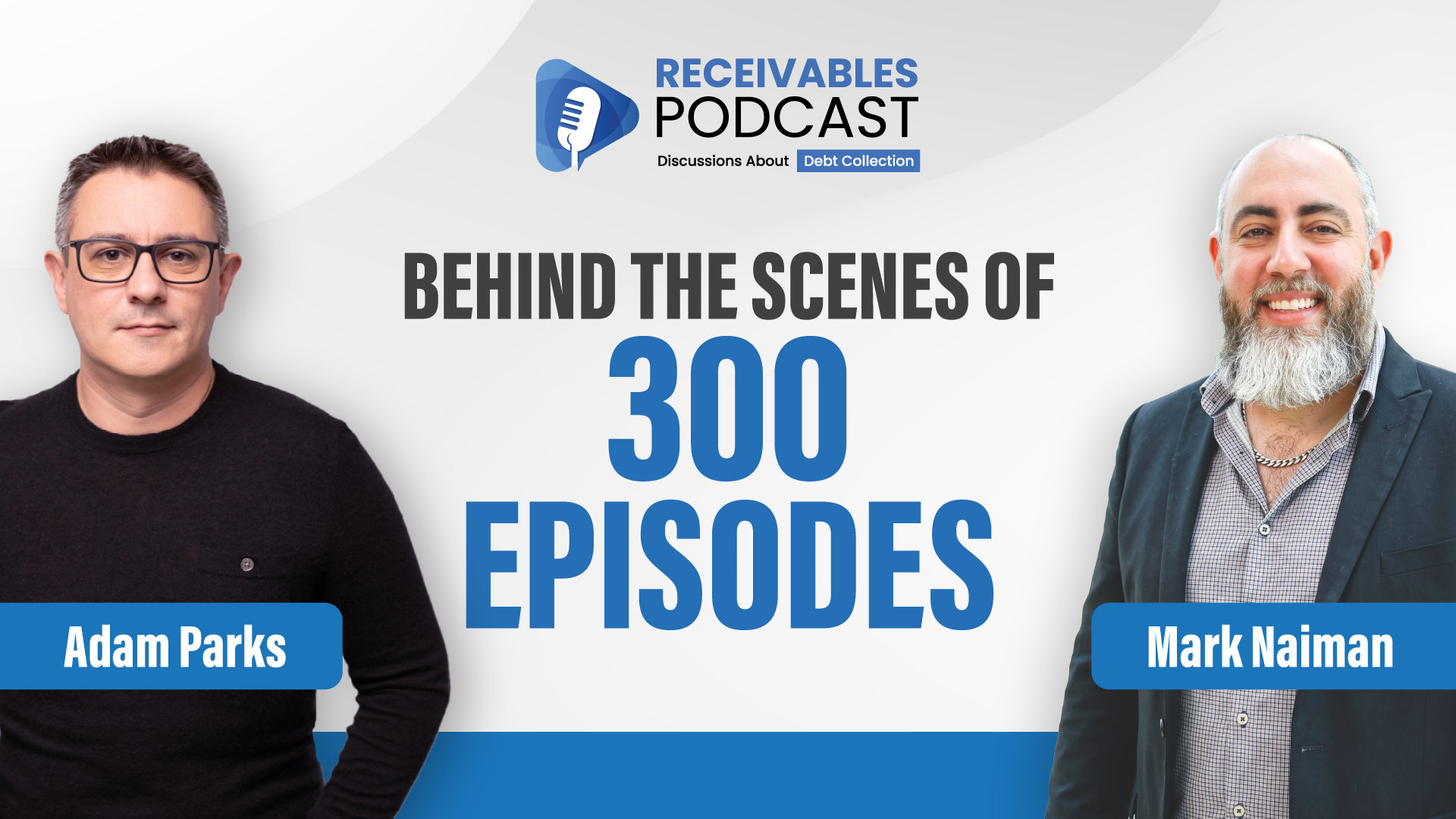
Welcome everybody. No, you have not reached the wrong show. Today is a very special opportunity. To celebrate the 300th episode of the Receivables Podcast, Adam has once again asked me to host the epic 300th Receivables Podcast episode here. And so, role reversals here. Going back 200 episodes, episode number 100. I was actually fortunate enough to be across the desk from Adam there in Florida as a riding mower, of course, entered the background. And production values were certainly a little bit different, but that’s some of the things we’re going to go into today.
I think all of you know both Adam and I, and so introductions will not be necessary, but I thought it would be a nice treat, as Adam is typically focused primarily on industry-related things. I’d like to do a little bit more of a deep dive into some of Adam’s personal things here, not just in regard to the Receivables podcast, but as some of the video clips that we’re going to dig into the archives for, we will demonstrate that a little bit of humor is always good to kind of brighten up the day.
So with that being said, Adam, thank you again for allowing me to host episode 300. And that’s what I’ve got for an intro. I hope you’re ready.
Adam Parks (01:14)
Look, I am ready, and I really do appreciate you coming on and doing this with me. It’s weird to sit in the other seat when you spend so much time hosting. But at 300 episodes, I feel like it’s at least worth talking about some of this. And within the time period of those same 300 episodes, it’s funny because I was on a flight earlier today, and I was looking at my phone and you know, with the little face notifications or the little how it groups by a person’s face. And I happened to look at Mark and went back to some of our earlier photos and just kind of scrolled through some of the adventures that we have had through the years, both traveling professionally, the conferences and all of the other things. So I can’t wait to see what you got cooked up for today.
Mark Naiman (01:58)
100%. I appreciate that, Adam. We’re gonna get right back into it, right? So let’s roll back to episode number one. What at that time made you think that the receivables industry needed its own podcast? And kind of following up with that, did you think that you’d still be doing this 300 episodes later?
Adam Parks (02:17)
Well, I didn’t even know it was a podcast when we started. Like I didn’t realize it was a podcast until somebody stopped me at a conference and said, I really like your podcast. And I said, okay. I should probably start distributing this through podcast channels. But it was like the beginning of COVID. And we went to the conference in February.
By 30 days later, the world had shut down. And I needed to find ways to stay connected to the industry, stay connected to my clients, stay connected to future opportunities. And as COVID got started, people were a lot more comfortable coming on camera. Maybe not at first, and it has taken some time, but pretty much everybody’s got, you know, Zoom or, you know, some other networking tool on their phone and every other machine they use.
So we saw people that were starting to get a little bit more comfortable with it. So I thought it was a great opportunity. But to me, it was just, let’s record some Zoom conversations and we’ll put them out on YouTube and see what happens. And I thought we were able to start creating some pretty good content early on, but it clearly has evolved significantly since then.
Mark Naiman (03:23)
That’s a great thing. Look, I look back to those times where, you know, the aversion of people to speak on camera changed drastically after COVID in the hybrid work environment. So I think you capitalized on it at a perfect time. So let’s do a little role play here, Adam. If you could call yourself right before you hit record on the very first episode, what would you tell Adam, future Adam?
Adam Parks (03:47)
I, you know, I would have told myself to invest in production quality and to invest the time and energy and to put it out there sooner because the way that it started was less of an intentional podcast, as I was saying. So if I had invested in the production quality and value, I think I missed some opportunities there. Because I slow-started this. I think I could have grown at a much faster pace and we’d be further along the path at this point.
The production quality, bringing other people in to help me. Not making it just the Adam Park show, but now there’s a whole team of people that touch every podcast. There are six departments now that all touch a podcast. And there’s one guy who just focuses on scheduling and somebody else who’s just doing this piece and just doing that piece. And our preparation has gotten significantly better. You know, when we first started, it was get on, have a couple of conversations, and it was less researched and prepared.
And now I find myself doing a lot more preparation and research before reaching out to any of these or like starting any of these episodes. So I mean, those are really the two things that I would focus on doing probably a little bit differently in order to accelerate our growth and our visibility.
Mark Naiman (05:01)
You know, one of the things I wanna mention here, and we’re gonna run a clip here in just one second here. Adam, tell me, did you learn any lessons about wearing your stylistic black Adam Parks T-shirt in front of a black chair? I feel like we might be able to identify a couple of these floating head episodes potentially.
Adam Parks (05:20)
You know, I can remember the floating head episode quite clearly. And what’s funny is it was at a time where I wasn’t even wearing black T-shirts all that often. Like it wasn’t part of, like, the brand.
Mark Naiman (05:32)
Wasn’t part of the staple look yet.
Adam Parks (05:34)
Correct. It wasn’t part of the brand yet. And in the early episodes, I was wearing like a different color polo shirt all the time. But honestly, it started to take too much effort and forethought. and it wasn’t really worth it. Yeah. Well,
Mark Naiman (05:44)
Different colors can really get tough, I know.
Adam Parks (05:47)
And when is what being published? And is it going to be two of the same colors in a row? And I mean, silly stuff like that. But the black hat on a black shirt – this goes back to production quality, right? This goes back to looking at how you’re going to be recording? What are you going to be recording? What tools do you have? And how are you going to manage it in post-production? Like now I’m standing on a black T-shirt with a white background by design, but I didn’t put that much forethought into it initially. I wish I had.
Mark Naiman (06:12)
Yeah, clearly. I floating heads and all. So in those. in those 300 episodes, Adam, you’ve sat across from hundreds of different people from diverse backgrounds within the receivables management space. Is there one conversation in that time that you can look back on and say that really shifted how you thought about a particular aspect of the business?
Adam Parks (06:33)
You know, and I’ve talked about this one a couple of times. For me, it was the John Nokes episode. The first episode that I did with John Nokes on the Receivables podcast was something that changed my mind frame. I was anti-artificial intelligence in a big way. I had even put out a memo to my organization that you could be terminated for using artificial intelligence to create content. Well, I’m hiring and paying creatives. I have an expectation of the creative output, and I didn’t want to start seeing AI slop and shortcuts.
So I wanted to avoid going down that path. And so I had put a block on it. Then I got on the podcast with John Nokes, and John starts talking, not in a grandiose, I’m gonna replace all my people terms, but he started talking about those small incremental improvements and tests that he was running across an organization, how he was measuring the impact, what it was starting to look like. And I think maybe the most important thing to me was that he admitted some defeats and some failures. There was things that didn’t work.
So he didn’t just come on a podcast and tell me about all the things that make him and his organization great. He was very honest about it. And that got me thinking quite a lot about the use of artificial intelligence and how I should be looking at it or leveraging it across my own organization.
And well, that sent me down the rabbit hole of 350 hours of learning how to prompt engineer and building my own prompts and trying to figure out how to do things repetitively and to actually be able to use these tools in a business context. And for me, that if you can’t do it consistently, it’s not a process, right? It’s a hobby. So I needed to do things consistently.
Mark Naiman (08:10)
You don’t need any other hobbies.
Adam Parks (08:14)
I definitely don’t need any other hobbies. Clearly I do enough.
Mark Naiman (08:16)
So let’s talk about some of these early shows, Adam. If we could walk back to, let’s say, the first 10 or 20 episodes, is there a stance or a concept? And again, I know you mentioned the AI briefly, but I know in the talks we’ve had, there are some other probably more notable items that stood out as kind of a walk back or like something like, “Hey, initially I hadn’t, you know, considered this, or I hadn’t utilized it to its full potential outside of that AI bubble.”
Adam Parks (08:44)
So in the early days, I was pushing back against having my team offshore, and really BPO and offshoring in general was not something that I was a huge fan of. It wasn’t something that I, you know, really believed in. And then I met Altaf Sayed and started to kind of go through that learning and education process.
And so we started to develop a friendship, and I had sold ComplyArm to Provana. I was over in Delhi, kind of finalizing the pieces of that transaction. Altaf got me to go over to Mumbai, spend some time there, get to see it, get to feel it, right? Really start to embrace it a little bit more. And then got me to start with a small test.
And then the small test grew into more people and more people and more people. And you know, starting with 5 and now being somewhere in the range of 30 at the marketing company, with the majority of that being offshore, has really been a very impactful thing for me.
But it was a stance that I had been pushing back against. I wasn’t comfortable with it. And even when I started using offshoring, I wasn’t talking about it. I sure wasn’t gonna bring it up, not just like I wasn’t gonna bring it up on a podcast or really start to push it out there.
Now I’ve seen how it’s transformed my life and my business, and I feel a lot differently about it today.
Mark Naiman (10:02)
That’s a great point. So after this many episodes, Adam, with some of the smartest people in receivables management, where do you think that the industry is still not kind of talking about something enough? And I know we’ve got a clip to support this and something that you and I have talked a great deal about.
I would quote this as Adam quote number one: that collections is actually an e-commerce platform, a business, versus kind of this people-driven manual process thing. Can you expand on that a little bit?
Adam Parks (10:32)
So the quote is that in the next ten years we become an e-commerce business. And I don’t believe that AI bots are gonna replace all the people on the phones, just like I don’t believe that all that self-service is gonna manage a hundred percent of our accounts at any point in time. But we are an e-commerce business right now, whether we wanna believe it or not.
We’re spending tons of money on digital outreach and digital channels, and you know, we’re putting that connection and content out to the consumers, but we’re not learning from the digital exhaust. We’re not leveraging all of those e-commerce behavioral things that humans are going to do because that’s what humans are used to doing. They’re going to do the same things over and over again.
And if you look at how we evolved into accepting two-day shipping from Amazon, right? And that became the norm. But prior to, you know, the mid-2000s and 2010, we probably still would have driven to the store to get it today. So we learned these new behaviors through e-commerce, such as delayed satisfaction in a delivery.
So it’s those kinds of things where I think there’s a lot of opportunity for us to learn from marketing businesses, from customer service businesses, and to find some of those opportunities to really improve our digital workflows, improve our ability to collect and to communicate because we are using the tools the right way.
But I think a lot of people don’t want to talk about it. And when I first went on stage and said that debt collection is going to be an e-commerce business, I thought people were going to start hissing. And I’m pretty sure, and I’m pretty sure a few people did.
Mark Naiman (12:09)
I think it’s tough, especially, you know, in the context of, and again, shout out to a good friend of ours that worked for a very large online auction house in, you know, the world. It fascinates me because so many of those conversations really were driven by the human component and the tracking of every click, every page, you know, every page touched, every item looked at.
And being able to aggregate that data at scale, I think, was pretty unavailable for the vast majority of people out there. We were aware of these things taking place, but I think the volumes just didn’t support that. You know, kind of in that same vein, you know, I want to shift over to AI.
I appreciate you keeping the vast majority of the conversation outside of the realm of AI currently, but I know you’ve been covering this for quite a while. And between you and me doing sessions at conferences, where do you think the industry as a whole is? versus where the vendor decks actually say we are.
Adam Parks (13:09)
Well, I mean, the vendor decks, there’s a handful of them that probably have some truth in them, but I think more of them are bullshit than are actual reality. I don’t think that some of the claims are realistic. I would need to not only see a case study that they’re publishing, but I would need to talk to that customer or somebody that I trust that’s using that tool before I’m truly gonna believe it.
And I might be more skeptical than others, and I think that’s because of my visibility on LinkedIn. Because every kid that has a dream of AI bots is starting to think about the debt collection industry in the United States. And they’re all calling me off of LinkedIn to talk to me about how they can enter the US marketplace.
And I always start with the same first two questions, right? Who’s your lawyer? And who’s running compliance? Well, that tells me right then and there whether or not there is a real potential.
Mark Naiman (14:00)
How often do you get that question answered satisfactorily?
Adam Parks (14:04)
One in twenty.
Mark Naiman (14:04)
Yeah, that’s a fair, and I think kind estimate.
Adam Parks (14:07)
And I’ll generally direct them to one of the tech-friendly lawyers that I’ve used and had success with. And I’ll point them to a compliance team that I think is capable of helping them build the training materials that are going to be necessary and other things. So I do try to point them in the right direction. I’m not against these folks trying to build something, but I don’t know that they truly understand the breadth of the requirements themselves.
What kind of a push is needed. And I don’t know that when they’re raising money that they have realistic expectations of what they’re going to be able to value themselves at over a five or ten-year period. Cause I have heard some wild numbers.
Mark Naiman (14:50)
Look, you’ve heard me say this time and time again. We work in an industry of exceptions, and I think we both understand how important it is to accurately gauge utilization and future-looking, making sure you don’t get left behind. Right. I think that, you know, a lot of the people in the space still, I don’t want to say, struggle to adapt to, but when you’re dealing with larger organizations, I think it becomes more difficult, especially from an age perspective.
And that’s something you and I’ve talked about quite a bit. In most discussions that we have over this, you know, can you provide some clarity on the four levels that you kind of have always approached AI from?
Adam Parks (15:30)
So it’s an interesting question. And this is ongoing, and probably not the same way you’re going to hear it from others, but I had to simplify this for myself. And so I’ll share it that way. I think about artificial intelligence in four layers of deployment and capability. And it’s not about the use cases, it’s more about how we are engaging and interacting with these tools and how we can use them.
So the first layer is prompting. And I think that’s where the majority of the industry lives today: at the prompting level itself. You can go in, you can talk to the chat, and it’s going to give you things back. You’re going to go back and forth, similar to the exercises that you and I conducted at the RMAI executive summit this year for the crowd in that workshop. So kind of prompt engineering, even still falls into that prompting level.
Then you go up a level, and you start thinking about skill building. And this is something that I actually first really got interested in at CRS this year when I did the session with Naama Bloom, and she was talking about skill building. And I said, Ho ho, like, what, let’s talk about these things, and like, what does that really mean?
And skill building is that ability to build a file or a series of files that are able to provide consistent instruction time and time again. So, as an example, I built a trip planning skill that basically will take a look at all of the travel itinerary information, build me a plan, and give me a document. And with as much as I travel, it’s actually pretty helpful. So you know, there’s that layer, and that means that you can now do something consistently every time, and you can package it and make it portable so you can give it to the person next to you so that they can do it too, and it doesn’t just rely on you.
But now, in order to conduct a business process, you may require multiple skills. You can’t stuff everything into one. And this is the third layer of automation. Being able to tie those skills together into a process that can happen automatically. There’s a trigger and an output, but each skill carries through. And you can’t really get to that level until you’ve really perfected the input and output of each of your skills. And when you have that, then you can move it to automation.
And now the layer that I’m starting to explore myself now, which really had my Uber driver laughing this morning as I was talking to my chief of staff bot, who was communicating to Calendar bot and travel bot, verbally. And so this guy definitely thinks I’m a little bit crazy. But that next layer is bots. And think about bots in this.
When we think about automation, a bot is the capability to make that automation better each time it runs. So if we’ve got an automation and now we can start bringing it back into this loop and actually having it conduct that activity, now we are having some success.
But you still have to keep those things, I’m gonna call it somewhat small context windows. And so a different bot and a different skill focusing on small things. And as I was talking about the skills from a trip planning standpoint, it’s not just one skill.
There’s a trip planning skill, there is a trip format document skill, right? There’s a series of those skills that allow you to actually execute that flawlessly each time. Because if you try and just, like, when you ask ChatGPT or whatever your favorite model is to do too much, same thing.
If you ask for it to do too much, it can’t do anything well. So you have to keep it small and incremental.
Mark Naiman (18:57)
Hearing you talk about the Adam Travel Agent bot, you know, kind of makes me remember our trip to India. And when we went to India a couple of years back, you spent probably a couple of hours, an afternoon on Google, kind of creating a trip from start to finish. That was every minute of every day, where we were going, what things we were going to next, where the transportation was. And I know since we were on the phone during it.
That it was repeated Google searches. It’s repeated, you know, online research. Knowing that you could have kind of let’s call it, codified that, then to create the travel agent you’re creating now, kind of prevents that, right? Instead of Adam doing forty-seven Google searches, all of a sudden the bot does it, and the bot does it in what amount of time? Minutes.
Adam Parks (19:43)
It does usually take a couple of minutes, depending on how many different locations. But I’ll tell you where it’s failing right now is it doesn’t know whether to book a trip as points or dollars. And so it’s still trying to learn the calculations of how to do that. Look, having a travel bot is a first-world problem, right? But I use it in a lot of third world countries to keep me safe because it helps me stay organized, and it helps me avoid standing on a street corner by myself in random countries.
Mark Naiman (20:10)
Yeah, fair. The classic Mark Naiman and crystal ball question. I realize nobody has one, but I want to do a little forward-looking here. Three hundred episodes in. Are you just getting started here, Adam? And is there a version of this that looks completely different at episode four hundred?
Adam Parks (20:27)
I’m not going anywhere. I love what I do. Like, this is my job. I’m privileged and blessed to have the opportunity to be able to create this type of content for an industry that wants to hear it. I’m blessed to be able to do it from anywhere in the world that I happen to be. And we’ve filmed episodes from three countries to this point. And I have a feeling I’m gonna push it a little bit further. Maybe we’ll try and throw Chile in there on my next trip to South America, or maybe a Nicaragua episode. You never know what you might see next.
Maybe something from Manaus. You never know what you might see. So I think that it’s gonna continue to evolve, though, too, because I’m also realizing that I’m not just a podcast. This is a network. I’ve got multiple hosts now. We’re looking at different topics. I’ve got some co-hosts that I can help facilitate some of those conversations with others, like the Applying AI series I do with Mike Walsh. I think there’s a lot of those types of opportunities that we’re gonna continue to see, but Receivables Podcast is my flagship.
And I think it does a couple of different things. The same reason that I started Receivables Info is to give our industry a voice. And I think we’re seeing more powerful folks from around the space that are willing to engage in these conversations that would not have even a year ago. And I think our ability to create that type of an environment where all of the different disciplines of debt collection can have a conversation together is important.
And I think each of the trade associations does a fantastic job of focusing on their specific discipline. But when something major is happening, sometimes we need that location where we can have some open discussions in a public forum. And I didn’t want to hide this behind, you know, webinar paywalls or any of that. I want this to be out there, available on YouTube, because I know when somebody joins this industry, I’ve been stopped so many times at conferences by folks that are new to the business, and they say,
Thank you so much for creating all of these episodes. Like, this is a great way for me to be able to learn because most organizations, especially small debt buyers, law firms, agencies, they don’t have these super detailed training programs on what the industry is. They’re more focused on the job tasks in front of the individuals. And I don’t think that there’s that much content out there that kind of focuses on that.
And so, as we’re rebuilding the receivablesinfo.com website for version 2.0, which I’m very excited about, I want to start building more, not necessarily more content, but more ways for people to be able to use the content because 300 episodes is intimidating. That’s hundreds of hours of content. And I don’t think that somebody new to the industry can sit through all of that and digest it. So, can I help them find the right path through the content to help them prepare for whatever their role in the industry is going to be.
Mark Naiman (23:13)
I’ve told you this a hundred times before. I think the conversational aspect is what’s most important. I’ve said it to you probably as recently as the last few weeks, where conversations that you and I have had on the phone have been far more engaging than some of the content that I’ve sat through in 20-plus years in the industry. And so I think that it’s about having those perspectives and supporting it. I think you’ve done a fantastic job of doing that. So this is pretty much from a professional perspective.
I want to shift over to some more. Let’s call it a little more personal things. And I know that people know Adam and know Conference Adam, but I want to focus on some of those personal aspects that perhaps people are not as aware of. So I’ll start out with, you know, you’ve spent the 300 episodes asking other people pretty challenging questions. Now you’re a dad. What’s the one thing about parenthood that absolutely nobody warned you about, Adam?
Adam Parks (24:08)
Volume control. Nobody warned me about volume control. That is that 18-month to 24-month window where they’re finding their voice, but they don’t know how to manage or control it yet. And I don’t know if you can hear her screaming in the other room right now or not, but having a directional microphone is one of those production quality pieces that was very much worth the investment.
You know, it’s been great. I miss having my wife on the road with me. And I know a lot of you have met Amanda through the years. She attended 36 or 32 conferences, you know, over the last couple of years. But it’s a great opportunity. And honestly, that’s why we’re spending so much time in South America now and going down to Brazil for six months of the year, because I want my daughter to have some of those opportunities.
And does anybody really care where I am? As long as I make it to the conferences, as long as I’m still conducting my business and executing, and I’m providing the service for my clients. Does anybody care? And before we left last year to go down to Brazil for six months, I called a couple of those key clients, those people that I really trust and respect, because you can’t look at everything through a siloed lens. And yeah, nobody cares.
Mark Naiman (25:15)
Yeah, you know, it’s interesting. That leads nicely into my next question. You know, interestingly enough, you spend about half your year in another country. Does being in another country change your perspective at all regarding receivables management? I mean, it’s drastically different here in the United States than it is anywhere else in the world. Does that start creeping in on the outskirts at all, Adam?
Adam Parks (25:36)
Yeah, I mean, though, as soon as I got down there, the first thing I started looking for was like Power Sports portfolios and what do the auto loans look like down here? And, you know, what’s the license plate camera situation? You know, what’s the technology available down here? How are the systems of record working? And you know what? For me, it’s been really interesting because Brazil has a completely different payment structure.
And what I mean by that, number one, they’re, you know, we lend 127% on average, for a used car, they lend maybe 40%. So the loan to value ratios are never, you know, in the same ballpark, which I think is interesting. And in 2025, they have a government-funded payment platform that’s based on mobile devices tied to your bank account, and you’re using something similar to, I believe, the UPI in India- the QR codes- and you scan it. So if you’re gonna buy a 50-cent coconut water, you scan the little QR code, you send the money. Nobody uses cash. Well, that’s not really the they exceeded in 2025 the number of credit card transactions volume through their PIX platform. So Brazil has moved the majority of that into another area. So I think it’s becoming harder and harder to compare the United States to other economies in terms of how those consumers are behaving and what you can learn. But I am seeing people functioning in different ways.
Right. The way that they’re using WhatsApp versus text messaging. The communication channels are different. How are they tying those together? So I think it does continue to give me some interesting perspectives. I keep meeting some really incredible people. I’ve been blessed to get access to all kinds of folks down there. And everybody is willing to talk to me, just like they are in the collections industry, and teach me what I don’t know. And I really do, every trip, I try and find a couple of things that I’m going to concentrate on that I’m going to learn while I’m down there. And I don’t know what it’s gonna be this coming year, but last year I learned a lot.
Mark Naiman (27:32)
No doubt. Absolutely no doubt, Adam. So look, in the span of three hundred episodes, you got married, you became a dad, you live half your life in a completely separate country. Did you plan any of this, or did this just happen while you were busy recording 300 episodes?
Adam Parks (27:49)
You know, I very little in my life has been planned lately. None of this was something that I thought would start. You know, when I started episode one, I was in a different marriage. I was living a very different life. And as I was coming out of the tail end of that, I continued to record and do what I did. I never expected it to go this way. Honestly, I didn’t know if anyone was ever really gonna engage with it.
And I knew I could get people to watch the content. The question was more about am I ever going to get people to share real information, real conversations? And are we ever going to be able to make interesting content that brings people back time and time again? And if you look at our podcast download numbers and our YouTube numbers and our LinkedIn engagement and all of that, when I start looking at the stats, I mean, it becomes quite clear what we have accomplished over this time period. And I hope that we can stay on that trajectory into the future. Although I realize that this market is only so big and there are only so many people in the debt collection space. So I am trying to create more content that focuses on the creditors’ perspective, more content specific to credit unions and others, because I think it’s an important part of the conversation.
And I’d like to start creating some consumer content in the not too distant future as well, because I think so much of the content and the influencers that they’re seeing on Instagram and TikTok and whatever are gonna get sued.
Mark Naiman (29:15)
They’re not gonna get sued. They can say whatever crazy stuff they want, but I think at the end of the day, having actionable information, the consumer’s gonna get sued. Yeah. Yeah.
Adam Parks (29:19)
No, I don’t mean the influencer is gonna get sued. No, that’s my point is that the consumer is being given bad information. And when the consumer’s being given bad information, it’s some of the advice is putting the collector in a position, or a lot of the advice is putting the collector in a position where they’re going to have to litigate. And even from, I guess, all the platforms, you start looking at some of what they’re saying there and that they’re quoting laws and stuff.
Mark Naiman (29:46)
Look, we all know what happened with the free ATM hack, right? Where you know people were withdrawing more money, not realizing it was just, you know, fraud. But besides that, you’re right in a lot of regards, Adam. Social media is a blessing and a curse in many ways. Touching on something you just said here, I know we’re kind of short on time. I want to keep this as tight as possible. Adam, whether it’s traveling, whether it’s at a conference, there are very few situations where I feel like Adam is not just prepared, but if I may or dare say, a bit overprepared, right? Two is one, and one is none. I’ve traveled with you. I know how that goes. So with that being said, I want to play a quick clip. And then when we get back, I’m going to ask you the question about that clip.
Adam Parks (30:34)
Roll the clip.
Mark Naiman (30:34)
Roll the clip. And we’re back. So Adam, at what point during this interaction did you feel like you had this situation under control?
Adam Parks (30:44)
Well, the whole time. I didn’t. I honestly didn’t even know I got bit until you were like, ” You just got bit by a monkey” and started calling me patient zero. so
Mark Naiman (30:53)
I mean call a Rose a Rose, Adam.
Adam Parks (30:59)
Hey, but at what point did I hesitate, or was I not prepared to continue?
Mark Naiman (31:05)
At no point.
Adam Parks (31:06)
So we kept working our way through it. We made it to the pharmacy, or as I like to call it, two road signs leaned against a tree, and got that vaccine and got to, you know, protect myself from rabies and tetanus.
Mark Naiman (31:19)
Yeah, That’s good. Add a heck of a deal, if I might add.
Adam Parks (31:23)
Heck of a deal.
Mark Naiman (31:24)
Any superpowers as a result, you or your daughter?
Adam Parks (31:26)
No, we tested all of the above. I don’t hang any better. There’s, yeah, none of that worked. I was hoping for the best. Like, this really did not work out in my favor. All I did was get bit.
Mark Naiman (31:36)
Yeah, well, I do have a follow-up question and clip for this exact item here. So let’s watch our final clip of the episode here. Roll the episode clip. Now we’re back. Adam, what part of the industry’s compliance framework specifically covers the self-administration of questionable vaccines in a pharmacy in the middle of New Delhi?
Adam Parks (32:01)
Well, you know, in that particular instance, right after the bite, I called my partner Bharath’s wife, who’s an emergency room doctor, and I said, Hey, what do you do if you get bit by a monkey? She said, “Adam, whatever you do, don’t touch the monkeys.” You can look at them, you can give them bananas, but don’t touch the monkeys.
Mark Naiman (32:22)
We’ve passed that. Unfortunately, we’ve passed that event horizon.
Adam Parks (32:26)
Well, my response to her was, Let’s pretend I’m not a good listener. And I’ve already been bitten on the neck by a monkey. Like, what do you do? And her suggestion was, and I gave her my vaccine list and the timelines. And you know, she said, I think you need to go get a rabies series, three shots, super fun, and a tetanus shot. So here we are. I don’t know that it’s even in our policies and procedures. And I’m wondering now if I need to add it or not. I’m hoping nobody else, I don’t know that anybody else in my company would be willing to give themselves a shot on the side.
Mark Naiman (32:58)
Fair statement. Fair statement.
Adam Parks (32:59)
So I’m not sure, we need a policy. We probably just need to keep me more under control.
Mark Naiman (33:03)
Once you have it, it’s always there. With that being said, I want to thank everybody for tuning in to this very special three hundredth episode of Receivables Podcast. If you have any recommendations for episode 400, please leave your comments in the links below. Reach out via email to Adam or me. We’d love to hear some of your feedback. And with that being said, I have to humbly pass the microphone back over to Adam Parks to close out his three hundredth episode.
Adam Parks (33:33)
For those of you who are watching, if you have additional questions or comments you’d like to ask, you can leave those in the comments below. Or if you have additional topics you’d like to see us discuss, you can leave those in the comments below as well. Hopefully, I’ll get Mark back here at least one more time to help me keep creating great content for a great industry. Until next time, everyone, thank you for your time and attention. We’ll see y’all again soon. Bye, everyone.