Adam Parks (00:06)
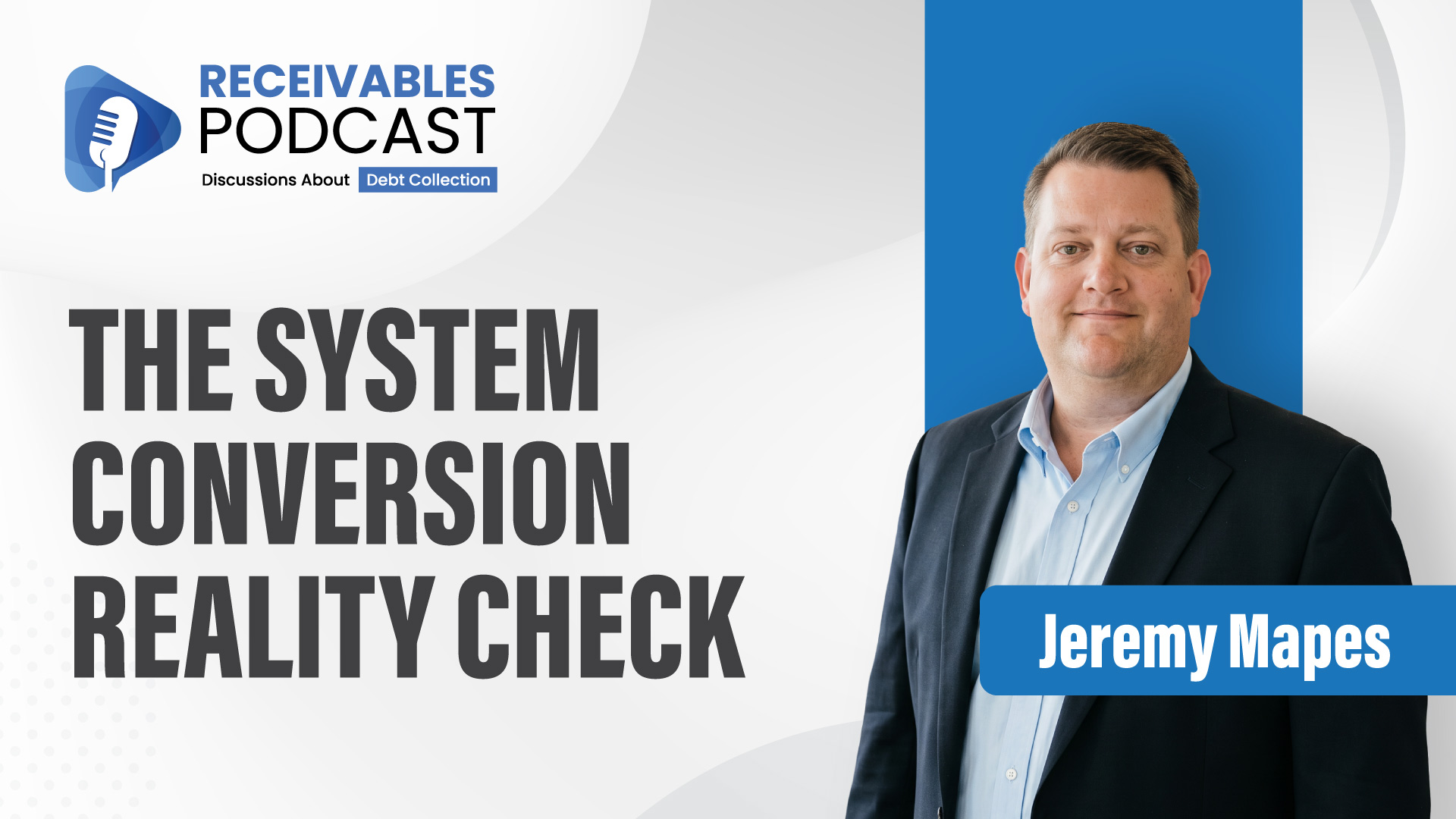
Hello everybody, Adam Parks here with another episode of the Receivables Podcast. Today I’m here with a longtime friend and someone that you’ve probably come across if you’ve ever converted systems, Mr. Jeremy Mapes. How are you doing today, Jeremy? Really appreciate you coming on, sharing your insights.
Jeremy Mapes (00:25)
Doing well. Appreciate being here, Adam. Another fun day in Florida.
Adam Parks (00:32)
Fair. Sometimes I forget that you’re really not that far away from me. It is a beautiful day here in Florida. Exactly.
Jeremy Mapes (00:36)
Just up the road.
Adam Parks (00:38)
Jeremy, for anybody who has not been as lucky as me to get to know you through the years, could you tell everyone a little about yourself and how you got to the seat that you’re in today?
Jeremy Mapes (00:48)
Sure. to try to give them the short long story or the long short story. You know, I started in the collection industry back in nineteen ninety four, April of nineteen ninety four, while I was going to college and I was looking for a job and after applying at a warehouse job I ended up over at this little collection agency in Wichita, Kansas and and actually got interviewed on the spot which I didn’t expect.
I wasn’t even dressed for it, but they said
They said, come on back and on Friday and we’ll pay you for a day to see if you could do collections. And lo and behold, I could. And so I did that while I was going to college for you know, for several years and and during that time I went from being a collector to operations manager to vice president of operations in Wichita. and the company was a healthcare collection agency and it changed over to being locally owned. The hospital that owned it sold it and then a local group bought it.
And that’s when I ended up becoming vice president of operations. And so I decided, like a lot of us do, to do this kind of tour, more than one agency, get the experience, and learn more places. And I I actually made a six month stop in Wyoming at an agency that needed to save themselves with a large actual credit card company that they’re working for and then moved on to Alliance Collections in Wisconsin, worked there for several years, as their
That’s when I kind of switched over from the operations world to IT, which was actually what I was going to college for, and ended up becoming vice president of IT for them. In about two thousand five, after I think my wife threatened me with being tired of being up to Wisconsin, said pick a place, pick, you know, pick California, pick Hawaii, pick Florida, preferably not California, ’cause I’m a little busy there.
We ended up here in Florida working for I worked for Aquin Financial Corp for their Aquin recoveries division. And actually they changed my position from a VP of IT over to senior manager of technology business, which is a long form of saying you work for the business group, but you run the IT side, which is based out of India. It’s a great opportunity to learn about international operations.
Worked there for a couple of years and then at the behest of some of the receivable CRM companies out there said, you give a lot of advice to people. Why don’t you go into consulting? And so at their suggestion, and at the time I was gonna end up with Aquin, if I stayed with them, probably end up in Georgia.
We liked Pierre Central Florida, so I went into business for myself back in two thousand seven, full time. And I’ve been working with collection agencies, creditors, hospital systems, attorneys’ firms ever since. And we started in the arena mostly doing professional services working for people, some custom jobs. had a lot of recurring clients. I still have one customer that’s been with me since the beginning, all the way back in two thousand seven.
We also did a lot of things I picked up from Aquin, which happened to be information security auditing, a lot of data transformation, no matter what it was, what I was always working with. So that lately has rolled into everything, you know, information security is probably the least of what I do.
Most of my time is working with agencies and operations, although I’ve got attorneys firms and a healthcare corporation as well. And it seems like more and more over the last couple of years it’s been conversions. Everybody’s always looking for somebody that knows different systems and how to convert from one to the other. And I’ve worked with a lot of the big softwares out there and some of the small softwares.
And then sometimes I end up with just last month we’re doing a software that was built before tandy computer systems in the early eighties was. And about a hundred fifty user agency got bought swallowed up by another agency and they were saving a lot of money using an old system, you know, that was a database that actually ran on tandy computers in the early nineteen eighties and and you know, that saves you some money when you don’t have to pay a bill to one of the big CRM companies. But of course it also ties your hands. But so I had to go out and figure out how to take the data out because
Whoever was managing it was long gone and they got moved over to a new system. But that’s where I get a lot of calls. I get a lot of calls for people that are looking to move systems, are moving systems, have actually acquired the company and they need somebody to just pull the data over, which is what I was working on five minutes ago. and so it’s you know, it’s a lot of fun, a lot of work, a lot of sleepless nights because everybody wants data tomorrow.
And a lot of times when I work with companies from A to Z, when we actually take it from conversion from the point of looking at software and bring it all the way across, then that’s where the real work is as opposed to an acquisition because there’s there’s so much more to just pushing data from point A to point B.
But that’s you know, but that’s part of the fun. And so we’ve done it from all directions.
Adam Parks (05:22)
Well, and it’s the headache that I think most organizations are trying to avoid, although I’ve heard more activity and organizations moving the system of record in the last, let’s call it two years than probably the 10 years prior to that.
Part of that, I’m sure, is being driven by the desire to leverage artificial intelligence tools. I’m sure it’s also got something to do with the application stack and being able to build orchestration layers that actually bring these omni channels, communication platforms together, but you’ve literally built a business on doing the things that other people don’t want to do or, you know, solving the headaches. It’s kind of a weird situation because it’s more of a one time thing. An organization probably needs ongoing management and data services, but like the big lift is in a one time scenario. What does that look like for a client relationship if you’re coming in for that isolated purpose?
Jeremy Mapes (06:19)
You know, it’s an interesting thing, as you mentioned, because you think, wow, it’s that you know, it’s it the business, how do you determine how you’re gonna be in business next year because you’re on all these events where you’re moving data and you you may not see these people again. But there’s actually a lot of places and pieces involved with it that it’s become a continuous event. and Adam, to your point, it’s what nobody wants to do. It’s what everybody hates.
And I think somebody said some wise man said to me a long time ago, who’s in the industry, said to me, you know, Jeremy, their particular business was a collection agency that actually collected in disparate areas and they would actually go pick up the business from their their local clients that were in bad parts of town back up in the northeast.
And they said, you know, Mapes, we just find that if you can find business that nobody else wants to do, you’re never gonna be out of business. And I guess that’s true.
Nobody likes to do conversions. Nobody likes the data process. It’s a scary thing. You know, we always say change is scary. Changing your business is probably the scariest thing. It’s taking your income and rolling the dice and hoping when you get to the other side that you’re gonna have a better business, but by the time you get done with conversions half the time that you still have a business sometimes and that you won’t have to move again after you do.
So, you know, we actually have relationships where we have clients that are ongoing afterwards. I’ve got, you know, several people to work for me. Some of them after they’ve migrated over, they still need reporting experts, SQL experts, people to do, you know, different processes. Some of them, like the big acquisition groups, they’ve got one after the next. When we finished a conversion project last month, they said, Mapes, we’ve got another one if you’ll take it on and you know that’s this month.
And since it’s an acquisition, they would like it done in thirty days. So as the first first of this coming month, you know, we’re gonna yank all the data out. I’ve got a good person on the other side for this project, Kenny Gol Goldman. He does a lot of latitude processing.
And so, you know, I’m the pusher, he’s the receiver and and and then we get the data across for the companies and and score a win and the next thing you know, they’re either acquiring another company or somebody’s calling or they’ve mentioned it and we’ve got the next one coming in. So it’s been really good that way. But yeah, we continue to work with a lot of people on reporting and data and analytics. So it’s been great.
Adam Parks (08:38)
I would think that ongoing service, like you’re developing this level of knowledge and expertise about their business and their data structure and how things are ultimately being done there. Because it’s not just about moving the data. There’s testing. There’s so many layers to going through this process. But once they’ve brought you in and you’ve gained that organizational knowledge, ending that relationship would be throwing that away because now you’re the guy who holds the keys to all the things.
Right. So I’m that’s what I’m trying to understand is in that relationship, how do your most successful clients work with you in the long term to be able to leverage that expertise?
Jeremy Mapes (09:19)
Well, and a lot of the clients that we get that the ones that do really well is they they took this endeavor, and some of them at least, you know, some of them it’s because they acquired a company, but several of them have taken the endeavor in the fact that they are looking to either better themselves or they’re getting off an alien system where they’ve realized they’ve got issues to begin with. But then I feel like it was Star Trek three or four where, you know, Spock’s brother says, I feel your pain, let me help you type of thing. Because w when we get into the process, there is so many areas that
People learn about themselves, companies learn about themselves because it uncovers so many things. Because you always hear and you hear this even before you do conversions. Yeah, there’s nowhere to hide
Adam Parks (09:54)
Yeah, like the Emperor has no clothes at that point. Like it is all out in the open.
Jeremy Mapes (10:01)
So they learn a lot about themselves in the process. What they know, what they suspect in a lot of cases. sometimes as far as activity of of the employees and their staffing,
it’s funny in some co in some software it it was hilarious. I don’t want to pick any particular software, just one particular you know, when they don’t want to work those accounts anymore, when they go, when they go dead or silent, the tickler doesn’t update it. It goes off the tickler system. And I’m like that it’s so crazy that the tickler system you just know, you just basically delete off the tickler and it doesn’t exist until something else pushes it. But we’re in
Adam Parks (10:34)
Yeah, until there’s another action, right? Like until something else is there to drive the next action.
Jeremy Mapes (10:39)
Yeah, so it ends up off there or they call it the whip list, ends up off their whip list. But you know, and I and I would expect more kind of driving processes around that where if you have active inventory, you’re gonna work an account so far. And some agencies suffer from the opposite, right?
You’ve got agencies out there that they don’t know any better, all they know is to do work. And actually when they improve themselves, they all all of a sudden realize that they’re running out of inventory and it scares them.
It’s like we don’t have any inventory to work with. What do we do? I said, Well, you have two choices. You bring in more business or or you can actually it’s it’s almost like they’re scared of what they were trying to do to begin with. Or you can reduce your number of employees, you know, you have two choices. I said, You don’t have to be the bad guy to reduce it. Get more business. bring more business in. and so it’s actually a good thing, but it scares the heck out of the first time they see that.
Where there’s a day, where we ran out of our whip list, we ran out of our work queue.
That’s not necessarily a bad thing. Did everything work? Did you know, did everything that was supposed to be done? Did you collect more money?
Adam Parks (11:34)
Did everything work and did you collect more money? Did the end result that you were looking for was it achieved? And now the issue is that you don’t have enough inventory because that’s a capacity issue that can be solved, right? Like you put your sales team to work.
Jeremy Mapes (11:46)
Yeah, one of my one of my earliest clients was like that where they back in two thousand seven, they when they came to me and I looked at their shop, the first thing I said to them is, I’m gonna guarantee you can take on three times the amount of business you got now without adding one more agent, or and this is back in old two thousand seven, or you can determine to reduce your staff and you’ll make just as much money.
And they’re in business today, they’re making way more money than they did and the management’s changed a couple of times.
over the years because they’ve sold and resold. They’ve got a really smart solution where the ownership, you know, plans like five, ten years, they pay off the company with what they invested and then they make their retirement fund and then they pass it on to the next generation. Really cool. And when I say next generation, I’m not talking about their kids. I’m talking about the management that they’re training behind
So you always have your people you’re training behind them and they’re gonna buy that group out and then that comes the next group and they’re gonna do the same thing. In ten years they’re gonna retire after they make the company successful and bring the next group out. I thought that that was amazing.
Adam Parks (12:43)
That’s a great model.
Jeremy Mapes (12:44)
It’s a great model. But yeah keep and it keeps them on top. But they haven’t you know they really haven’t added more people but they’re doing three times the business today. Three or four, three or four, five times the business. And they’re very happy. Because i I don’t know how many agencies you visit, Adam, but some of them you visit and th it seems like a sweatshop or they seem like they’re not happy or you get a lot of people out the smoking bin, which is not necessarily
You know, because of that, but that happens to be. and then like this company, they’re very happy. They think these people are, you know, they can joke. They’re not stressed. And I’ll tell people something else. One of the agencies I work with that do acquisitions all the time, those people are not upset. They’re not stressed. They’re not, you know, you see a difference. And I have to say that to a lot of agencies out there. If you feel like you’re just barely making the bar, if you’re, you know, just keeping your wheels on the road.
Then you’re doing something wrong. Something’s very wrong because you shouldn’t be that stressed. Because there are agencies out there where they can joke, acquire other companies, keep on moving, and it’s all good. You know, they’re not riding the tightrope. So they’ve got something working right better than the rest.
Adam Parks (13:49)
Well, out of curiosity, since you’ve had an opportunity to touch so many different conversions over time, what’s the shortest conversion time frame that you’ve ever seen actually work? And how optimal was the scenario going into it?
Jeremy Mapes (14:05)
Well, I’m gonna cheat. I’m gonna cheat with the shortest timer. I’m gonna cheat with one that was an acquisition. They converted in thirty days. And it worked.
Adam Parks (14:12)
Yeah, all right, let’s not share that with me. I feel like the audience should not set that as any kind of an expectation of reality.
Jeremy Mapes (14:18)
No, no. That’s a cheat. That’s a cheat code because they’re absorbing an agency and they’re not worried about the workflow and the software. It’s gonna be embedded into what they’re doing currently. So that’s a cheat code. No, the average yeah.
Adam Parks (14:32)
Yeah. Okay. So that’s straight up moving accounts. But for an organization that’s going through, you know, moving from one platform to another and continuing to operate. What’s real, like what’s a short time period that you’ve seen? What’s an average? What’s long?
Jeremy Mapes (14:51)
The shortest time period I’ve seen for com is actually literally converting yourself over to another platform three months. And I don’t think that was done the best. A lot of times it averages probably six months. And then you have complex agencies, that can be a year or more, just because you’re taking into account everything that you’ve got to untangle from what’s really worth it. We just got through with one agency that they had over twelve hundred letters that they were managing for their company.
And I’m not gonna call out by their size, but let’s just say they’re a bit over a hundred people, right? So you’re about a hundred and twenty user groups, you’ve got twelve hundred letters on file. What the heck is going on? Yes, they do do litigation. Yes, they do do litigation, but you still don’t need twelve hundred you know, twelve hundred letters. I think by the time we get done with them, I think they’re gonna probably be down to under a hundred letters. You know, it’s what’s built up over time and it’s just you’re carrying so much baggage.
Adam Parks (15:45)
That’s the residual that starts to build up. And I think that’s where a lot of systems of record conversions get stuck is what actually needs to come over. What do we need to bring over and where do we need to fix? So if we’re just talking about a truly healthy organization moving from point A to point B, I think that’s a different kind of conversion.
But I think where it gets conflated is that a lot of organizations that are going into the data conversion process are really going through a transformation process.
It’s not a data migration project. It is an organizational transformation project that is the core of your business. So as you’re changing systems of records, you’re looking at how to orchestrate differently, how to run different models and workflows and setting these expectations. And it feels like those two things might get confused in the conversation as to what is actually moving data and what is a fundamental change to ourselves.
Jeremy Mapes (16:44)
Right. Well and let me tell you the worst type of organizations I see or the worst outcomes. The worst outcome I see is an organization committing to change over to software. They lay down the money, there’s your commitment. And then they expect the software company to do all the movement so we’re gonna have A B C software company, they’re gonna take on changing our converting our data, setting up the new things, setting up workflows, you’re gonna make us better. And that’s the problem. You’re gonna make us better.
And so they just ride along and they have a meeting once a week and then the software company will ask them something or the conversion company because somewhere in between people like us will get involved.
We may take on the responsibility of just getting the data out of the main system, getting it over to the other system. There’s times where we actually train the agency along the way, they probably have the best outcome where we’re helping train them in the process and what to expect when they get to their side because the CRMs are good companies.
But they don’t necessarily never actually collect. They’re good software companies. And so they know their tools, but they don’t know how you’re gonna use them. They don’t know how your secret sauce is gonna work on the other side, if it’s gonna work on the other side, or what tools you may be losing in the process, because everybody thinks about the new cool thing they got, but what they may lose.
And so they need to be very involved in that when they move over. But on top of that, they need to be considering how they’re actively pursuing it too.
Because I saw one conversion, like I said, the worst ones the software company convinced them that they needed help and they were gonna convert it over. And then months went by. It was six months so the timeline wasn’t wrong. But at six months their staff thought that they would probably get out of going to the converting over. They thought it was a you know not a joke but they thought this isn’t going to happen. The problem is they had looked to convert before and then they pulled out at the last second. So they get down to the last month. The data’s gonna be getting shipped.
The owner understands that too because their software is gonna get turned off at the end of the month. So they’re not gonna have a backup plan if they Yes. You wouldn’t believe that’s how a lot of agencies also set up their structure of how we’re gonna move. Our deadline is August twenty seven. Why?
‘Cause that’s when our licensing comes up and we’re shutting off at that time. We have to shut off at that time. That’s never a good way to work backwards from. Never a good way. So so but it would happen more of it no, yeah.
Adam Parks (18:47)
Ooh, they cut it close. So they’re not, they’re not even running concurrent systems for wow. No, that sounds like a nightmare. I mean, you’re giving yourself no flexibility. You’re giving yourself no I like you’re you’re you’re cutting yourself out at the knees.
Jeremy Mapes (19:18)
It happens more often than you’d think, though. And so that like the worst one some of the worst ones I was telling you about, they get to they get a week out from converting, and it’s like
They’re gonna have to go, go, go. And then their staff comes back to the owner and says, Well, we haven’t, you know, they were sitting in training classes. So they got the training classes, but they weren’t paying attention. And I sat in on some of the classes and I kind of warned the owner, I said, Look out. It sounds like they’re having a really good time. I don’t think they’re paying attention to what they’re being trained on with the new software. So sure enough, day one gets there, the data gets converted over, and they’re sitting there going, We don’t know what to do.
We don’t even know how to get on into the accounts. And the software company had sent on site a team of people to work with them. But still you’ve got eighty seven people there working two different lines of business. Two thirds of their company was healthcare. Another third was commercial collections, which run totally different than medical collections runs. And nobody ever even talked about how they were gonna handle the medical or the commercial collections, which those agents operated in a completely different way.
They would always train for manual labor. They would just run a list of accounts off and work manually where the medical collections will work off a dialing campaign. So I mean, it was a crash that I had wanted to close my eyes, but I was up front for the whole show. And I always promised myself if I could help it I’d never let anybody go through that again. If I could help it, you know. Warning signs, please stop. Yeah.
Adam Parks (20:43)
Well, that’s the challenge as a consultant is that all we can do is provide advice and too often we’re paid for advice that’s not listened to. you know, and it just kind of is what it is. It’s one of those challenges that I think every consultant ultimately faces is that you’re not the decision maker.
What you have here is an opportunity to try and help and do the best you can for that. Now, what are some of the areas or what are some of the steps that an organization should be taking before they’re going into this process to better understand what the project really looks like. What are some of those scoping exercises that you’re doing to help people really understand the breadth of the project they’re taking on?
Jeremy Mapes (21:28)
In the beginning, they really need to start with a SWOT analysis. They, you know, strengths, weaknesses, opportunities. You know, they need to understand the good parts and the bad parts of what they have today. And a lot of them look at the bad parts. We know we want to get into AI. We know we or or they want to look at the good parts that they think they’re going to gain. We want to be able to move accounts better. We want to give up this manual process. And that’s wonderful. But get the full list and get the full list of the strengths too.
Because some of them may not have much of a list, but l most of they’re in business today because their system works to some level. It may not be perfect, but it works. And so when they need to understand what the superior strengths of their company is too and the software they’re using. Because if you just look at what you think you’re gonna gain and you don’t look at what you’ve already got, you may end up with the list that you wanted.
But you may lose something on the list that you thought you had. They just assumed they were gonna gain this. They didn’t know that they were gonna lose connectivity. A good example is back in the days of you know, all the green screen terminals and everything. Yeah, it’s ugly.
And you know, you w it was pretty when you went to a GUI type of process, GUI graphical user interface type where you can move your mouse and do this and that. But you give up some things too. Studies have always shown that once you take a mouse, you’re gonna slow down. You lose so many seconds per account based on that process.
Jeremy Mapes (22:47)
But even more so, can you blow data in like you used to? And what I mean by that is a lot of us would, you know, on the programmer side would I guess call it cheating, but we could set up a terminal session where we could have it pretend to be a person. If we needed to update a thousand client masters all at once, we could have it do a terminal session where it would do a macro where it would just continually revolve and push that in.
Well in a graphical user interface until recently, that’s a little hard to do. You can’t just set up a terminal instance that does that because it’s a graphical user interface and it doesn’t have pinpoints or x you know, x y coordinates of where to put the data. Now with automation, with AI, that’s a little more possible, but it’s still not as quick as being able to push that in.
Adam Parks (23:30)
Yeah.
Jeremy Mapes (23:30)
And kind of where I’m getting with that is that the big problem is you need to know how you’re gonna get that data now.
Does your new system have an ability to import data at the client level? Does your b system have an ability to get to all the fields that you have in your system? SQL becomes much more important or some type of import export becomes much more important. People don’t think about that. So they could be at a disadvantage now because now they can’t mass push data in and out like they used to.
I’ve seen some of the new systems out there that say they’ve got everything and they look gorgeous but or do they really have everything working or do and and and also another one is do you expect to do everything yourself or do you expect the CRM to do everything for you? So you’ve got two dynamically different collection agencies at the big and small end. A lot of your large agencies have developers on staff who want to be able to customize the system. A lot these new systems that are hybrid systems out there or or even cloud systems
They don’t have as much functionality to be able to you know, customize them as opposed to the older systems where if they needed to create a new application to do, let’s say charity care, if you’re doing medical, they could over the weekend, I remember over the weekend, writing a charity care app that actually connected all all the hospital systems. And there was one big hospital system with twelve hospitals and they could go to any of those hospitals and get a s what’s called a spin down, which is how much available charity they have left between those twelve hospital systems.
Well that’s a great giveaway for us for me to create over a weekend and give it to our clients. But in the new systems, the ability to do that may not even be possible by any means. You may have to go create a different system to do that. So how flexible are you with your clients and what you do? Do you have the rate tables to be able to do some of the different fancy rates that come up?
You know, that we’re gonna charge you zero percent for the first twenty days and then you’re gonna go to you know, ten percent on a contingent fee. Some of them, you know, have just stock rates. All it knows is ten percent. You’re gonna have to do mass changes. So you need to work all those little details out as far as the flexibility in the system of what you can do with the accounts, with what you can do with the clients, things like Suit auths How do those get presented day today to your clients? There may be a great opportunity if you’re manually sending them over, signing and getting it back.
Or can you have a portal that connects to your client so that they can just go through the list and just you know, do an electronic suit auth and then that automatically generates in a work queue in the system to tee it up to go to the legal process in the agency. Those things make a big difference when you talk about the flexibility of a company and how they work with their clients.
Adam Parks (26:06)
Well, it sounds like that underlying technology piece is going to be the conduit that’s pushing the data back and forth. So how are we working with those clients? What level of flexibility are we gonna have to work with them and what are they going to know, what’s going to be acceptable for them? Because I think that’s the first piece. The second piece is dealing with those individual collectors and the interface, whether it be
Keyboard driven, mouse driven, right? W whatever it is, the collector’s ability to understand those things. And I think where we’re, what we’re going to see in the future is more of trying to provide better information to those agents, creating that super agent, right?
Empowering those live agents versus replacing them with artificial intelligence. And although I think some of the technology tools are gonna support our ability to service more accounts at a more reasonable cost structure, our ability to feed the information to those collectors, I think is going to be the key.
If you had one piece of advice or or one let’s say prediction for what’s going to come of system conversions over the next five years as artificial intelligence quality improves, what do you think starts to happen? Do you think it can ever untangle the web, or does it still require someone to drive the symphony?
Jeremy Mapes (27:29)
I think somebody still has to drive the symphony. The untangling of the web’s probably the good part about the conversion is sometimes you clean out your house, especially if you’re I’ve had agencies where I was pulling data off and they still had c had listings from nineteen seventy eight. I had one that had accounts that were before I was born. Yeah. For all that.
Adam Parks (27:43)
And they’re and they’re paying additional for cybersecurity coverage because that still exists. Yeah.
Jeremy Mapes (27:49)
Immutable data, next thing they know they’re they’ve got a ten thousand dollar a month bill just for their immutable data on their backups. So,
Jeremy Mapes (27:55)
you know the things that are gonna change is yes, there’s gonna be automation anywhere and I think our actually our industry’s been we always say we were bad about it. We’re actually a lot of people who try to be good about being able to automate as much as possible. Where our industry’s always been held back is by litigation.
You know, a lot of things that a lot of the other industries could do. I know attorneys out there ’cause I’ve you know I’ve been an expert witness in court cases over data. and I’ve had attorneys say to me on the other side say
Hey Jeremy, we’re gonna make sure that there’s no way we’re gonna ever let them go back to having full reign on their dialers, like the good old days where they could, you know, save a lot of time and money by having electronics, you know. So I know there’s a competing force trying to hold our industry back from automation. And they do that for their benefit because I mean really what they care about it’s not so much holding back, but so much is how much money they can make off a lawsuit because somebody, you know, made a manual error.
You know, they’re gonna look for the opportunities to be able to collect their, you know, their money, collect their turnip blood.
Adam Parks (28:57)
There’s a whole business around consumer litigation and leveraging consumers to attack collection agencies. That’s a different topic for a different podcast. But Jeremy, I really do appreciate you coming on and sharing all your insights and war stories with us today. System conversions are clearly one of those challenges that organizations need to prepare for well in advance and need to set some reasonable expectations for what is to come next in the process. And I think go ahead.
Jeremy Mapes (29:29)
I mean the big thing’s gonna be AI, how we use AI and so forth, you know, it’s coming. I mean if you’re not using AI, you’re gonna be using it one way or another. So I mean if I’m gonna leave any thoughts to it is even though we do get held back in our industry, we still have to proceed ahead. And so we have to change and develop with the tools we have available and everything is able to be bundled in now. There’s opportunities to save money where we had to spend money before with other companies.
And what I’m talking about is outsourcing transcription in your system, outsourcing voice recording. Those can be all brought in house. So there is the ability to save money in our industry too.
Adam Parks (30:08)
I don’t disagree. I think there’s a lot of interconnectivity between the systems. And I I think some of the things that we’ve done, I think there’s a lot of opportunities to handle things that people don’t want to do anymore. Right? They didn’t want to manage servers in-house, now we’re in the cloud. I think that is gonna continue to be the wave of the future as we try to outlay those things that are not part of our core business, what we truly understand and what drives our revenue.
But Jeremy, thank you so much for joining me today. I really do appreciate your insights. For those of you that are watching, if you have additional questions you’d like to ask Jeremy or myself, you can leave those in the comments on LinkedIn and YouTube. We’ll be responding to those. Or if you have additional topics you’d like to see us discuss, you can leave those in the comments below as well. And I bet I can get Jeremy back here at least one more time to help me continue to create great content for a great industry. But until next time, Jeremy, thank you so much. I really appreciate you.
Jeremy Mapes (30:58)
It’s been a pleasure. Thank you, Adam.
Adam Parks (31:00)
And thank you everybody for watching. We appreciate your time and attention. We’ll see y’all again soon. Bye everyone.