Adam Parks (02:32)
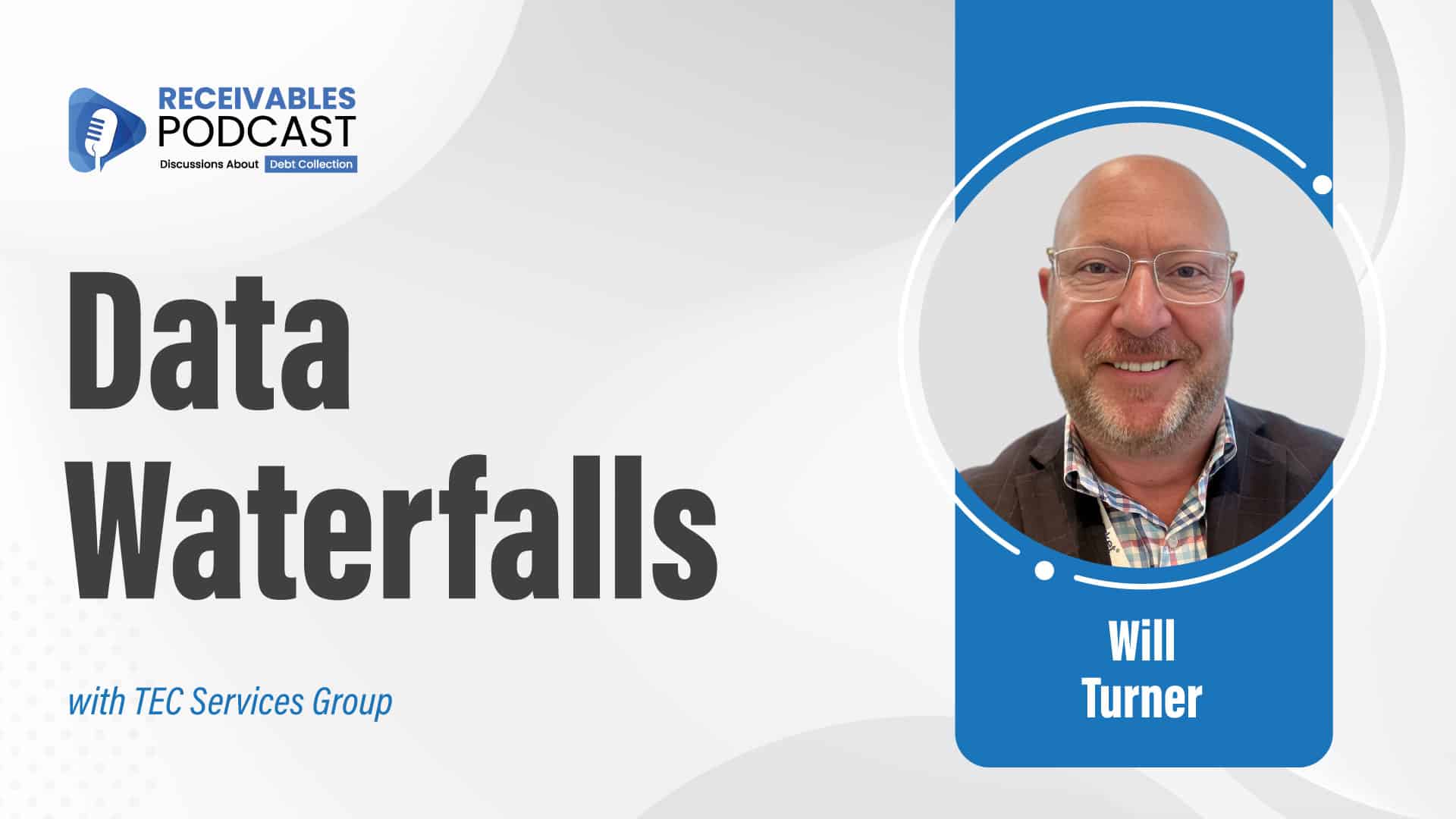
Hello everybody, Adam Parks here with another episode of Receivables Podcast. Today I’m here with a returning guest, my good friend, Mr. Will Turner, joining me from TEC Services. Very excited to have him here today because, just like me, he is a deep data nerd. He loves to look at the information behind the decisions being made and try to understand why or how decisions can improve operationally. That’s what makes today’s discussion very exciting.
Last time we talked, we covered data waterfalls, building your waterfall and testing your waterfall. And today I want to take this conversation a little bit further. And I want to talk about the real cost of bad data in your organization. But before we get to that, Will, thank you so much for joining me today. I really do appreciate your time and attention and coming on here, sharing your insights.
Will Turner (03:25)
Hey, thanks, Adam. Thanks for having me back. Just a quick introduction. My name’s Will Turner. I’m a senior data consultant. I’ve spent roughly 30 years working for large data companies, consulting for data companies around the topic of consumer data, helping clients solve business problems with data and analytics, and now AI.
Adam Parks (03:43)
Well, and you’ve done a great job at that, with a lot of different organizations. And I think your consulting experience is one of those things that really gets me excited about these types of conversations, because the depth of experience and understanding across different situations, scenarios, and circumstances really does change through a consultant’s lens, since you get access to so many different types of challenges.
So, Will, as we kind of kick off this conversation today, when you think about the cost of bad. Debt for a debt collection operation. What’s that first thing that comes to mind? How do you frame that in your own mind?
Will Turner (04:17)
Yeah, great question, Adam. So when I think about the cost of bad data in debt collections, the first thing that comes to mind is performance. You know, whether you’re a lender, a debt buyer, or a servicer, you’re trying to recover money, of course. And you know, bad data across that whole delinquent account lifecycle is a barrier to collecting money.
And so, you know, from a performance standpoint, if you’re a servicer, that’s revenue and profitability, if you’re a lender, your losses are more significant. Yeah, the percent that comes to mind is performance.
Adam Parks (04:51)
Those performance issues are so you have this cost of not being able to optimize that performance. So you’re going to have a lag to your competition from a timing perspective. You may not hit the same numbers overall. But when we think about bad data, what is some of the data that is going stale the fastest? And where should people be looking within their data workflows to say this might be the first place that I should look to identify?
Will Turner (05:18)
Yeah, so as far as I think of things like addresses, about thirty-seven million people move every year. A small percentage of those are posted with the United States Postal Service as a move on file.
I think there’s a large volume of reassigned numbers that prevents, you know, risk and performance issues. I think about email addresses. Not necessarily that email addresses go bad, but they go unused, and typically consumers have multiple email addresses. So, you know, having the right email address that the consumer is actually using.
Those are things that come to mind in the legal collections market, of course, you know, place of employment; people switch jobs. Yeah, so the topic of bad data is pretty broad, but as it relates to contact information, those are some of the data elements I think about.
Adam Parks (06:04)
Well, let’s think about it from the perspective of different disciplines of debt. So from a collection agency standpoint, it sounds like the highest cost of bad data would be directly related to that contact information, the phone numbers, the emails, potentially addresses, whatever you’re gonna need for that output.
And it’s not just the cost of not finding that person; it’s not just the opportunity cost, but also there’s gotta be some other risks that are coming along with sending the wrong communication or communicating with the wrong people.
Will Turner (06:35)
Yeah, absolutely. And the one that comes to mind immediately is, you know, FTCPA third-party disclosure. You can’t communicate about a debt to the wrong consumer. And so if your contact information is wrong or your phone number’s been reassigned to another consumer and you’re communicating about a debt, you know, that’s inviting risk, you know, regulatory risk, financial risks, litigation risk, reputation risk. Yeah, so beyond the performance side of it, bad data can lead to other consequences.
Adam Parks (07:07)
And the cost of being wrong at scale is that we’ve started to apply artificial intelligence because now we’re getting to a point where we can send more customized messages, right? We can do things at a larger volume and scale, but that scale also brings additional risk.
Because if you’re going to be wrong, if you’re going to communicate to the wrong phone number, if you’re going to send out emails to the wrong addresses, you’re not just going to be wrong one or two accounts. You’re going to be wrong at scale.
How do you kind of look at that risk tolerance and how does that go into the decision-making process when a collection agency is looking at how they might want to address the bad debt in their organization?
Will Turner (07:47)
Yeah, I totally agree, Adam. As far as when we think about using AI, especially virtual agents, or we think about, digital collections, digital communications, comparing it to the voice channel and live agents, you’re right, bad data amplifies this problem at scale because you’re typically throwing up a higher volume of activity, especially when it comes to outbound communications.
And so from a consulting standpoint, when companies are migrating away from the voice channel or augmenting their voice strategies with AI virtual agents or digital communications, you know, part of it is helping the customer understand those risks, evaluating their portfolio and the accuracy of their information to identify those risks, and then coming up with a risk mitigation plan so that they step into those new channels carefully.
Adam Parks (08:38)
Now, if we think about the same problem from the perspective of a law firm or a debt buyer who’s purchasing accounts for litigation, the cost or the potential cost here seems to amplify even more. Because if I’m a debt buyer or a law firm who’s using that data to make an operational decision about which accounts belong in which operational channel, that could be a massive cost if I were to move the wrong accounts into the litigation channel.
All those court costs, all those expenses, process service, right? It’s a very expensive channel to operate in. So it seems like there’s even more risk there, but potentially even more opportunity if you get your data waterfalls working correctly and you are actively moving the right data over your accounts.
Will Turner (09:29)
I agree, Adam. And that’s something I think a lot of people overlook is that, you know, even on brand new accounts, forget contacting the consumer. When we think about, you know, scoring the account and segmenting the portfolio, the quality of the data. A good example would be, you know, having the correct name and address- as simple as that- impacts a third-party vendor’s ability to score that account correctly.
Which leads to a lot of decisions from the very beginning, right? In terms of segmentation and which flow this is, which collection path this account is gonna go down.
Adam Parks (10:07)
Which is interesting. We’re finding ourselves in the situation where we’re getting this increase in accounts. And I believe it was from the TransUnion report in 2025. We said that 73% of firms were expecting account volumes to increase in 2026, up from 52% the year before.
At the same time, we’re seeing a stagnation or decline in liquidation of those same accounts, meaning we’re having to do more with less and being able to leverage data to make the impact of each action more powerful from a collections perspective seems to be the wave of the future, or at least the end goal for a lot of organizations right now.
And as a consultant who’s helping to build these waterfalls, what kind of actions are you taking to help organizations down that path of exploration and understanding of how to unlock more value from that data?
Will Turner (11:02)
Yeah, so Adam, this is the most fun part of my job.
Adam Parks (11:07)
I see you get excited. That’s why I asked.
Will Turner (11:11)
Like it is using data, helping companies use data in a more optimized fashion to make a measurable and meaningful performance impact, is kind of at the core of what I do as a consultant.
The steps that we go through to make that happen, I guess, you know, it starts with a conversation about what’s important to the customer in terms of desired performance outcomes. And that might be very different by client or portfolio, or, in the case of the lender, by line of business. And that’s where the conversation usually starts.
And then, based on that, we start analyzing, whether their data processes and strategies, the quality of their information, are aligned with those goals. And you know typically there’s an opportunity to improve whatever they’re doing today to further optimize that desired performance outcome.
And that becomes the measurement. And then we build a strategy, a data strategy around that, typically using their internal data as well as third-party data providers. And then we run an A-B test, and we kind of look at what they’re doing today, and that’s the champion strategy. And then we come up with challenger strategies that are designed to outperform that champion strategy.
You know, and typically, regardless of kind of how mature a customer is in their data strategy, you know, typically when we’re running an A-B test, we’re looking for a meaningful lift. We’re looking to generate a meaningful lift. By meaningful, I mean, you know, 20% or higher, you know, sort of increase in performance.
And again, regardless of how good or bad somebody is today or how mature they are, with their data strategies, there’s always room, almost always room to further optimize it.
Adam Parks (12:51)
There’s always room to further optimize it. Whether or not you can further optimize to 20% each and every time, I think it’s a big goal, but it’s definitely a doable thing because the impact that data can have ripples.
And when you figure out that process, and you’ve got it right, it’s like finding the right recipe. You’re gonna make the best pasta here. And when you know which ingredients have to go in at which measurements and in which order, it changes the way that dish is gonna turn out.
And I think if you can continue to tweak and understand that, what kind of testing programs do you build for that to clean out the bad data and append with more powerful, accurate information and data?
Will Turner (13:33)
Yeah, so it kind of depends on the data type. You know, we’re doing a lot right now with debt buyers and law firms around, you know, address waterfalls, address hygiene, appending good addresses, just ensuring that they have a good address to reduce retard bail and increase process serving rates.
And so, you know, for that we look at, how well a company is cleansing and validating their addresses, how accurate the information is, and what their append strategy looks like, if they have one.
Typically, we introduce some sort of address scoring component, very similar, you know, for phones. I guess the methodology is pretty similar overall to how we evaluate how well somebody’s current strategy is for whatever problem they’re trying to solve.
And then the methodology we use for testing kind of depends a little bit about, some of it is how well they can maintain control, of the test. I mean, we do all the testing methods and our methodologies are pretty broad, Adam. So you know, we do everything from, sending the same accounts to multiple third-party data providers; everybody, all the data providers get the same accounts.
We do a lot of champion-challenger production testing where we’ll take a portion of a client’s inventory and we’ll always have them running through sort of challenger strategies, multiple data providers, you know, in a sequence. Sometimes we’re testing with, you know, the bad data, the information that the customer knows is wrong, and then we’ll demonstrate, using third-party data providers, the lift that we can provide with information that they know to be bad. We’ll take fresh portfolios, as well as aged portfolios.
One of the things that I find interesting is that when it comes to bad data, when we think about debt collections, the older that account gets, in some ways, the value of that bad data amplifies. And what I mean by that is, you take an account that went from a creditor to a first-party agency and it now becomes, you know, a tertiary or quad account.
The bucket of bad data increases as those accounts age, which is, you know, if that problem is resolved, it represents an opportunity for somebody to collect that money. So I find, the strategies that we deploy can sometimes depend on how bad the data problem is, and you know, the age of the account sometimes, you know, it often amplifies as the account ages.
Adam Parks (16:09)
Well, as that account is going through the aging process and you’ve got more of that data that’s decaying over time, I would think four, five, six, years down the road, the data’s not great, but the quality of the consumer is probably improved if it’s going to improve over that time block. So the opportunity to re-engage, I think, is very real, but the cost of not having good contact data there or not appending.
Let me ask you this. When you think about new data that’s coming over to, let’s say, a third-party agency. So they’re receiving the data from the creditor, how well is the understanding of that data quality managed and communicated in that early onboarding process, meaning if I’m an agency who’s getting accounts from a creditor, how well am I gonna truly understand what that account has been through previously? And how much of that do I have to learn through experimentation and testing versus communication?
Will Turner (17:11)
Yeah, so I think part of what you’re hitting on there, Adam, you know, what’s the communication needed between the servicer and the forwarder of that debt in terms of the history of that account? Yeah.
Adam Parks (17:25)
Especially in the early stages. Well, not necessarily even just the history of the account, but the history of the data associated with that account.
Will Turner (17:33)
Yeah. Yeah. So, obviously, that’s key for, you know, when you’re bidding on a portfolio, to understand that when you’re thinking about your contingency fees and how rates are set compared to how hard a portfolio is gonna be to work, and and how are you gonna likely perform, and what investments and data you’re gonna need to make in order to perform.
One of the things I often see when people get accounts, you know, typically a servicer and lenders too. They have some decent operational metrics to know, you know, things like right party contact rates and conversion rates and liquidation rates or recovery rates.
I think sometimes people get the sense that if your Right party contact rates and your conversion rates and your liquidation rates are what you expect them to be, that you don’t have a bad data problem. And what we try to expose is what your right party contact rates, your liquidation rates, or your rates could be if you further optimize the data.
And so I do think there’s a false sense of confidence oftentimes that, “hey, my data’s good,” “My data strategies are good.” And typically for somebody that’s satisfied with their current performance, I don’t know that we can, you know, help them, but people that are open-minded to saying, hey, we’re doing things really well today, we’re performing, we’re winning, you know, we’re top of a lot of scorecards, but we want to know what we could be, or we wanna stay ahead of the curve. We wanna maintain our forward position.
You know, there’s a lot of opportunity there. I think there’s a lot of, you know, sort of overconfidence.
Adam Parks (19:12)
I agree with that statement because you’re only as good as you think you are right now, and where you can go is never determined if you’re only operating on that same platform. So if you’re doing everything exactly the same way, yeah. Hey, you’re not gonna necessarily get worse results, and you might investigate if you got results worse than expected, or you might investigate if they were better, but just because it’s meeting your expectation doesn’t mean your expectation is correct.
Where and how has your expectation been level set at? Is it through a champion challenger? Is it through a scorecard? You know, how are you level-setting your expectations?
How do you suggest a client level set their expectations? I think it’s a good question for you, right? Like, you see all these different situations and scenarios. How do you help someone to understand what level setting really means from a performance perspective?
Will Turner (20:03)
So, as you were talking, Adam, I’m thinking some one of some of the characteristics over the years that I’ve noticed about top performers; there are two things that stand out for me. First, there’s a level of humility. They may be super good and super confident, but they still have some humility.
And second, there’s this mindset of ongoing improvement. And so one of the ways that we level set is to, you know, evaluate how somebody is performing today, and, can we get a lift? You know, is there room for improvement? And so I don’t, I don’t think, like, for me, when it comes to optimizing data strategies, it isn’t like you arrive at something that’s the best and then you walk away from it. It’s an ongoing thing that you evolve over time.
And so I again, I think characteristics of top performers, to me, are people who are not really satisfied; they’re humble enough to know that what they’re doing today could be better tomorrow. And there is this sort of mindset of ongoing performance improvement.
And so a lot of times we’ll walk in, you know, people haven’t touched their data strategies or haven’t really evaluated their data strategies in years, or they’ve had the same data strategy in place for years and typically that’s almost always that’s suboptimal.
You know, it’s something that we’re optimizing over time. And again, with top performers, we typically have a portion of their inventory always running in champion-challenger tests. So it’s not like something that you arrive at and walk away from.
Adam Parks (21:40)
Well, success is the first step in the journey of a thousand miles. And each success starts another, you know, new journey of a thousand miles that requires not only for you to get there, but for you to maintain along the way, which, you know, brings in more challenges.
Now, we’re living in a time right now where system conversions are happening at a pace that I don’t ever remember seeing before, at least not since like the early 2000s. And with all of this bad data getting locked in, and and all this bad data being collected. How do organizations start looking at that cleansing process at scale?
Are organizations only looking at new accounts coming in and trying to improve for the future? Are organizations trying to better understand what they could strip away from their current storage in order to reduce overhead, reduce cyber liability costs, other things. You know, how do you think organizations are looking at that ongoing data cleansing and management process?
Will Turner (22:41)
Yeah, so I’m not an expert in all of those particular areas. You know, as a company, we manage a lot of data conversions and help companies through that transition.
For me personally, the piece of it that is kind of most relevant for me and how I help clients is that, you know, during a data conversion, it’s a perfect opportunity to look at their data and optimize that data.
For one, it’s gonna make the data conversion to a new platform much smoother, and then all the technology and scoring products and the people and the processes that you add to that, the performance of that, it’s gonna it’s gonna run more smoothly; it’s gonna perform at a much higher level.
And so, certainly when it comes to data conversions, that’s a perfect time to look at this and evaluate your data. And then certainly from a cybersecurity standpoint, you know, there’s data, there’s probably data there that doesn’t need to be s stored indefinitely, which, you know creates risk, right?
Adam Parks (23:37)
Creates risk and opportunity to reduce that expenditure. But let me go back to kind of the last piece of my first question, which was more around, as you talk to an organization about building a solution for data cleansing into the future. Are they more focused on, let me clean up what’s coming in now? And from today forward, we’re going to do it this way, or people looking at trying to manage that entire ball of wax, how are people addressing the challenge?
Will Turner (24:09)
So if I understand the question correctly, Adam, I see it more as there being a specific problem that they’re trying to solve. So, “hey Will, we have too many too many accounts, and a high percentage of our accounts are still in skip. that that’s an opportunity that we’re not currently capitalizing on.”
Or, you know, “hey Will, our for legal collections, I see that on client scorecards we have competing law firms that are achieving higher serve rates than we are.” And so oftentimes, you know, it presents itself as a specific performance problem.
And it may not it may not present itself that way. It also could be, you know, “hey, Will, our liquidation rates are really strong, but our margins have compressed, and you know, we have a profit problem that we need to solve. So how can we maintain our level of performance but fix that profitability problem.”
Adam Parks (25:07)
So you see it manifesting in specific instances or challenges that they’re trying to solve. And the end result may be a deeper cleanse of the data. Do you find they need to taste a little success before they’re willing to go deeper into that data-cleansing investment?
Will Turner (25:27)
Yeah, I hope there are companies out there that are just saying, “hey, I should be looking at, you know, data cleansing across my portfolio for lots of different use cases and reasons.” I hope that that’s the case.
For me personally, it has presented itself more in, you know, specific challenges. And you know, to answer your question, yeah, again, I think there is a little bit of overconfidence. And so, when we can demonstrate the impact that can be made by cleansing your data, adjusting your data strategies, and somebody sees the financial and performance impact of that, certainly that motivates them to say, “Hey, wow, you did that, you know, you helped us do that. Now let’s look at this process.
Adam Parks (26:11)
This might be the right investment for me. Fair.
Will Turner (26:13)
Yeah, yeah, exactly
Adam Parks (26:15)
So, are there any big misconceptions around dirty data in a debt collection organization? Is there anything else that we haven’t talked about today that you want to make sure that our audience understands about bad data?
Will Turner (26:28)
So one that comes to mind, and often with medical debt, I hear the misconception that, we can’t skip trace; we only use the contact information that comes over from, you know, our client. And that’s a common misconception. And certainly when we work with servicers of medical debt that are high performers, they’re definitely using third-party data to validate, to score, to append, to skip trace.
And so you know medical’s a big asset class in our industry, as you know, and I think there’s a lot of opportunity there just because of some of those misconceptions. And again, I work with a lot of smart people and customers, so not diminishing any of that. I don’t know if everybody, I don’t know if it’s commonly known, kind of the impact that data has on the investments that companies make in their people and in their technology.
And so when I think about you know, different technology initiatives, you know, there’s an expected ROI, there’s expected performance when they’re making those investments. And sometimes I think it’s overlooked the data side of that and what the ROI and the performance impact could be on those investments that they’re making if data was a bigger priority or a bigger part of that conversation. And so that’s something I see across the board, Adam. All types of customers.
Adam Parks (28:02)
I think it’s a great observation. I think the conversation has only started to come to the forefront because people have gotten excited about artificial intelligence. And now they’re realizing they need the data to be available, right? They need to combine these things. They need to make it available to a single tool or location. And there’s some data cleansing that goes into that. And that was really the introduction of that technology, let’s call it, over the last two years.
I think that’s been the driving force pushing people to optimize the data. What’s the point of running these artificial intelligence tools, outbound calls, text messaging, orchestration engines, all of these things if you’re just gonna fuel it with bad data? It’s like taking your brand new Ferrari and putting regular gas in it. It’s just not gonna function the same way.
And honestly, that’s where this topic today kind of came from a lot of the conversations I’ve been having in the marketplace about the deployment of artificial intelligence. And everybody’s talking about the AI pieces, but very few people are talking about the data that actually fuels those opportunities. What does that workflow look like? How can we be using it specifically for this use case?
And we’ve seen growth in data appending in research use case as we talk about the six use cases of artificial intelligence specific to the debt collection industry. And I think this is just the beginning. I think that’s where we’re going to see a lot more investment over the coming two or three years as organizations get the rails set up.
And I look at it similarly to the way that we saw the communication change over time. Setting up the rails to send a text message is one thing. Setting a content strategy is another. Setting an orchestration amongst all of the channels is yet another thing.
And I think the industry is going to phase its way into that approach. First, it’s gonna want to get AI installed. And then it’s gonna wanna start taking it where it is, and then it’s baby steps going forward as we continue to grow as an industry and as we continue to test and understand not only the impact from a consumer standpoint, but who knows, in the next months or years we may have the CFPB coming back, and who knows how they’re going to view some of these tools, some of these processes, and some of our responsibilities from a data cleansing perspective into the future.
Will Turner (30:26)
Yeah, hundred percent, AI is opening up opportunities as it relates to data cleansing, identifying problems, resolving problems within a customer CRM. That’s a piece of what you’re talking about, right, Adam?
Adam Parks (30:39)
It’s just a touch of all of those things. And I think as we look at being able to cleanse that data, whether it be in our sales CRM, in our customer management databases, but our ability to do fuzzy matching logic and to do other things that allow us to better manipulate data at scale more reliably and more accurately, is where I see us spending a lot of our time and money in the coming two to three years.
Will Turner (31:07)
Yeah. So Adam, I wanted to go back to a question that you asked about, you know, the process in helping customers identify, you know, a problem or an opportunity to increase performance. And you know, typically we’ll start with a call, a discovery call, to learn about a company’s business.
We’ll set up a sort of data assessment where, after we know a little bit about the customer’s business and their goals and the types of debt that they work with, the services that they provide, we’ll walk through their existing data strategies. And part of that is understanding their reporting and their KPIs.
And so when we when we look at somebody’s email strategy, for example, well, we know what’s possible in terms of email delivery rates. We know what’s possible in terms of bounce rates, and you know, so that becomes “hey, I know that you’re performing at this rate today. We try to help clients using data achieve these kinds of performance levels. We think we can do that. We think we can demonstrate that for you. Let’s do a pilot and prove it out.”
And so that’s part of the process as well: just kind of understanding, after working with a number of clients on certain strategies, you know, what’s possible. And oftentimes people are not performing at that level, and we see an opportunity.
Adam Parks (32:26)
Well, the opportunities are definitely abundant in the upcoming future. And Will, I could talk to you for hours, buddy.
Every single conversation we have, whether it be on a podcast, or walking through the halls at a conference, I learn something from every discussion. I value your friendship, and I really appreciate you coming on here and sharing your insights today.
Will Turner (32:42)
Yeah, yeah, likewise, and appreciate the opportunity, Adam. Thank you.
Adam Parks (32:47)
Absolutely. Will, I really appreciate you. For those of you that are watching, I’m sure that you have some questions here for Will; you can leave those in the comments on LinkedIn and YouTube, and we’ll be responding to those. Or if you have additional topics you’d like to see us discuss, you can leave those in the comments below as well. And I’m willing to bet I can get Will back here at least one more time to help me keep creating great content for a great industry. I know we will have no shortage of topics to discuss. But Will, thank you so much. I really appreciate you. Thank you for coming on.
Will Turner (33:11)
Thanks again, Adam.
Adam Parks (33:14)
And thank you, everybody, for watching. We appreciate your time and attention. We’ll see y’all again soon.