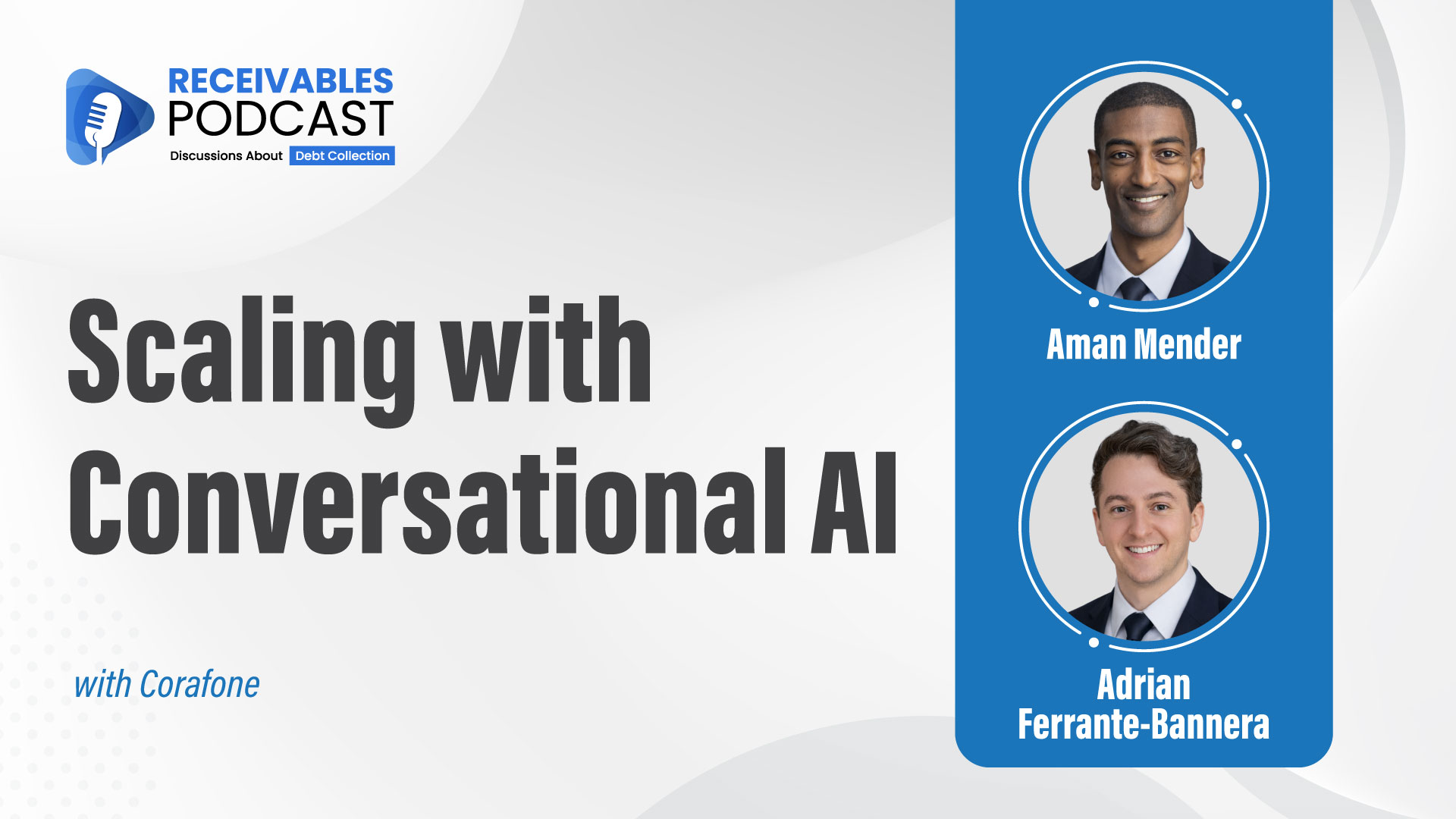
In this episode of the Receivables Podcast, Adam Parks sits down with Aman Mender and Adrian Ferrante-Bannera, co-founders of Corafone, to explore what real-world conversational AI deployment in collections looks like today.
Listen to Your Favorite Podcasts





Adam Parks (00:06)
Hello everybody, Adam Parks here with another episode of Receivables Podcast. Today, I’m here with a very interesting conversation. Two gentlemen, Aman and Adrian, who are, well, they’re neck deep in conversational AI. And with that being the next frontier of the debt collection industry, I wanted to have them on and have a conversation. I demoed their product, Corafone, earlier today. I thought it was a great demo. Really enjoyed the conversation. I tried to stump it. I tried to play games with it. And it gave me some really good responses that ultimately ended up with me on the phone with them when I had asked for a supervisor. So I thought it was a really interesting conversation. But as I got to meet Aman at the Debt Connection Symposium Conference back in October, We had a really interesting conversation about how they got started and how they moved into conversational AI, not with a giant leap, but with small calculated steps in the right direction to build their models and ensure the level of compliance that we all expect in the debt collection industry. So, Aman, Adrian, thank you so much for joining me today. I really appreciate you coming on and sharing your insights.
Aman (01:23)
Yeah, thanks for having us.
Adrian Ferrante-Bannera (01:23)
Thank you for having us.
Adam Parks (01:24)
So for anyone who’s not been as lucky as me, maybe starting with you, could you tell everyone a little about yourself and how you got to the seat that you’re in today?
Aman (01:33)
Yeah, definitely. So yeah, my name is Aman. I grew up in Oslo, Norway, and I was lucky to have a computer from as long as I can remember. And, you know, my father and my big brother were both engineers. Programming was something that came pretty natural. And I love gaming. so, you know, naturally, I started building my own games and I also started working pretty young and it was really fascinating to me to see how you can just get a job and you’re put into a system and that a business is just a set of systems and processes that produce an outcome. So that also helped me gravitate towards, you know, starting a business one day or the idea of being an entrepreneur. So, basically my whole professional life has been working as a engineer, either in my own startups or for other companies or also doing some consulting and telecom and banking. And when whisper first came out, I was just super fascinated and I’ve been working on conversational AI related products ever since.
Adam Parks (02:42)
That is probably one of my favorite all time quotes on this podcast. A business is a series of systems and processes. That is one of the truest statements I’ve ever heard. I don’t know that I ever realized it like that until you just said it that way. But I really liked that quote. Adrian, how about you? Could you tell everyone a little about yourself and how you got to the seat you’re in today?
Adrian Ferrante-Bannera (03:05)
Yeah, sure. Similar to Aman from Scandinavia, but I’m actually from Sweden, Stockholm. I grew up there and I was, as a child, I was always curious and wanted to be an inventor. I used to break down stuff and rebuild them as I was growing up. And my dad got a bit annoyed on that. But yeah, that was kind of me. I was always questioning things, questioning the status quo. Growing up, also, some people, some people in the States might not know this, but. You you’re actually paid to study in Scandinavia. So, I mean, I, of course, I took advantage of this and did my bachelor’s in Stockholm. Wanted something more global and moved to Germany, learned from German, worked with startups. Was always into innovation and technology. Did my master’s in Norway. This is where I met my girlfriend and living in Oslo now. So kind of like why I’m in Oslo right now. And come from a finance background. But right after that, I actually joined Lending Fintech. And we were doing these merchant cash advances. And I was growing it. I joined it very early stage when they had essentially no customers and grew it up until in the eight figures, euros in lending volume. And I was in charge of basically the end-to-end solution from the landing page to like donning and repayment.
And funnily enough, after that, I promised myself, know, lending is hard. ⁓ I promised myself, I’m not going to work with. Right. I’m not going to work with debt. I’m not going to work with enterprise. This was my learning for this. Then fast forward a few years and I’m with Aman. We’re building these voice agents for, or actually AI collectors, right? And funnily enough.
Aman (04:20)
Yeah.
Adam Parks (04:22)
So you chose debt collection?
Aman (04:24)
Thank
Adrian Ferrante-Bannera (04:38)
Life takes a good turn and yeah, this is where I’m at right now.
Adam Parks (04:41)
Love the, look, I love the backstories guys. Now you’ve got your own organization. Tell me about your company and what it is that you do.
Aman (04:48)
Yeah, basically, as Adrian said, we build AI collectors. So focusing on voice, but we’re also, you know, having that AI send SMSes and emails based on the conversation. So moving, you know, rapid and intly into a omni-channel sort of solution.
Adam Parks (05:07)
Interesting. Now, one of the conversations that we had had that I thought was very interesting was about how you guys cut your teeth and started moving from let’s call it inbound to outbound. So you identified an opportunity and kind of went through this growth process. Could you tell us a little about that story?
Adrian Ferrante-Bannera (05:25)
Sure. We found a design partner, or our first customer in the US, who was really excited about AI. And was also visionary, looking forward. And we were on the same level there. And we started working together. And the fun new story is, where would you assume that AI would be more effective? And what is the lowest risk? That was kind where the conversation started. And I mean. you’re missing the calls in the after hours, right? You don’t have Spanish closers. So we saw some opportunities where we’re like, inbound is a bit safer because outbound is still a harder conversation to have, which we can delve into. But that was kind of the starting point. And initially, our partner was also a little bit uncertain of, it going to work? How is it going to work? So we set this two month trial to like, okay, let’s just try it. And I remember, Aman, when we did this the first time before we went live, we were over-engineering it. Did we think about this? Did we think about that? Did we cover this scenario? And we had like thousands of scenarios. And we were like, at some point we were like, okay, guys, all the critical components work. It verifies. It doesn’t say things it shouldn’t say. It’s always non-committal. When should we actually start, right? We can sit for another month or we can just try it. That was kind of where we started. And maybe I’m only one to fill out.
Aman (06:46)
Yeah, basically we we just I think one thing that we did really great is like our that client that first US client because we were familiar with European collections right client had like a script and was like a very AI script it was like do this and do this and we’re like no no give us your training trade give tell us how you train a new employee and that’s what we based that first collector off and I think that’s what made it much more powerful, much more persuasive so that the first night we deployed it, it took a payment. And that was the calls that this owner was hearing being unanswered every evening when people went home. And that also gave us like a flux of feedback and you can plan all you want, but you never know what a human is gonna say. Like a conversation can go a million ways. So you can’t.
Adam Parks (07:30)
Yeah.
Aman (07:36)
pre-program everything, you can just sort of say, this is what you’re going to stick to, and this is the things you’re absolutely not going to do. And this is, yeah, this is what you should try to stick to and avoid these things and generally bringing back to here because people are smart. People will have, know, especially if they figure out it’s a bot. They don’t always figure out it’s a bot, but if they figure out then, you know.
So just getting it deployed over hour and after hours and seeing that work, honing it in based on that, honing on all the, you know, there’s always going to be things that you don’t think about in that situation. So just listening to all the calls really understanding when it went bad, trying to emulate a real collector, getting their top collectors on a call listening to calls with them. That’s kind of how we gradually, okay, now it’s ready for doing overflow. Okay, now it’s ready to be like the first line of defense, you know, and when it’s like that first line, then you’re getting all sorts of requests, you’re getting people pissed off, you’re getting people who are, you know, who just like, I’m, you know, I’m going bankrupt, or you’re getting people who just you get weird, we get weird calls, we’re like, Hey, I’m calling for pizza, you know, like, this is not a pizza place. And then the AI not going to make sure it doesn’t try to collect from people that aren’t real consumers, right? So, so we kind of gradually, broadened it out, but it was, it was definitely a learning process. Each step that with more volume, we, the new issues arose and, know, not only new issues, like there’s also a limit to how much manual oversight you can have. Like when you’re getting into thousands of calls, who is gonna sit
Adam Parks (09:15)
At scale, yeah.
Aman (09:18)
and listen to every one? So you need to analyze them at scale and figure out what’s going wrong and figure out why it’s failing and then look into those calls. And so, yeah. And of course we really had to tailor it around their operations, right? Every agency in our experience has their own statuses, their own policies, what they want to do if someone says they’re bankrupt or what they want to do. Like exactly, like a lot of their sort of non-goal statuses, we would just like immediately transfer or say, hey, someone’s going to come back to you when we open up. And that’s kind of that, that, made it easy. Like we made that first collector focused on collecting. Like it wasn’t trying to do inbound support. was, its goal was to collect all the things were subsidiary to that.
Adam Parks (10:11)
So when you look at kind of building it in that format, how do you build those compliance guardrails over time? So it sounds like you’re going through this learning process, you’re starting to change its focus a little bit on these inbound calls. How did you build the compliance guardrails around it that would make you comfortable enough to kind of take it to the next step in its deployment process?
Adrian Ferrante-Bannera (10:35)
Gradual, incremental. That’s a short answer. We tried to push the boundaries of the agent while staying compliant. this was like what Aman was saying, you we did, we started with one use case, right? But similarly, we, you know, we were on, we were playing on the safe side with our partner where, know, if someone called in to make a payment, initially we said, okay, transfer to human because we don’t want to miss this payment, right? But then we, you know, to push the boundaries, we were like, well, what if we let the user decide instead?
Adam Parks (10:37)
Okay.
Adrian Ferrante-Bannera (11:04)
And we asked, well, I could process your payment being the digital assistant, but if you want, I can transfer you to a human. And surprisingly, most people, almost everyone actually went through with AI. And similarly, we did the same thing with compliance. So we started off very safe and gradually built out where do we push the boundaries of AI essentially on the compliance side. But we started off like I said, like the elements that had to be in place, they were thoroughly tested. had thousands of automated tests. had our own, I probably spent hours talking to it. I was going crazy, testing different scenarios. Yeah, I dreamt about it. So that was the level. But I would say incrementally, this is kind of the approach we had.
Adam Parks (11:39)
It’s gonna play with you over time, right? Like talking to the bot all day.
Aman (11:40)
Yeah.
Adam Parks (11:53)
And over time, did you see that the volume of calls that were being transferred to the live agent has changed? Like have you seen a reduction in, I know you were playing it safe early on, but it sounds like over time, the bot has been able to manage more and more of the process at a higher confidence level.
Aman (12:11)
Well, it’s building a kind of a full circle to be honest. So in the beginning yeah, we were transferring a lot and then we gradually got down and down like all like People a lot of people like if they understand is digital they want to transfer but then when they hear it’s conversational and here can actually Understand what they say then it’s kind of like I could transfer you but let me just try to help you and then when it actually helps them and understands their request then people are amenable to actually engage further. But we also had a full circle, at least with some of our deployments, where if the AI is getting really close to getting someone to pay, but it’s not able to, or has a certain number of tries, then just transfer that person if it’s opening hours. Because that’s such a hot lead that you would rather at least some agencies would rather just try to have a human pick up at that point. Just so that that they don’t lose that person, you know, that’s that’s that person is basically ready ready to pay and yes, exactly. So it’s kind of been a fluctuating but we definitely like we could turn that really down and it would probably not transfer. It would transfer very few calls. Just really when when people are calling in that
Adam Parks (13:13)
money on the table. Yeah.
Aman (13:28)
shouldn’t talk to the AI. So, and I think on the guardrails, just commenting on the guardrails, I think it was really a matter of accumulating data about what kind of things people are calling in that is in the bucket of, you know, conversation that shouldn’t continue with AI. So understanding and interpreting that, because honestly, the LLMs are really good at understanding intent and interpreting intent, but you have to give enough sort of information about what is that intent. It’s not just a word trigger. It has to be that the person is expressing this and this sentiment or, you know, maybe that word, but also in this kind of setting. So building up that library of what a lawsuit risk is or building up a library of what is someone claiming to be? Are someone claiming to be bankrupt now? Or just were they bankrupt, but now they’re willing to pay. There’s all these kinds of nuances that you only get from just conducting a lot of phone calls and then reviewing them and analyzing that data and understanding, okay, this is how people communicate, especially in, I think this is very country and cultural specific, right? What people mean by different things.
Adam Parks (14:40)
I would even state by state, right?
Especially if you’re dealing with the United States, like a common phrase in Florida is not common. There’s soda, there’s pop, there’s coke. There’s all different ways in which we say the same thing. So I can imagine that building that intent library would be pretty labor intensive.
Aman (14:49)
yeah. Yeah.
Adrian Ferrante-Bannera (14:59)
Yeah. But it’s definitely worth it. That’s essentially our take. I can also add to what Aman is saying, because this is part of getting that data to separate the non-intentional transfers from the intentional transfers. So that specific term, or if you call it non-intentional transfers, that has dropped dramatically. So we’re handling more cases now than we did before.
Adam Parks (15:04)
Sure interesting.
Adrian Ferrante-Bannera (15:26)
Pushing the AI slightly broader and broader. And then there are some deliberate transfers, like Aman was saying, which is just like, don’t lose this money, Grab this money. That’s kind of the, there are strategies we we develop for that, right? So they’re not bad transfers, so to say.
Adam Parks (15:34)
Yeah, sure understood. For me, I was just trying to understand within the context of, we continually improving there and are we seeing it? Because my question is really around, you managed it with this inbound calling, and you kind of cut your teeth there, but how did that give you the confidence to unlock kind of the next stage in your use case deployments?
Aman (16:09)
Yeah, I can say one thing. When we were seeing that, especially with this first client, we were seeing that driving traffic to inbound was profitable, was working, was generating minimal sort of issues or weird incidents. When that was sort of totally off the table, that’s when we said, okay, the client actually came to us. I mean, Adrian knows the story, but yeah, he came to us and he basically just wanted to, to start running outbound basically.
Adrian Ferrante-Bannera (16:42)
I remember we had a two month trial and it came after like 28 days. So was like, can we do outbound? Can we do outbound? Because it worked, right? So we were like, well, okay. I I guess we don’t need to think about that anymore, right? So.
Aman (16:48)
Thank
Adam Parks (16:48)
You
Aman (16:55)
Yeah.
Adam Parks (16:56)
Well, and knowing this guy myself too, because I know we’re not going to drop names on a podcast, but like knowing this guy, like that’s a, he’s usually pretty conservative, right? He’s not usually one to jump out in front of, you know, what was a, a trial date and saying like, okay, hey we’re going to move faster rather than slower right now. Cause he’s usually pretty methodical in the choices and movements that he makes, especially from a technology perspective.
Adrian Ferrante-Bannera (17:19)
Yeah. But he’s also the visionary, right? He’s also like, he sees this, right? He sees it happening. So there’s this combination where it’s like the right level of enthusiasm and willingness to take that leap, but also strategically, right? So starting with the inbound of hours, Spanish, and then as it works, just push it.
Aman (17:19)
Yeah, yeah. So.
Adam Parks (17:42)
That brings me to a whole other question here, right? When we talk about doing it in Spanish, I mean, you’re doing this in multiple languages. You cut your teeth, you started doing this originally in Europe, which is, I mean, as many languages as you can throw a stick, you’re gonna find a new language, right? So there’s a lot of, there’s a lot of multi-mix there. Then you come into the United States, you start doing it in Spanish. You gotta obviously start converting all of that, do that in English as well. So how flexible have you seen or how different is it as you’re trying to do these things between language?
Aman (17:53)
Yeah.
Adam Parks (18:11)
And how does that play into your intent library?
Aman (18:14)
Yeah, that’s a good question. It definitely was a process like we hired a Spanish speaker with experience in customer service just to sit and listen to the Spanish calls because we could, you know, we can transcribe and listen to them only one in English, but we’re not going to know how well how well is going. We can only listen to, guess, to sound like the sentiment and emotion. But yeah, so it’s definitely been been a journey like Honestly, when we started, like AI voice was struggling, especially in this Nordic languages. It was only really the big languages that it could do. It could do well. could do a conversation pretty well, but then there’s so many regional dialects over here and inflections. Like sometimes it would not understand. Yes. You know, which is like very basic word. So English was English was a lot easier and we kind of did English first and then Spanish and, Yeah, moving into Spanish was not that difficult, but I think one thing we really had to go through is like we had multilingual and that was like, it was an amazing experience, but it also created so much uncertainty, like having the sort of AI pipeline understand which language this person wants to speak and not misinterpret and like, are you trying to say something in Spanish? That kind of stuff.
That was like, that was a big problem. So that’s something we had to solve by basically, we basically have multi, a multi-agent paradigm. Like one agent speaks English, someone wants to speak Spanish. They go to a monolingual agent that speaks Spanish. And if someone wants to speak English to that Spanish agent, they go to, so, by doing it that way, we got them to be really, really a lot more precise. so.
Adrian Ferrante-Bannera (20:02)
And easier to assess, right? And the quality, like the quality of the awareness, was just easier to test them separately than to, you know, test one that tried to speak different languages, right?
Aman (20:14)
Yeah, so a multilingual is like a great demo, but in our experience, it’s not the optimal thing to put into production with real consumers, because honestly, it was frustrating to, know, things that are not Spanish being interpreted as Spanish.
Adam Parks (20:23)
Yeah. Which makes a lot of sense then if you start throwing in languages like Portuguese and how close it is to Spanish and Portuguese versus Italian like I mean there’s so much similar but not the same language I can see where that could start causing some pretty significant challenges. Now when we were talking about the the growth of artificial intelligence conversational AI has been the slowest in terms of the adoption rates of the six use cases of artificial intelligence specific to the debt collection industry. And from my experience, I just finished writing the TransUnion 2025 debt collection industry report. I’ve got all the raw data. I’ve got some insights that I can share, but I thought it might fuel some conversation for us here today. What we saw in 2023 was 60 % of companies said that they were never going to use artificial intelligence. Just weren’t going to do it.
Last year, 40 % of companies said that they weren’t going to do it. Like they’re just done. 40 % said we’re just, we’re just not going to do AI. 2025, I think there was yet another dramatic shift. Now it’s 7 % of companies are saying that they’re not going to use it. A 93 % adoption rate. Now that’s across all the use cases, not just specific to conversational AI, but conversational AI is where I saw the largest shift.
Aman (21:21)
Great.
Adam Parks (21:48)
Right for the individual use cases and people starting to get more comfortable with it. I think part of that is because people have taken the incremental steps to put things in place. It’s not so much the big scary. You know, we’re just going to go let this bot. I’m not going to let chat GPT go talk to consumers. Let’s be honest here. Really? That’s probably not a great model for us to take. Feel like that would be a big scary one because as one of my lawyers told me, know, chat GPT is like a drunk frat boy. It’s going to tell you wrong information.
Aman (22:05)
No. No.
Adam Parks (22:16)
with all of the confidence in the world. Looking at it that way, now from a collection standpoint, the other thing that we saw was looking at it as a payment channel and saying conversational AI is a payment channel. Of the companies that are using it, most of those companies are collecting somewhere between one and 20 % of their payments through that channel, which I think is really interesting. There were some that were at much higher rates that were collecting 50%. Let’s say in terms of what they were able to collect. And then obviously a lot of organizations saying that they weren’t really ready or they had not deployed it yet. So they weren’t currently taking payments through that channel. Now, as someone who’s out there talking all the time with organizations and over the last couple of years, have you seen a shift in the way that conversational AI is being viewed by the debt collection organizations?
Adrian Ferrante-Bannera (23:07)
Yes, that’s the shortest answer I can give. Yeah, of course, of course. So we started selling this over a year ago, right, with AI voice. And then back then, like, first of all, the models weren’t as good. And especially us selling in the Nordics and in Europe, the models had less data to be trained on. They were just performing worse, more latency. And it was just a headache, right? Then.
Adam Parks (23:09)
Well, you can elaborate on that.
Adrian Ferrante-Bannera (23:32)
If you think a little bit about what is different from AI versus the paradigm before AI, right? Before AI, you had to define the scenarios and you had to specify if this, then that, if this, then that, all the way, right? So for payment agent, that might be a viable solution because it’s a very happy path, right? You know, like they’re to take a payment. But when it comes to more sophisticated conversations, like the one we’re having today, for example.
Your input influences my output, right? And with that in mind, like I need to either know exactly all the variations of what you can say and how you’re gonna say it, and then, you know, have an output for that. Or I have to be able to understand what you’re trying to say and then have some instructions on how I should handle that, And this is kind of where AI opens up the possibilities where you can now, without having to pre-program a trillion scenarios, you can find these ways around it. And when it comes to the conversational aspect, I think that’s the most complex one. So that’s probably why it has been slow as to get to a level of sophistication. Because in order for us to use this voice, the text had to be good before. The reasoning still comes from the AI. So if you see the reasoning just outputting the text, you can read it in your own way, but communicating it with tonation with, you know, emphasis on specific things and then adding this multilingual problems, Where it’s like, well, what language are you talking? Well, languages are complicated things. We’re complicated beings. Grammar is complicated. States vary, right? So this is probably like why AI voice has been the slowest to be adopted. But this is also like the biggest paradigm shift, right? We can now handle very complex calls which you couldn’t before.
Aman (25:28)
Yeah. So it’s funny, like, whenever we talk to people running collection teams, like even without talking about AI, they’re always, they’re always, their main constraint has been staff and finding good people, finding good collectors. Usually right now the shift, like most of the people we meet, everyone sort of sees that this is inevitable.
And usually it comes down to, well, well, what’s the numbers and like, how well does it actually convert? And is this worth something worth giving my portfolio to? And these are the conversations that are arising now. And it’s kind of like, yeah, if you have a top collector working on, you know, credit card debt or auto loans, and they’ve done that for 10 years and they’re like one of the best in their, in their company or team.
They’re going to beat the AI. They’re going to do things. They’re going to respond with emotion at the right time. And there’s always going to be room for that. But then it’s question of like, does that person need to sort of right party everyone who doesn’t even end up paying? Like, does that person need to talk to every consumer or should that sort of, you know, ultimate collector sort of sit at the top and take whatever The other channels didn’t. So we kind of see it as like, you, wouldn’t call someone before you sent an email and you, you, wouldn’t text someone before you sent an email. So you should probably do those things first, right? You should email it first, use the text first, and then you should have it talk to AI. And if AI doesn’t, is not able to do it, then someone should step in. And that’s where you, if you do that the right way, then you can sort of get the superior sort of liquidation that the people are asking about. So honestly is really a lot of people, some people are still scared. Like what can I say? What’s the guarantee that it won’t say X, Y, Z, but when they talk to, for example, our agents and they demo it and we say like, hey go hard, like try to break it. ⁓ And usually they’re not able to. And then it’s kind of like, okay, but will this work? And you know,
Adam Parks (27:36)
That to me sounds like an invitation to our audience. I’m gonna put the link below for people to go on and have a conversation with the bot, because I did it earlier today before the recording. I was really impressed with the entire process, but I’m gonna suggest that everybody that’s watching, if you wanna go have an interesting conversation with a bot, because the conversation around latency, for example, is something that I heard a lot last year that I don’t really hear a whole lot of in 2025. And I think part of that is the…
Aman (27:45)
Mr. Kross.
Adam Parks (28:13)
going from speech to text to the model to text to speech again, and now being more speech to speech and kind of shortening some of those gaps. We don’t see the same, could be the processing power, but we don’t see the same kind of latency that we all think about when we think about really a, I’m going call it an overpowered IVR, not necessarily a bot.
Aman (28:34)
Yeah.
Adrian Ferrante-Bannera (28:34)
Thank
Adam Parks (28:36)
that you can have a conversation with. But I’m going to take Aman’s comment as an opportunity for the audience to go talk to the bot, try and break it, have those conversations. I think it’s a worthwhile 10, 15 minutes of your time to go on there as a consumer, receive that call and have that conversation.
Adrian Ferrante-Bannera (28:55)
Yeah. And we encourage you to break it. If you break it, we can fix it, right? That’s the…
Aman (28:56)
Yeah, definitely be the toughest
Adam Parks (29:00)
You
Aman (29:01)
consumer we ever see. That would just, it would just help us.
Adrian Ferrante-Bannera (29:04)
Yeah. And it’s interesting, if only enough you’re mentioning latency and, there’s this notion that lower latency is better and there’s, it’s true to a certain point, right? But if you have too low latency, then, you know, naturally I can pause for two seconds without it being unnatural, but can an AI? This is like, you know, so you want, you want to have a, there’s a sweet spot. If it’s too fast, it might interrupt too much. Right.
Aman (29:30)
Yeah, that’s something
we also worked a lot on like the interruption and how sensitive it should be. And honestly, it’s more that those are the things are more like an art, you know, it’s like, you come from tech and you want everything to be very precise, but and it probably should vary based on like, you know, segments, how you how you would communicate just as if a real collector’s callings you know, an older person, they should probably talk at a slower pace. then if they were calling someone who’s pretty young and just wants it quick and fast and wants to know what it’s about.
Adam Parks (30:07)
We used to do that between New York and Texas. I wouldn’t put a Texas collector on with a New York accountant, vice versa, because they are just talking at two very different paces and talking about how we look around the country and how those things might be a little bit different. But as you guys have gone through all of this, I’m sure there have been some moments that have just made you laugh when you’ve heard some of the things that the consumers have said to the bot and all that. Any stories you could share with us that might make the audience laugh?
Aman (30:33)
The first one, I mean, some of the ones that come to mind is just when the consumer has been informed that it’s an AI, and they talk to it, I don’t know if they forget. And then they’re like, hey, I’m going to transfer you to human and like, you’re not human. Am I talking to a computer and stuff like that.
Adrian Ferrante-Bannera (30:51)
So were actually sitting in the office of our partner, and sitting next to the collectors, and we asked them, and they were like, well, people ask us to pray and all.
Aman (30:59)
Thank
Adrian Ferrante-Bannera (31:00)
So now they have to convince the consumers that they are not AI. They’re just there to do their job, So that’s part of
Adam Parks (31:07)
Yeah, I what kind of recaptcha do you use to prove you’re human over the phone at that point?
Adrian Ferrante-Bannera (31:12)
Yeah, exactly. So you talk about the games or the football, but that’s pretty much it.
Aman (31:12)
Yeah. Yeah, we’ve also heard some like there’s on on one of our deployments where we have the Spanish agent, there’s like a Spanish consumer has been calling weekly to make their payment and they prefer doing it on the phone. And we’ve heard the consumer say, I like calling you, you feel so safe. And like, it’s just a machine. But that’s I mean, that makes me super proud. Yeah.
Adam Parks (31:40)
Well it should, but it also ties into the whole idea of the shame factor. And I think the shame factor, and I’ve talked about it in other podcasts, is a big part of why consumers prefer self-service. They’re in a bad position in their lives. They don’t want to talk to another person they don’t know about it. And I feel like the conversational AI as it’s gotten better provides one of those outlets for the consumer to where we’re actually able to provide a higher level of customer service because the consumer gets to feel confident and comfortable with the bot in which they’re having a conversation with. The bot doesn’t come across, you know, the bot might sound sympathetic in some instances, but it never comes across as judgmental. It’s never having a bad day. It never needs another cup of coffee before it gets on this next call. I feel like that’s that opportunity and have you had any experiences around that shame factor?
Aman (32:30)
Yeah.
Adrian Ferrante-Bannera (32:35)
AI is another channel, right? Some people prefer text, some people prefer emails, and some people want to talk, but they don’t want to talk to a human, So you’re basically adding another means to capture the different individualities that live in the States or in the world, I guess. And I guess in terms of the shame factor, this is more of a transactional call. So. like at the end of the day, you don’t call for pleasure. It’s not, the AI is not calling out to, you know, talk, you know, fun things that would actually be a bit weird if you, you I was asking like, how’s your Sunday? Right. That doesn’t make sense. Right. So, so, there’s definitely, you basically, you remove the obligation to be social. So in that sense, yes. The shame factor isn’t really there because you understand it’s transactional, but we’ve had people ventilate about the creditor, about how this wasn’t handled properly to our AI, right? The AI just listens. It’s just, yeah, thank you. And then we understand the frustration. Yeah, and it’s almost like a theory. Right, it’s epic.
Aman (33:36)
Yeah. vent out their life. Yeah. Yes, definitely.
Adam Parks (33:41)
But sometimes that’s all the consumer wants, right? The consumer just wants to be heard.
Aman (33:47)
I mean, those are some of the most, I mean, the people who get to sort of put their all their frustration out and then the AI listens to it and empathizes. Those are very, like highly converting calls basically because the person feels heard. we haven’t heard anyone specifically say that hey I don’t feel shame or anything like that. But we definitely see that when they, when they just can say whatever you, you can get someone who’s like, you know, go to hell and all these kinds of things. And they’re just, you’re, some of them will just calm down because the AI is just taking it, you know? So, it’s not fighting back. It’s not like, it’s just, it’s, it’s returning to the subject, but it’s also like, you know, listening to it. I’m sorry to hear that, that kind of thing. I think that is where the shame and guilt or anger, those kind of emotions can be lowered, basically.
Adam Parks (34:43)
That’s interesting. Now, when we start talking about the outbound calling and we’re now reaching out like, you’ve gone from, we handled overflow calls to we started handling inbound, you know, in replacing the IVRs or expecting there always to be a collector available to take a live call to outbounding. What kind of impact have you been able to have in terms of right party contact in the number of contacts that an organization can make in a day because now the capabilities are endless. It’s a scalable feature in toolset as compared to 88 % of debt collection companies having trouble hiring and 81 % having trouble retaining the people that they have hired. So what does that look like as you bring this scalable capability to a debt collection operation?
Adrian Ferrante-Bannera (35:33)
Yeah, maybe we can break it down into how outbound started and what mistakes we did there, and then also talk a little bit about where we’re at right now. But essentially, just one thing to think about is having that overflow or inbound AI allows you to drive more traffic. So you can be more aggressive in texting, you can be more aggressive with emails, and with ringless voicemails, for example, you can also be more aggressive with Outbound.
Maybe this is where we can talk about how many accounts we ran through through a day. And you want to share that story, Aman? Well, OK. So essentially, 28 days later into this trial, he comes to us and says, we want to do outbound? Can we do outbound? And we said, yes. Of course, let’s try it. And we wanted to run through 30,000 accounts that week. That was essentially it.
Aman (36:07)
no you can go ahead. I yeah
Adrian Ferrante-Bannera (36:26)
And this was on a Monday and we wanted to pace it because we do up on calling, people call back. So you’re going to expect more traffic. You can also expect that the human collectors would get more transfers. And it’s not just, you know, AI takes all the calls and handles all the calls. You also have to predict that some people that call back are also people that we didn’t call. So people with certain statuses that the AI shouldn’t handle. So there are always going to be more traffic. You have to account for that. Right. So it allows you to use that tool and we took on the task to build our own dialer. Because we hadn’t found a dialer to integrate with at that time. And we had two days before we had to go live, right?
Adam Parks (37:05)
That’s like a short time period guys, my god
Adrian Ferrante-Bannera (37:09)
Well.
Aman (37:10)
Yeah. And I mean, retrospect, we should probably have not done that because, know, we’re sort of tech guys. We’re not AI guys. We’re not telecom guys, but we took that apart ourselves. Like what is a dialer? How hard could it be? Now we were able to sort of, I honestly, I thought like we should get a product, but it was really hard getting a hold of a dialer.
Adrian Ferrante-Bannera (37:29)
Thank
Aman (37:35)
a dollar company that wanted to do AI at that point. Now we have since figured it out, but at that time we basically rolled our own dialer using, we were using Twilio and we just sort of did all the geo matching, like the numbers matching and that kind of things and like planning out the campaign. So it wasn’t a full dialer, like a predicted dialer with a human agent, but it still had some of those features. And they started calling with that. honestly, the pickup rates, et cetera, were pretty good. But we then had a big problem with voicemail. Then we started integrating with, yeah. And having AI talk to voicemail or even AI answer voicemails is just like a total waste of resources, right? Because AI tokens are pretty expensive compared to prerecorded ones.
Adrian Ferrante-Bannera (38:13)
Yeah.
Aman (38:27)
So yeah, basically we had to find a dialer and I think we integrated with two different ones. At some point there was like a click based dialer and yeah, but in the end we were able to really run the outbound through TCN and that has been working as a charm. And where we deployed outbound now, it’s basically they’ve been able to do twice the amount of volume with 50 % of the staff. So yeah, it’s been a pretty big lift in terms of the capacity. I think Adrian knows better about like all the RPC rates and so forth, but yeah.
Adrian Ferrante-Bannera (39:09)
Yeah, our PC rate was on par with humans, but it was this voicemail thing that was the biggest pain that cost crazy amount of tokens and also cost a lot of frustration because now we had this junk data as well, right? We didn’t want that. So that was like one…
Aman (39:23)
No. parsing that out also in determining voicemails, even like, yeah, it’s not.
Adrian Ferrante-Bannera (39:30)
Yeah, then we had to manage. Yeah, right.
Adam Parks (39:31)
Right party from a voicemail. Yeah, understood. Now you
Aman (39:33)
Yeah.
Adam Parks (39:34)
have a set of data that you have to start to comb through. New problem.
Aman (39:37)
Yeah.
Adrian Ferrante-Bannera (39:37)
But on the good note is we managed to detect voicemails really well, because we got all the data. But that wasn’t our core. We shouldn’t have built the dialer. So we’re really happy with integrating. This was in the third integration and the fourth attempt. So now it finally works quite consistently. And I think when it comes to capacity was Aman is referring to is also like the overall capacity of the organization. So outbound is one thing, but outbound is just one channel, right? You elevate the humans with AI. That’s kind of what we think. Human plus AI makes the best combination. And if you remove the fact that, you know, outbound calling is more, it’s more difficult. It’s a, You’re calling me, I’m having dinner. Like, why am I talking to you? I want you to pay my debt. That conversation is harder. So the conversion of that and like getting like the conversation such that you could get through to the RPCs. That was the tricky part, right? So really getting the start and the AI had to know the data in advance, right? So it’s not like something you can fetch from the system of records or CRM. You had to know that you were talking to this person you had to verify. So was like a different flow, different understanding, different way of persuasion, so to say. But what happened was everyone who you would never have converted anyways, they were just gone. They just disappeared from the universe of the human collectors. So that’s kind of what happened. And then the ones that transferred back, like the ones that AI didn’t close on their own, they were already massaged.
And they were already confirmed that they were RPC. They got to a certain point in the flow. And now on top of that, we had data on what are the conversations that they had? What was the offer that they gave the AI? And why didn’t they accept it? Or why did they want to talk to a human? So that’s kind of the shift that’s more important than did we call out and did they convert or not? It’s more like the holistic view to that.
Aman (41:44)
Yeah, it changes operations of outbound basically.
Adrian Ferrante-Bannera (41:44)
that’s we can do to the organization, right?
Adam Parks (41:47)
You’re bringing together new data sets. Like now there’s more information that’s going to the collector at the point in which that inbound call is coming in or at the point in which the collector is being connected to the consumer on the phone. The collector has more information and there’s three things that matter in negotiations. This isn’t me, this is Herb Cohen, like the world famous negotiator, right? Time, information and power. So time being like how much time do I have for all of this to do is one thing, but much information I have walking into that communication is a significant advantage from a negotiation standpoint.
Aman (42:20)
Yeah, and we’re getting a lot of structured data as well from these conversations that a human wouldn’t have, you know, the time to sit and like, did they negotiate? Did they still have a job? Like, they can do that, but it’s very time consuming. So yeah, that’s it.
Adrian Ferrante-Bannera (42:20)
Great. And that brings a good point actually, because in outbound dialing, the rebuttals matter more. Because you’re disturbing someone, right? And that’s kind of where we got really good in honing in the rebuttals and having the specific rebuttals. I mean, of course, we do our rebuttals for both inbound and outbound, but for outbound, that’s more key. Really understanding which one to use at the time. You’re calling me at a bad time. I can’t talk now. It’s like, well, we could just. We could have that conversation later, but we’re already on the phone and we could work this out in two minutes. Why should we postpone it? There are certain things that we already have built in.
Aman (43:18)
Yeah. Yeah. I guess we also want an Adrian was saying that was about what was kind of tricky when we went to outbound besides the dialing was also just a conversational aspect, like getting someone to pick up and not be automatically turned off that it’s a bot basically getting someone intrigued to want to have that conversation, understand that it’s about them, understand that it’s not a scam basically, and they have a legitimate reason to contact them.
Aman (43:44)
That is hard, because, yeah, you are basically.
Adam Parks (43:46)
That’s hard for a collector anyway, now you’re adding an additional layer of complexity if they’re talking to a bot.
Aman (43:52)
Yeah, yeah. So that’s also another thing we worked a lot on and we got to a good place. Yeah.
Adrian Ferrante-Bannera (44:01)
The one you demoed by the way was an outbound one.
Adam Parks (44:02)
I mean. What’s that?
Adrian Ferrante-Bannera (44:04)
That was an outbound one.
Adam Parks (44:06)
From an outbound perspective, it’s, getting any consumer on the phone and making them, getting past the challenges of even getting them on the phone and establishing that it’s not a scam or it’s not a problem. And I can see that there would be different rebuttals that you’re gonna have to deal with from, when you start from an inbound perspective and then building out that library and that intent library for the outbound purposes, I can imagine would be pretty significant.
But for those organizations that are just starting to take those first steps, I mean, I think most organizations now say, okay, there’s value here, there’s gold in them there hills. But like, what’s the first step? Like how does a debt collection organization start taking the right steps to prepare to deploy this type of technology?
Aman (44:39)
Yeah. I think one thing is getting a good understanding of what’s working now and then being able to translate that into an conversational AI solution. I think that’s what me and Adrian have gotten really good at is like being able to understand the, how they normally operate, how real calls proceed and then recreating that with an AI because You already figured out how to do, how to do this. So you should, you should do your best to try to emulate your top, you know, collectors. think that’s really like the leap someone would need to do. And you don’t need to do everything at once. Like some, some people will come to us and be like, I want this to say, like we build end to end, but it’s just like, it’s better to get something working and then gradually bite off more and more instead of trying to do everything at once. That would be my.
Adam Parks (45:49)
sounds like that’s been the secret to your success. Starting with a small use case, focusing on that, getting really good at it, and then continuing to deploy. I think some organizations look at it and they want to get to the end result so fast that they don’t think about the journey that they need to go through to get to the right end result.
Aman (46:06)
Yeah.
Adrian Ferrante-Bannera (46:06)
Yeah, a hundred percent. And again, like it’s about like, how do you utilize the people that are now free? And there are certain things that you wouldn’t do with a digital dialer, but you can do with a human, right? Now you have more humans to do that. You can drive more traffic. You think less about, you know, is it 4 PM? Is the staff going to run out before they call back? So it just opens up different avenues to collect and you can build new strategies. But what we see is essentially the ones that adopt this, what Aman was describing, like how does this fit into my organization? They’re the ones who are most successful. The ones that are brute forcing it to work on this aspect, this aspect, we do that. It might get there soon, but the most successful ones just are more pragmatic, right?
Aman (46:54)
Yeah. And I think another thing, if you’re a company that wants to make this leap and you’re already have a, know, you’re already doing collections. Like you probably have so much data that you’re not aware of, like all the recordings that you have to keep for compliance reasons. There’s valuable data, especially if you, if you’re able to map that to different outcomes, you can create a good idea of what is working and then use that to build a solution that actually works. And also of course, starting lightly, having a very low threshold after hour solution that is only doing something, but with a clear plan, like how to get to overflow and how to get to this being your main inbound and then how to get to outbound. That is how I would break it down.
Adam Parks (47:48)
Baby steps. I mean, it sounds like again that you’re, given kind of the playbook of how you guys took it on. Taking those baby steps and moving towards the end solution. I look at this as an opportunity across our industry to increase capacity. When you can increase capacity and break down some of those time barriers, especially when it comes to inbound calls, it allows us to expand our capabilities. And if we’re having trouble hiring live agents, what can we do to accentuate those live agents and still drive cost effective payments?
Aman (47:49)
Yes.
Adam Parks (48:17)
And cost-effective right party contacts with the consumers because I think that’s our underlying ultimate goal.
Adrian Ferrante-Bannera (48:24)
Yeah. And maybe on that we can actually, you know, the next level is that what Aman was touching on that there’s already valuable data in your organization, but you know, the AI, when they talk, this data is already structured out of the box. Like we’re analyzing it, you know, using AI, we get this structured data, which is now useful in further campaigns, right? We send Spanish emails to the ones who speak Spanish. We understand that this user cannot pay this much. Now we can have a more personalization at scale. So there are aspects that are being opened up that we didn’t even consider before we started with the Voice AI.
Aman (49:01)
Yeah.
Adam Parks (49:05)
And what does the next 12 to 18 months look like for you?
Adrian Ferrante-Bannera (49:09)
Well, very good question. I have to be honest and say anyone who thinks they know is lying. So 12 months in the AI world is insanely long. We went from no one trusting AI and questioning every aspect of it, the high latency to overnight it working quite well.
Adam Parks (49:14)
Okay, fair. I can accept that.
Aman (49:33)
Yeah, and having more people asking for it than we could supply at one point. That’s a good question. You know, I mean, we’re looking to basically deploy our agents into more organizations, have it service more debt, hone in on the conversational aspects, hone in on handling all the different types of events that can happen with payments. And then finally, adding in more omni-channel sort of bits. Like we want the AI to work in concert with the texting and email and the portal in a very intelligent way. Whereas basically like, the end goal is really for it to be sort of autonomous with some oversight of course, but autonomous is the sort of the goal.
Adrian Ferrante-Bannera (50:27)
Yeah.
Adam Parks (50:27)
Okay. It sounds like an intro. Look, I think that’s a noble goal and a great direction, especially as we look at the growth of omnichannel orchestration becoming a focal point, especially when it comes to creditors, debt buyers, agencies, and eventually law firms will start to fall into that space as well.
Adrian Ferrante-Bannera (50:47)
Okay.
Adam Parks (50:48)
when we talk about these bots and we talk about the ways in which we’re able to use them across the debt collection industry, one of the things that we’ve talked about is high balance versus low balance. And I’ve heard the argument many times that, you know, we similar to the way that a lot of organizations, a lot of organizations started using BPO services in doing, let’s call it send the low balance offshore. People are saying send the low balance to the automated collections tools, but that doesn’t seem like necessarily the best solution. What has your experience been?
Adrian Ferrante-Bannera (51:21)
Yeah, we have a quite contrarian view on that. We think that AI serves best on the high balance accounts actually. So the way it works, again, like we’re talking about the future of AI and what happens in 12 months. Yeah, we will have omnichannel. We will know, you know, what is the lowest cost channel that we can use for this specific consumer and a personalization at a scale, right? But the reality is, you know, the way that the cost scales for traditional agencies with humans is kind of why high balances make more sense with AI. And I’ll give you a mathematical example for this, just to prove that, like how it works, right? Say you are a debt collection agency, you work placement, so you get contingency and you get 30 % of what you collect, right? And your human collectors for simplicity, say $18 an hour for their salary. That’s around 30 cents per minute talking or working.
And then on top of the collection time it takes, you also pay a bonus, right? You pay a 10 % bonus to industry. It might vary, but this is an industry standard to pay a bonus on the fee, So now say you close an account that is $500 with this human. Now, if it takes 10 minutes, it’s $3 for the call and it’s $15 for the bonus because you would get a $150 fee.
Now, let’s say you use AI and it costs the same. So it’s $3 for 10 minutes and it also closes this account. Now your cost to collect is $18 and my cost to collect is three. So we have a six to one ratio. Right. Now what happens when you, because of the bonus, right. When we go up in balances. So say we go to 5,000 accounts now, you close this account with a human, you get 1500 in fee and they cost $3 for the call and $150 in bonus. And our AI still costs $3. Now it’s a 51 to one ratio, right? And now we go up to 10,000, it’s a 101 ratio. the efficiency gain, correct. So the efficiency gain kind of scales with the balance. So when we can run more,
Adam Parks (53:34)
exponential growth, yeah.
Adrian Ferrante-Bannera (53:43)
high balance accounts and we have to close fewer ones and we’re still more profitable essentially with AI. So this is kind of like where we stand right but with humans and AI this is kind of where you get the highest liquidation still.
Adam Parks (53:57)
Well, I think people looked at the BPO objective as like, I’m just going to do this cheaper. Let me send those low balance accounts because I’m not going to get the same level of quality that I was getting elsewhere with the internal live human agents. But I do think that as we start looking at how artificial intelligence and these conversational AI tools are being used in that same context and based on the experiences that you’ve had and other conversations that I’ve had.
It sounds like that quality level is there. And so if you’re not dropping on quality level, why not increase profitability?
Aman (54:29)
Yeah, exactly.
Adrian Ferrante-Bannera (54:29)
Correct.
Adam Parks (54:31)
which leads us for an interesting balance.
Adrian Ferrante-Bannera (54:31)
So yeah, and it’s a good starting point. Like again, we talked about being pragmatic, right? If the low balance is warehoused and you’re not working it, you might as well, right? It’s a good starting point. It doesn’t mean that it’s wrong. It’s just like the efficiency gain is higher on the higher balance ones.
Adam Parks (54:50)
And it doesn’t necessarily change the way the consumer is behaving or the way they feel about the AI bot or anything else. Whether you’re dealing with a $500 account or a $5,000 account, you could potentially be dealing with the same consumer. So is there really a differentiator that would drive you to put low balance accounts onto the tool?
Aman (55:10)
Yeah.
Adrian Ferrante-Bannera (55:10)
Based on our experience, we haven’t seen a higher propensity to pay on the smaller balance accounts. It’s actually like you wouldn’t put a lien on a car for $50, right? You wouldn’t go to court for 100. But once you get up to like high balance, that’s when more methods are available. And the consumer knows. Like we said, they’re smart and they’re also human,
Adam Parks (55:17)
It’s interesting. Very interesting. I like the approach and I think it’s something that organizations really need to consider as they’re looking to deploy conversational AI within their organization because just like every other tool in our business, we need to have a strategy for the use of that tool. And it sounds like the use of conversational AI should not just be limited based on balance range or, even necessarily based on product type because whether we’re calling on a credit card, a fintech, an auto loan, or another type of consumer credit account. I don’t know that there’s going to be that big of a difference between it. Commercial maybe has some differences there, but have you guys tested anything in the commercial space yet?
Aman (56:13)
No, we haven’t. No, I think Adrian just had that realization because it was like 11pm. And, uh, and then we just saw like the biggest payment come through like $7,000 in one go. And just like, you look at it, it’s like, wow, the AI, the AI took that, uh, the AI collected that and it’s just the same work. It’s like, so if you have something,
Adrian Ferrante-Bannera (56:14)
Yet. We are PS. Yeah, it like an hour.
Aman (56:40)
Yeah, doesn’t matter if it’s big or low, you should just run it through AI and the greatest benefit will come from from the high, obviously, if you collect so
Adam Parks (56:51)
It sounds like an interesting thing for folks to talk to you about at the upcoming Arm AI conference. I know you guys are going to have a booth. I’ll put a link below for your calendar meetings as well. Because for those of you that are watching, I’ve really enjoyed every conversation that I’ve had with these gentlemen at the Debt Connection Symposium conference, getting a chance to hang out with Aman and all of our preparation calls for this podcast and just kind of getting to see their approach to conversational AI.
But also I highly suggest that you go try and break the bot like spend a few minutes call the bot the link is down below you can go have that conversation let it call your phone and actually have a discussion because I think there’s a lot of interesting opportunity and I think it also helps to increase the comfort level for those of us that are old-school debt collectors and we’re starting to move more into this newer more interesting technology that will allow our businesses to scale. So gentlemen, thank you so much for coming on, joining me today. I really appreciate all of your insights. This has been a fantastic discussion.
Aman (57:52)
Yeah, thank you.
Adrian Ferrante-Bannera (57:53)
I thank you too, this has been very enjoyable.
Adam Parks (57:55)
Well, I appreciate that. And for those of you that are watching, if you have additional questions you would like to ask Aman, Adrian or myself, you can leave those in the comments on LinkedIn and YouTube and we’ll be responding to those. Or if you have additional topics you’d like to see us discuss, you can leave those in the comments below as well. And hopefully I can get these guys back at least one more time to help me continue to create great content for a great industry. But gentlemen, looking forward that you’re flying over from Europe to hang out with us in Las Vegas in just a couple of weeks. Looking forward to breaking bread, spending a little bit of time together, and can’t thank you enough for your insights today.
Aman (58:29)
Yeah, thank you.
Adrian Ferrante-Bannera (58:29)
Looking forward to meeting you in Las Vegas.
Adam Parks (58:32)
And thank you everybody for watching. We appreciate your time and attention. We’ll see you all again soon. Bye everyone.
Aman (58:37)
See you.
Adrian Ferrante-Bannera (58:38)
Thanks, bye.
Why Conversational AI Deployment in Collections Matters Now
For years, conversational AI in collections was treated as something experimental: interesting in theory, risky in practice. But that narrative is breaking down quickly.
Across the receivables industry, staffing shortages continue to pressure call centers, while compliance expectations grow more complex. Collection leaders are being asked to scale performance without scaling headcount. That’s exactly where conversational AI deployment in collections has moved from “nice to have” to operational necessity.
This episode of the Receivables Podcast features a deep conversation between Adam Parks and Corafone founders Aman Mender and Adrian Ferrante-Bannera on what it actually takes to deploy AI voice responsibly. Not demos. Not pilots. Real production use.
Adam has long emphasized that technology only works when it reflects how collections actually operate. That theme runs throughout this discussion, especially as the conversation moves from inbound use cases into outbound AI collections strategy, compliance guardrails, and AI voice as a payment channel.
Key Takeaways from the Episode
Conversational AI Works Best When It Mirrors Real Collectors
“A business is just a set of systems and processes that produce an outcome.”
— Aman Mender
Rather than scripting artificial conversations, Corafone focused on how agencies already train their best collectors.
From an operational perspective, this is a critical distinction. The AI wasn’t designed to sound impressive, it was designed to behave predictably, stay compliant, and move conversations forward.
Key takeaway: Technology adoption fails when it ignores frontline reality. AI succeeds when it reflects it.
Inbound Is the Safest Place to Start AI Voice
“The first night we deployed it, it took a payment.”
— Aman Mender
Inbound calls, especially after hours, create a lower-risk environment to test conversational AI deployment in collections. There’s less friction, fewer objections, and more consumer intent.
From there, Corafone gradually expanded the AI’s role, using real call data to refine intent detection, escalation rules, and compliance guardrails.
Key operational implications:
- After-hours collections automation creates immediate ROI
- Overflow calls reduce agent burnout
- Inbound success builds internal confidence for expansion
Compliance Guardrails Are a System Design Problem
“You can’t pre-program everything. You can just define what the AI should stick to—and what it should never do.”
— Aman Mender
One of the most important themes in the episode is that compliance isn’t about scripts, it’s rather about boundaries. Rather than reacting to risk, Corafone built guardrails into how the AI understands intent, escalates sensitive conversations, and exits non-goal scenarios.
Compliance works best when it’s designed into the system and not when layered on afterward.
Outbound AI Changes the Economics of Collections
“Human plus AI makes the best combination.”
— Adrian Ferrante-Bannera
Moving from inbound to outbound AI collections strategy required new thinking—especially around voicemail handling, right-party contact, and agent utilization.
The biggest shift wasn’t just scale. It was who handled which conversations. Instead of human collectors chasing low-probability calls, AI filtered, qualified, and prepped conversations before transfer, changing how collectors spent their time.
Operational impact:
- Higher-value conversations reach humans
- Structured data flows back into strategy
- Scaling collections without adding headcount becomes achievable
Building Compliance Guardrails for AI Collectors at Scale
- Start AI voice with inbound or after-hours coverage
- Treat AI as a payment channel, not a novelty
- Define non-goal statuses early
- Build escalation rules before scaling volume
- Separate multilingual AI agents by language
- Expect outbound to require different rebuttals
- Use AI-generated call data to refine strategy
- Measure success by capacity, not replacement
Industry Trends: Conversational AI Deployment in Collections
The industry is moving away from asking if AI belongs in collections and toward how it should be deployed responsibly.
What stands out in this episode is the emphasis on incremental rollout, compliance-first architecture, and human-AI collaboration. These themes reflect a broader trend toward operational AI and not experimental AI. As Adam often notes, the winners won’t be the agencies that move fastest but the ones that move deliberately.
Key Moments from This Episode
00:00 – Introduction to Aman Mender and Adrian Ferrante-Bannera
03:10 – Why conversational AI deployment in collections starts with inbound
09:45 – AI voice as a payment channel
16:20 – Compliance guardrails for AI collectors
24:40 – Inbound to outbound AI collections strategy
33:10 – Managing voicemails in outbound AI campaigns
40:15 – Scaling collections without adding headcount
47:05 – High-balance vs low-balance AI strategy
53:30 – Future outlook on AI in collections
FAQs on Conversational AI Deployment in Collections
Q1: Is conversational AI compliant for collections?
A: Yes, when compliance guardrails are designed into intent detection, escalation logic, and system boundaries from the start.
Q2: Does AI voice replace collectors?
A: No. AI voice acts as a capacity layer, allowing human collectors to focus on higher-value conversations.
Q3: Where should agencies start with AI deployment?
A: Inbound calls and after-hours coverage are the most common and effective starting points.
About Company

Corafone
Corafone builds AI voice agents designed specifically for debt collection operations. Their technology focuses on compliant, conversational AI collectors that support inbound and outbound calling, multilingual engagement, and scalable payment conversations without replacing human collectors.
About The Guest

Aman Mender
Aman Mender is the co-founder of Corafone and brings a systems-first engineering perspective to conversational AI deployment in collections. With a background in building scalable technology platforms, Aman focuses on how AI collectors must be designed with clear constraints, predictable behavior, and compliance guardrails from day one.

Adrian Ferrante-Bannera
Adrian Ferrante-Bannera is the co-founder of Corafone and approaches AI voice through the lens of operations, economics, and scale. Drawing on experience in fintech and lending, Adrian explains how conversational AI can increase collections capacity without adding headcount by reshaping workflows and prioritizing high-value conversations.