Adam Parks (00:08)
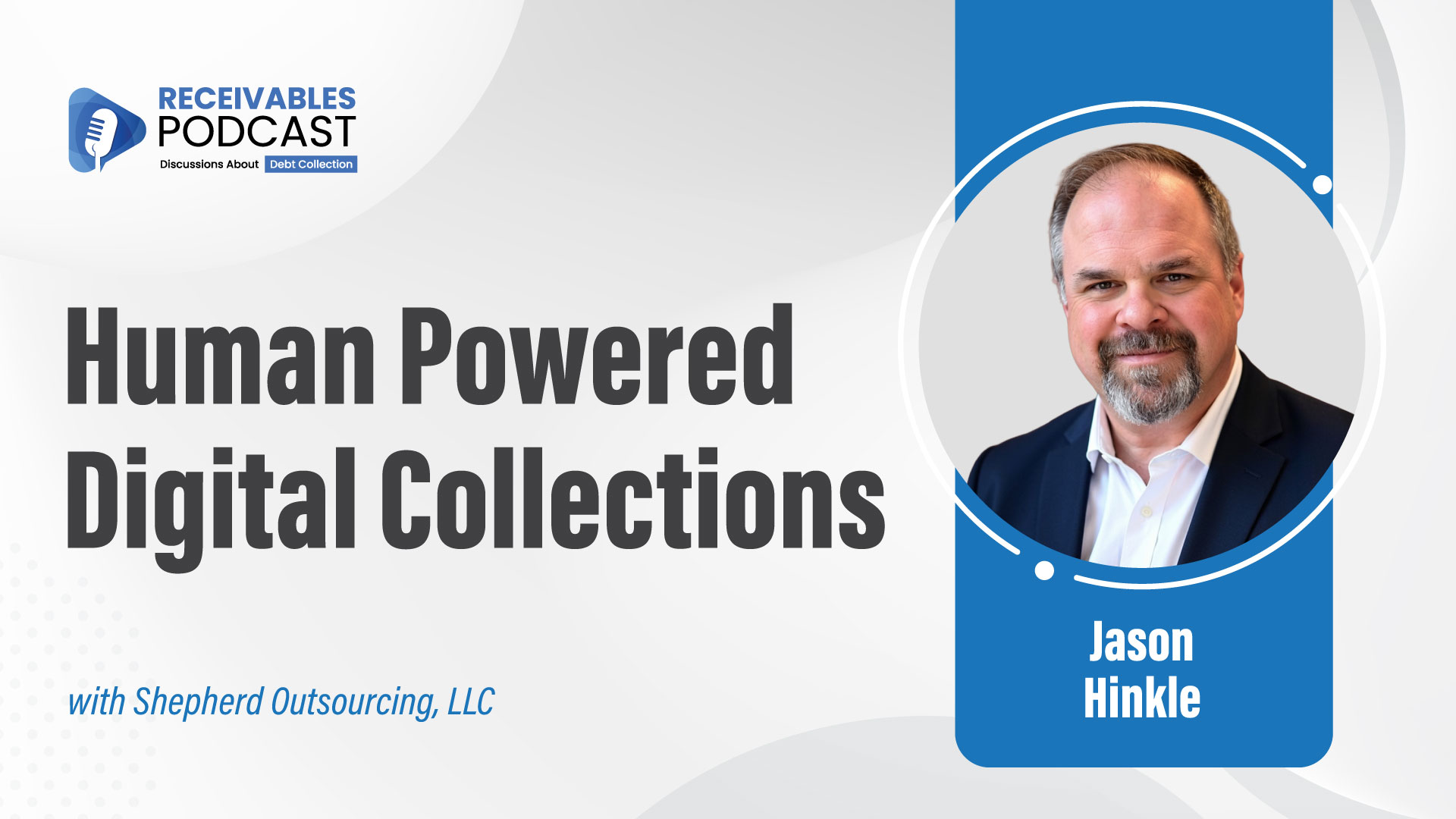
Hello everybody, Adam Parks here with another episode of Receivables Podcast. Today I’m here with an exciting guest here to talk to us about being a digital first agency. And Jason Hinkel with Shepherd Outsourcing has really been on the forefront of digital collections as it has evolved and become an essential part of the overall debt collection ecosystem.
So Jason, thank you so much for coming on today, sharing your insights. I really do appreciate your time.
Jason Hinkle (00:41)
Yeah, thanks for having me, Adam. Excited to be here.
Adam Parks (00:45)
Absolutely. Now Jason, I know that you and I have just started getting to know each other over the past year, but for anyone who has not been as lucky as me, can you tell everyone a little about yourself and how you got to the seat that you’re in today?
Jason Hinkle (00:56)
Yeah, you know, it’s, I think it’s a, it’s a pretty common story, um, with maybe guys like myself where, I started as a collector, you know, and I won’t say the year, but I was in college and I worked, um, and went to school in the, you know, in the afternoon or morning. And then in the evening, I was a first party collector for a bank in Cincinnati, Ohio. Um, I really found it interesting.
And for whatever reason did really well. I kind of worked my way through the bank while was in college. And once I was done with school, I got promoted. like off the phones, my second job within that bank was a dialer manager. Those positions aren’t so common today, but like I was running the dialer for our domestic. And back then it was like a big deal when you’re in India. So I was running the dialer for. You know, those two sites and it was a lot of fun. remember the Y2K thing was a big deal right when I started. like doing the testing. I know, I know, I know, but it’s been in the industry a while. I left that bank and actually went to work for a company down in Atlanta, originally from Ohio. And the division of that company got purchased by a third party collection agency.
Adam Parks (02:01)
now you’re dating yourself.
Jason Hinkle (02:20)
And that was in the early 2000s. and that’s how I got into the third party space. I began and operationally running some first party, some third party, our call center was like 1200 people. and so that was really where I got my first taste into this industry and like, man, it’s exciting. Like there’s, there’s a lot to learn every day. And I was a finance major. the, you know, the analytics behind it and then the, you know, the managing of the people and the leadership skills that you develop by running teams and things like that was something that suited me real well. So, you know, I bounced around from there a little bit to a few different collection agencies within our industry that everybody knows. And then I got to Greenville, South Carolina, about 12, 13, 14 years ago. The company that I worked here in Greenville had the opportunity to purchase. about four years ago, I purchased that and that became Shepherd Outsourcing. So we rebranded a lot of the same people that I’ve worked with for the last 12 years. But since we’ve purchased it, we’ve grown at 7x in the last four years, just some real low hanging fruit, if you will, mostly being kind of the digital effort.
Jason Hinkle (03:36)
that some of the old ownership wasn’t so much interested in and I knew was the future. So we started making some really heavy investment or I started making some really heavy investment in the last three to four years into the digital space, expecting texting, email, chat, all the things. Bots is something I’ve been working on for 18 months, developing our own.
We’ve done a lot. you know, we are one of the better, yeah, I don’t consider myself a digital agency because the people are, are super important to the whole kind of omnichannel experience. with, without that, I think you lose too much, if you will. Like if you’re just trying to get everyone to self-service, doesn’t seem to work as well as having the agent on the other end who is your traditional collector and knows how to talk things off, knows how to talk to a customer and build rapport and those kind of things. I really think the combination of all the channels and the people has what’s made us so successful in the last several years.
Adam Parks (04:42)
Do you think having the live people available brings a level of comfort and trust for consumers to engage through the digital or self-service channels? Like even having that option available?
Jason Hinkle (04:54)
Oh, you know, large, so a large portion of the customer base still wants to talk to a human being. You know, they’re, what we see a lot of, right? Our customers really want to handle the nuance, the wrong number, the, you know, stop calling me, whatever, in a faceless environment. But when they want to give their credit card, there’s still, or checking account or resolve something that’s on their credit report, there’s still a comfort that’s needed from an agent that only an agent can provide. Yeah, yes, sir. Your issues resolve, your credit report will be updated, et cetera, et cetera, where a bot, a portal, whatever it is, doesn’t quite give that same level of comfort. Now, I think as we continue to age, that will become less and less, but today it’s still great.
Adam Parks (05:53)
Do think there’s a correlation between the way in which a consumer originated a debt and the way in which they expect it to be serviced into the future? Like fintechs tend to be more self-service. If they originated online, they want to service online. Whereas if they went into the bank and opened a credit card, their expectation is a little more personal.
Jason Hinkle (06:15)
Without question, without question. someone has originated a loan, and I can give you some real stats here. If someone has originated a loan online, we’ll see somewhere between 70 and 80 % of all the cures or all the resolutions done self-service. Whereas if it’s a car loan, for example, they’re going to be less likely to do self-service because they bought that in person, they don’t remember if they’ve got an email address, that they’re maybe not, they’re getting paper statements or something along those lines. Those are like two real distinct differences that we see. typically the digital data, cell phone, email that you get from some, a person or alone that has originated online is much better than what you get from someone who has originated something in person. And a lot of times email address is handwritten on the application, you maybe like a subprime car dealership, if you will. And so inevitably down the path somewhere, someone’s had to manually enter that in and email addresses are easy to fat finger, right? So we see a lot of difference in quality of data depending on the origination of the debt, 100%.
Adam Parks (07:30)
That’s really interesting as we talk about that data that fuels it because within those self-service technologies and within those multi-channel or omni-channel communications, data becomes an integral part because whenever we amplify our efforts, if we amplify it on bad data, we amplify our problems. If we amplify it on good data, we can amplify the benefits. Any thoughts around how you’ve looked at the kind of the flow of that data appending information and being able to improve your outreach to that type of data hygiene.
Jason Hinkle (08:04)
It is my biggest initiative of I would say, know, the neck the last 18 months and the next, you who knows how long is looking for the best possible data and the way to verify that data. I work with a lot of different vendors, which is the primary source of that data unless it comes directly from the client. But there, don’t think.
In my opinion, in my business, there’s nothing more critical now than the data we’re putting on accounts and how we’re using that data. So it’s easy to go buy copious amounts of data for every account you have in your CRL. But what you do with that and how you leverage it and making sure you’re using all of it is, I think, the real trick. And one of the separators that we have is, you know, I don’t buy anything that we’re not going to use. for example, you know, there’s a lot of companies out there who sell multiple things. But the CRM or your system is really kind of your limitation of how you use it. Like you may know the best time to reach somebody based on their usage of their cell phone or whatever it is. But that’s really difficult to program.
And like say, hey, it’s seven o’clock at night. I need to send Jason a text because then your staffing changes and a lot of variables under. So we want to make sure when we get that data, that one, we’re going to leverage it. but two, there’s value to it. And so I would say, you know, lot of my competitors, if you will, are very pragmatic in what they do and what they spend. I am as well. But I think the difference is where I’ve made investment and how we use it and what we put on the accounts and even what my collectors know. I think there’s a gap there too, where sometimes it’s controlled at the top and pushed down where the agent is talking to somebody and doesn’t understand it or your portal doesn’t understand it. Then there’s a gap there and we have done a good job of closing those gaps.
Adam Parks (10:06)
Sounds like you’re only looking to append data if it’s going to provide an actionable intelligence. If it’s gonna be able to drive some next step or improve the communication opportunity to a particular consumer. So it sounds like those investments are a little bit more, it’s called targeted and focused on specific actionable intelligence that you can drive forward. Now you bring up a really good point about the difficulties when it comes to managing a CRM and being able to program the level of intelligence that you have. What kind of strategies have you used to be able to improve your communication strategies while working through those, let’s call it, technology limitations?
Jason Hinkle (10:54)
Yeah, so, you know, when we really made the shift to be digital forward, like again, we’re not, I wouldn’t call myself a digital shop, but we are a omnichannel that uses a lot of digital. But when we made that shift, we really saw the value in the electronic side of dealing with a customer. When I say the electronic side, like, whether it be chat, whether it be email responses, SMS responses, that’s where you really need to know and understand what this particular customer, how this particular customer wants to be communicated with, right? The origination of the debt will sometimes help you with that, but really pushing in on targeting those folks, like we talked about using the strategic data you know, whatever other demographic information you have that may help you understand that this is going to be the best channel for this person. But also, you know, it’s a different environment now. So you have to understand, you know, I had a conversation with someone the other day and like one of the underutilized or valued skills that are required in today’s agencies are collectors who have the ability to write, to communicate with the written word.
You can lay over top some AI software that will help them auto correct and things like that. but you know, unless you’re going to script it out, which is also a strategy, you’ve got to have the ability for people to respond back in a way that is compliant, professional, and it’s going to accomplish the goal. I think, you know, that’s a tough question to answer, like, you know, short, but it is, there’s just so many different components to how our industry operates now, that it’s not just kind of the main, like, know, hammer them home if you will, data, strategic, targeted, yeah. All that kind of goes into those strategies that really, you you want to drive people into you. Like some of the collectors that I’ve had that have been here for 12 years or more love their jobs now more than ever because they’re some of our best collectors and they get a preferred line of communication. So inbound calls, right? And it’s like, Jason, this is great. Just take inbounds all day. It’s no longer the obstacle of whatever the obstacle is. on the front end, our intelligent IVR bot, whatever, does a lot of the verification for them. So the hard part’s done. Now it’s just talking it off.
And so it’s fun to watch. It’s an exciting time to be in our industry and the folks who aren’t leveraging that kind of stuff. And there’s a lot of tools out there to do it. Yeah, that’s where I would encourage them.
Adam Parks (13:40)
Well, it sounds like you’re perfecting the blend between the digital realm and the personalities of the humans in terms of that contact. What does that intersection really look like? And one of the examples you gave was talking about direct communications, written communications. Are there other methodologies or skill sets that have needed to evolve or improve for the collectors in order to really perfect that blend.
Jason Hinkle (14:09)
Yeah, the agents now have to be different than the agents of old. Different skill sets, different. I guess skill sets are the way to say it, but work ethic, the desire to win, those are constant. That’s always been the culture here. But you’re looking for something more. Like everyone, regardless of what you’re hiring, you’re having to pay more. But we’re in a small town in South Carolina and I’m paying as much as large market collectors.
And the reason I do that is because I need these people, the agents to be more versed in all the things. They’ve got to be able to do a little bit of everything versus before. Maybe I was just an outbound collector, I worked one client, one type of debt. I think that’s where efficiency of digital has really helped is you certainly don’t need as many collectors, but your collectors have to be a lot better than they were years ago. It’s no longer a butts in seats kind of thing. Like our training classes, you know, instead of 15 to 20 are now five to seven, right? And so I think that that scale has been, um, it’s been fun to watch because you see these people like really learning. And when we do like our 90 day, like stay surveys with our agents, you know, what are they most uncomfortable with and comfortable with? Um, the uncomfort is still around.
Adam Parks (15:18)
Interesting.
Jason Hinkle (15:38)
compliance. You know, just like learning all the laws and whatnot to do. And I think that’s been constant for 20 years, right, as things have really started evolving because of the intelligence level that you’re hiring now, the understanding the account, the understanding like the balances and interest and itemization, that’s a little bit easier for them to understand than maybe in the past.
Adam Parks (16:00)
Very interesting. I like the approach of how you’re viewing that individual and their contribution to the organization and kind of how that skill set has had to change. And in a world of constant change, I think another thing that we deal with is the technology stacks continuing to evolve and change.
And as you went through the process of reviewing, evaluating, and deploying these different pieces of technology that ultimately come together into an omnichannel solution, did you look for a single provider? Were you looking for the best use case for each one of the individual channels? How did you view that?
Jason Hinkle (16:40)
So, I think I made a lot of the mistakes that a lot of people make in trying to get into the digital side. Initially, a CRM, legacy CRM that we had bolted on a bunch of different applications to, but nothing truly worked together. Flat file exchanges, whatever it was. So, one of the big things that I invested in, shortly after the acquisition was a CRM that was truly on the channel. Where, you know, everything is real time. So if currently today, if I send a text, my agent sees that text on the account within seconds of it actually going. Before the customer receives it, my agent knows it went out. Emails the same way, chats the same way, and automatically a chat will come in the account hits or the note, whatever comment is made. Unfortunately, it’s sometimes vulgar and whatever, but that is on the account, right? So that was the real big thing for me and seeing where the industry was going. And honestly, in just looking at some competitors who are really doing well and like, what’s the main difference here? Controlling what your digital output is doing and being able to see it real time and being able to react real time. Like if you applied 15 years ago, what we used to do on the dialer, right? So, my contact rate is low in this campaign. I’m gonna pause it, rebuild it, put everyone else into this, try a different score break, whatever it is. Very similar with your digital strategy. But a lot of people don’t think that way.
A lot of people think in batch or like a mail campaign where we’re just going to, you know, carpet bomb everybody. And that’s not the way to do it. So it just got to be very targeted. When I was looking for this CRM and that’s what I was looking for, something that was super flexible, obviously it’s got to have the API capabilities that you need today for QA, you know, voice analytics, whatever it is to be able to real-time kind of interact with these things. And we’re doing some cool stuff now outside of like digital, but like gamification type stuff, right? For the agents to make it fun. But the CRM is a huge component of that. It’s got to be able to feed data real quick because if you have this platform you’re trying to motivate people with, but it only updates once a day, you’re not gaining anything. So. I would say that is the biggest game changer for us has been that platform.
Adam Parks (19:13)
So you just said one of my favorite words, gamification. And as we talk about that connection between the human and the intersection with the digital strategies, I think that’s a big
Jason Hinkle (19:23)
Thanks.
Adam Parks (19:25)
part of the opportunity for our industry going forward. And we’ve seen a couple of different organizations enter the space with gamification technology. Is it something that you’ve kind of developed internally? Is that something that you kind of plugged in and what kind of impact has it had when you’ve brought gamification to the jobs of those that generally like video games?
Jason Hinkle (19:47)
It’s brand new, like to us. So it’s hard, I can’t answer those fully. But here, here’s what I’ll say. there is a distinct difference in the engagement of it, of people who are, I would say a younger demographic who grew up gaming or maybe currently still game versus the folks who, yeah, not a big deal. Like an avatar or coins and hearts are blowing up on their screen when they do something good.
Adam Parks (19:51)
Okay.
Jason Hinkle (20:14)
It doesn’t matter but for the majority of my stuff, especially, you know, I own a captive company in Panama that especially there and the culture down there is just you know, it’s obviously different but the demographic of my center down there is is younger and huge hit there huge hit, you know anyone who’s watching this who has interests call me and I will gladly tell you who I’m using. But it’s, the technology is really cool and the driver, it does a couple things. One, it takes a lot of work off the operations staff of like, how do I keep people motivated? How do I, and motivation’s fleeting, right? So everyone’s fired up for 15 minutes and then whatever. This kind of like does that every minute, 15 minutes, 20 minutes, whatever, builds the discipline and disciplines not fleeting, right? And so that’s where I think the gains will come in. That’s what sold me on it. I’ve seen it work in some other shops and I’m like, man, this is cutting edge with the wrong word, but it’s a different approach to how we’ve always done things, the bingo cards, know, hitting the gong, pizza parties, whatever it is. But it’s. I think we’re onto something here, especially in an industry that has a high turnover. And we’ve done a really good job with some of the other stuff that we’ve talked about, like really reducing our turnover. I’m really happy and proud to say like in January, we had zero, like 0 % turnover and we have 125 agents, right? And so we’re doing something right. So this should really like kind of take it to the next level. Okay. Now we’ve got these people who want to be here.
Jason Hinkle (21:58)
How do we make them better? How do we treat them better? How do we make their lives easier and things like that? Give them little rewards for just doing their job every day. And it’s not expensive by any means, but as the owner, it certainly is gonna save me a fortune, because I don’t have to hire 15 new people every quarter.
Adam Parks (22:17)
Old turnover is one of our largest expenses and the cost of those staff members that don’t survive the first 90 days is a big chunk of the challenge that we have as an industry. What I think is most interesting about what you’re talking about here with the gamification piece is it is at that intersection of managing the people and providing these digital strategies. So what can you do to engage these folks in a deeper way, get them enjoying their day-to-day activities because it is a little bit more mundane to be on the phone all day, every day, right? Fielding the same kind of calls. And these collectors tend to develop a skill set and a subset of call type and may find themselves on that very similar call a lot more often than others. When we think about onboarding those folks and bring them into our organization, and now you’ve got these smaller classes. Is there any technology or tool sets that are being leveraged in that training process or how has that evolved as the skill set requirements have changed?
Jason Hinkle (23:24)
Yeah, you know, we have tried a few different things. 100 % instructor led, 90 % through our LMS where it’s self-paced. So we found the blend is the best way to go. So, you know, we’ve used instructional designers to help us build our training program visually and like how it flows.
We have dedicated trainers and all of our sites who then deliver that. Our LMS is the base, our learning management system is the base. There are certain portions, like the real nitty-gritty compliance stuff where it’s instructor-led through our LMS. It’s really important to constantly test. So, we just covered this module, so let’s test it. And then retest and then retest it. So it’s very mundane, but it’s important to get the fundamentals in quick and repetitive. So we’ve tried a lot of different models, but the instructor-led, the LMS, self-taught, the combination of the two is what seems to be working best to get people to graduate.
We have a pretty strict policy on testing. A lot of people have seen it in the past. won’t say a lot of people, whereas everyone requires, you to get a hundred percent on your test, but you get to take it 18 times before you pass it. If you don’t pass the second time here, you’re gone. That’s like, we have invested weeks of training, testing, retesting, testing, retesting. If you can’t get it the second time, then. And the chances of you being a problem down the road are high. So I would say you’ve got to be, you got to make the tough decision early to get rid of some of those people because eventually it’s, you’re to have to find for the same reason. So, you know, save yourself the money and get rid of them now. But yeah, the instructional design side of it, I think it’s important. It’s, it’s an extra for sure, but having like an expert consultant, whatever, come in and say, okay, know, understanding your material, what you’re trying to do and like the way that it should flow over the three weeks, I think is a really important piece that not a lot of people in our industry invest in. I did for a lot, because I’ve seen it like elsewhere when I was at the banks and stuff. And it’s important. And you know, just to like you handing the guys the pack of the paper on the FTCPA and you UDAP and say, okay, you know, let’s burn through this. You know, if you really want, I use this analogy all the time and make fun of me if you want, but if you really want the Bruce Lees right? Like we don’t need white belts anymore. We need the Bruce Lees of the world. If you really want those caliber of people on your floor, then you’ve got to make that investment. So it’s engaging and it’s really good so that they see you’re as professional as you expect them to be.
Adam Parks (26:29)
I like that it’s setting an expectation and holding everybody to it. And it sounds like you’ve really found this. You found a digital strategy that’s powered by people, which I think is a unique approach to the debt collection industry. And I think more organizations are starting to see that that might be the path. Now for you’ve been on this journey for quite some time now, it’s not like you started this yesterday. And as you’ve been on that journey to evolve your organization.
What advice do you have for someone who’s at the beginning of that journey? Is there anything that you would have done differently or prioritized differently if you were starting that journey over again?
Jason Hinkle (27:08)
Ask questions. Seek counsel. I mean, so, you know, and that’s something I learned a long time ago. It’s like, you know, go to the conference and pull on every coattail that you can pull on and ask all the questions. A lot of people won’t give you the time, but if you’re just starting out, you know, go ask everyone for their biggest mistake. Go ask everyone for, you know, what the light bulb was and, what turned the corner and where you need to focus.
Adam Parks (27:10)
Good advice.
Jason Hinkle (27:37)
There’s so many good people in our industry, not only at what they do, but just good human beings that, like me personally, my personal belief is if I help someone get better, I get better because my industry gets better. You’ve been around a minute, so you understand, we fought off a lot of bad press for a lot of years, and we’re finally to the point where we’re reputable. It’s easier to go higher.
MBAs in our industry than it was 10 years ago. You couldn’t people wouldn’t even talk to you, right? You’re a collector, you know, whatever but now because we’re you know financial services on the tail end of the financial industry, you know people are like, there’s a lot of value here then when they start looking into the the investment and the money and the private equity and whatever else is also seeing the value of our industry. So it’s easier to get people so my point to all that for someone who is just getting started and maybe trying to start their own. Don’t feel like you have to do it dirty, like number one, because you don’t. And ask as many people as you can for help and glean what you can out of it. Some people may not give you the full response, but that would be the way I would go. I it’s the way I did it, essentially. I learned a lot over the years. I’ve got a 20-year head start on a lot of these guys.
But just sitting down with good people. And I was lucky. I had a lot of good mentors and some of the bigger agencies that I worked for that really invested in me. And I was able to see different ways that people did things and then kind of like, here I am today. And then kind of all that together.
Adam Parks (29:18)
I think that’s great advice because this industry will answer questions and you can walk up to just about anybody at an RMAI conference and ask pretty much any question. You’re going to start a discussion because we all are working together towards the common goal of providing a good consumer experience while also doing our jobs. And we’re an essential part of the economy because we keep interest rates low and we keep credit available. And I think
Jason Hinkle (29:45)
That’s right.
Adam Parks (29:46)
It’s often forgotten, but we’ve spent a lot of time, energy, rebranding and effort and communications all related to helping the rest of the world understand where we fit within that credit ecosystem.
Jason Hinkle (29:59)
And that’s a critical point that when I introduce myself to our training classes, I make is how this impacts the world, right? Because a lot of people think what we do is just what we do. They don’t realize the upfront, like how it impacts the stock price of a bank. And when they sell their debt and it offsets their losses and we collect that and give it back.
There’s a lot of value in that statement too, especially if you’re recruiting people and like they want to be a part of something, right? Especially if they’re finance focused. So yeah, that’s a great point.
Adam Parks (30:34)
Like it’s something that I’ve spent a lot of time and all of my lobbying efforts at a state and federal level. And really every time that I’m addressing, whether it be a training class or a public speaking engagement, because I think it’s often not seen by the rest of the world because we have this old stigma to the industry, which has not been true for a very long time between RMAI certification program and the required audits and all of the different things that our industry has done and partnered with, which I think also ties back quite nicely to our discussion about everybody being helpful. We’ve all kind of seen the common challenges and work together as an industry to help resolve those things. And then you take it even one step further by deploying this balance of the people and the technology within your own organization and allowing for that type of engagement, which is ultimately enabling the consumer to communicate and connect in the channel and format in which they’re most comfortable.
Jason Hinkle (31:36)
Yeah, absolutely. We can’t get as our industry, can’t get shortsighted and like, okay, you know, now we’re digital, right? Now we’re allowed to do this and like lose that, you know, focus on the customer. because that’s where I do a lot of debt purchasing work and that’s where banks begin to feel real comfortable is when they come to a Shepherd Outsourcing and their customers are getting better treatment than they are entirely at their back. Right? And so, you we’ve seen that and it’s like we’ve heard that. Wow. How do you guys do this? And so, I mean, the word I use all the time is culture. Right. And that’s so critical within an organization, but within an industry. And I think our industry is not gotten there yet, but is so much closer to having that across the board culture of like, here’s how we’re going to operate. The bad actors are gone and we’re just going to continue to flourish and grow.
Adam Parks (32:32)
Jason, I think this has been a fantastic discussion. I can’t thank you enough for coming on, sharing your insights with me and helping me understand your perspective of how you can have a people powered digital strategy.
Jason Hinkle (32:46)
Absolutely. Thank you, Adam. I enjoyed it.
Adam Parks (32:50)
For those of you that are watching, you have additional questions you’d like to ask Jason or myself, you can leave those in the comments on LinkedIn and YouTube and we’ll be responding to those. Or if you have additional topics you’d like to hear us discuss, and I can think of a few just from this conversation, you can leave those in the comments below as well. And hopefully I can get Jason back here at least one more time to help me continue to create great content for a great industry. But until next time, Jason, thank you so much. I really appreciate your insights.
Jason Hinkle (33:15)
Yes sir, thank you.
Adam Parks (33:17)
And thank you everybody for watching. We appreciate your time and attention. We’ll see you all again soon.