
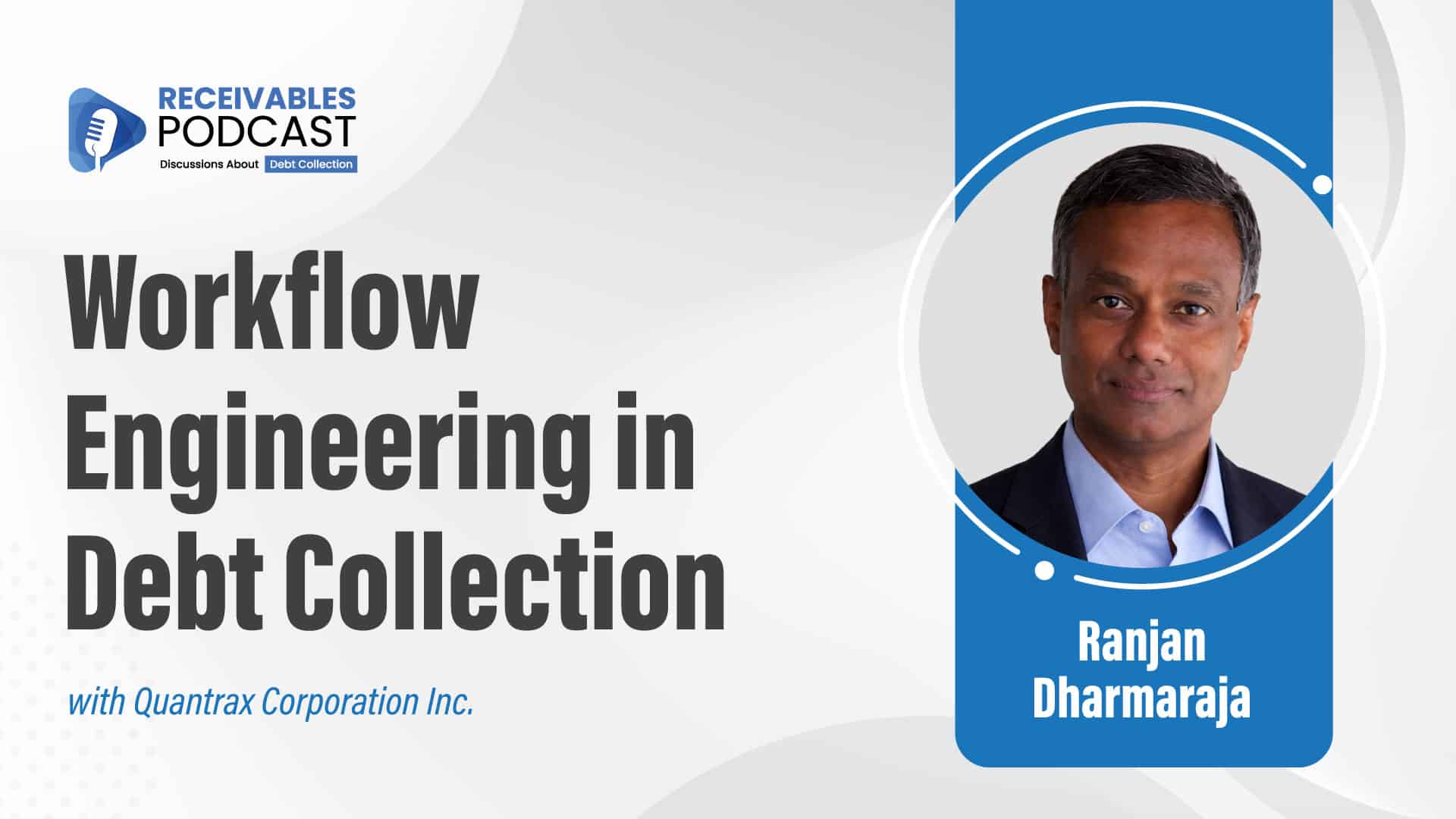

In this episode, Adam Parks sits down with Ranjan Dharmaraja of Quantrax Corporation to explain why collection operations are an engineering problem, not a people problem. Ranjan breaks down how machine driven decision making in collections turns data signals into automated next steps, reduces cost per account, and scales consistency across millions of accounts.
Listen to Your Favorite Podcasts





Adam Parks (00:07)
Hello everybody, Adam Parks here with another episode of Receivables Podcast. Today, I've got a very interesting guest that I'm willing to bet that you have met at one of the conferences throughout your years in the debt collection space. Ranjan with Quantrax has been a workflow engineer since the beginning of workflow engineering. And as we prepared for this podcast, I was just blown away with some of the things that we were able to talk about in terms of how he looks at the world as a series of workflows and how he's been able to empower collection agencies through that vision. So Ranjan, thank you so much for coming on today and sharing your insights with me. I do appreciate you.
Ranjan Dharmaraja (00:53)
Thank you. This was on my bucket list to be on one of your podcasts and hey, I'm crossing it off. Thank you.
Adam Parks (01:00)
Well, I'm really glad that you were able to join us. You know, for anyone who has not been as lucky as me to get to spend a little bit of time with you, can you tell everyone a little about yourself and how you got to the seat that you're in today?
Ranjan Dharmaraja (01:11)
Sure, was born in a small town. You don't want me to go that far back, right?
Adam Parks (01:15)
I think talking about how you came to the US is a great part of the conversation. It was really interesting for me.
Ranjan Dharmaraja (01:22)
I'm kidding you. I'm from a country called Sri Lanka. I went to college in England. I was one those fortunate people. Not a wealthy family, but my parents put me through.I didn't get a job in engineering which I studied so I sold books door to door for one year. No salary, commission only. Some of the best times I've had, best learning experiences. Went back to Sri Lanka and got a job, worked for IBM for a few years. Quit them and joined a company that did technology.
And that's how I got into technology. I worked there for a few years. was some, there was a civil war in Sri Lanka, came back to, came to the US and worked for a collection software company. That was my first job. I was with them for about three and a half years and was not happy with what they were doing. And I decided two kids in a mortgage, no job. I decided, Hey, time to go and do my own thing. I took that risk and started Quantrax. That's what happened. I did that for about a year and then realized that, you know, hey, I had nothing to do. I went back to collections and started supporting some of our clients. That was how I got in the collection business.
Adam Parks (02:27)
I think that's a great story. I love the way that this comes back around again, because creating the software and then realizing how you could empower other organizations with it, I think is an important part of it. And when you think about Quantrax for anyone who's not familiar with it, what is it that you do there?
Ranjan Dharmaraja (02:42)
So we do collection software. I was thinking of different ways of presenting that. We build collection software, but more than that we advise people on how to run their businesses. Because like Steve Jobs said, you start with the customer and then get to the technology. So we believe in that. So what I was also going to finish here is about a year into my being on my own, I was up one night and realized, hey, there's no money coming in. What do I do? And that's when he said, let's build intelligent software for collections, which was a crazy thing over 30 years ago. That's how it was born.
Adam Parks (03:19)
What an interesting storyline, because as we start thinking about organizations, and we start thinking about debt collection, you know, you were definitely the first person I heard talking in the space about the application of artificial intelligence. And I think that the, you the launch or the creation and now ubiquitousness of a agentic AI has confused the marketplace, so to speak, about what artificial intelligence is and the many flavors and forms in which it can take, Anything from agentic to process engineering to all different kinds of different ways to use machine learning, et cetera, and if there's one thing that we have in the debt collection industry, it's mountains of data. And how can we start taking the signals that we can learn from those mountains of data and actively turning them into actionable intelligence that collects dollars. And this for me was one of the more interesting, and I forget what bar we were sitting in in what city, but you and I sat down and we started talking about how your organization has been focused and you've been focused on process engineering, which I think is really unique and interesting language because it's something I think that a lot of organizations do to some level but without a hyper focus and concentration on it, it's got limited value. When you really start to focus on your individual processes, how they come together and what the experience for the person is like on the other side of the phone or the other side of the collection activity, I think starts to change it. So I know you were a kind of an engineering student early on, but what was that aha moment that made you go process engineering is what my future looks like?
Ranjan Dharmaraja (04:59)
It goes back. But by the way, it was at a Washington Nationals game at baseball game bar. That's where it was. Hey, I'm on you and you're losing your memory there. The aha moment was I had been, I had studied a little bit of AI, you know, early in my career here. And I realized that AI when used in business to solve a business problem, you call it an expert system, right?
Adam Parks (05:03)
Yeah. That's right.
Ranjan Dharmaraja (05:24)
Machines that can think like a human expert. And when are they applicable? When you're dealing with a problem that has lots of business rules. When you're dealing with high volume and we're dealing with experts who are expensive. 30 years ago, collection, who are the experts? Collection managers and collectors. They were getting more and more expensive. I thought this is a great thing to solve with AI. And that was the aha moment.
Ranjan Dharmaraja (05:51)
Hey, here's the customer. They don't even know they have this problem and I want to solve it. That was the aha moment. Let's do something about
Adam Parks (05:59)
So you saw a rising cost and said, here's an opportunity for me to maintain this because the cost of the people is never going to slow down, exponential lift in the cost of people over time. And so understanding how you can apply it now, artificial intelligence on the whole, I think is often mislabeled as you've kind of built your organization and helped organizations to activate the data sets that they have, how do you envision artificial intelligence from a high level?
Ranjan Dharmaraja (06:30)
So remember the time I got into this business we had just automated from cards to computers and all these the software was doing was automating the card. There was no thinking all thinking was done by a human So we said hey, is there any of this thinking that a human can do so take the simple example, agents work accounts and they want to give up on an account. What did they do? They used to put a code in there send it to a supervisor the supervisor looked at it and closed manually closed every single account. That's how it worked. So we said, wasn't this a great use case? Let the agent say, I want to close it. Let's clone the manager. Let's clone the manager and let the manager without looking at the account 90 % of the time decide what to do with an account. So that was very early thinking on in that direction of AI.
Adam Parks (07:07)
So if and then statements for workflow rules, establishing if this then that is true. If then that is true, then the next thing, right? So kind of working through those decision trees would be an early stage. Now, when we moved from cards to computers, where we still like, help me help me set the stage for the audience here. Are we talking about punch card computers? Are we talking about right green screen? Or are we beyond that point now, and we're talking more about like Windows operating systems, just to kind of set the stage.
Ranjan Dharmaraja (07:48)
We are talking about collectors who had trays of cards. That's the card system we worked on.
Adam Parks (07:52)
No, from the cards, but as we start moving on to that next level, as the industry was going through that change, where was the development of the technology life cycle?
Ranjan Dharmaraja (08:02)
At that time, the technology life cycle was we're going to make that user interface, that window the collectors work on more and more. We spent five years. Do I put notes on the same thing? That was it. Because remember, these interfaces were not PCs were not there. So that's what we spent money on. We did this and we got carried away with that. And nobody was saying, how can we use computers, the power of computers to actually do more than just present information and have the human decide? That was a challenge.
Adam Parks (08:13)
Okay. Interesting. And so what does that, what's the first step look like in a journey of a thousand miles when you're trying to solve that problem? How did you take that first step from, okay, I'm gonna collect and manage all this data in a database and I'm gonna display it. How did you start to identify those opportunities to move something through a workflow or a life cycle?
Ranjan Dharmaraja (08:56)
So once I decided that I'm going to give up this crazy idea of trying to make money consulting and I'm going to build something that no one's built we took that into account and honestly, I up a five page document saying this is what thinking software would look like and by that time I knew enough people took it to five small companies. These are people with 10 or 15 people and I said hey, what do you think of this? And I said what if we built this, you know their first question how much?
Adam Parks (09:22)
How much? Very collection agency oriented question.
Ranjan Dharmaraja (09:25)
It'll probably be a hundred thousand dollars, but for you, honestly, I'll give it to you for 10 and everybody said, oh, that's great. We'll take it. So five people took it and we basically built this, but we did ask them, do you want us to build this for very smart people to use or high school qualified people to use? And you know what they all said? High school qualified.
Ranjan Dharmaraja (09:49)
I don't want to have programmers. don't want, I want you to do everything for me. And that is exactly what we did. Right? So that was the beginning. We didn't listen to what they wanted. Like Steve Jobs used to say, if you listen to the customer, what they want, you know, you're not going to win. So you decide what to So we decided we understand the business. We understand the problem. Let us give you the most creative solution. Nobody told us I wanted to think behind the collector. Nobody told us that. When you get a broken promise, I want you look at the account and kill it just because of your fourth promise. I want you kill the account. Nobody told us that. We figured all this out and said, we're going to put thinking, take an agent or a collection manager and clone them.
Adam Parks (10:25)
Well, the people that are actively doing that job when you're going into a planning process are often constrained by the parameters of their world, like there's a box built around them, whether it be regulatory, whether it be client requirements, but they live within this box. And it does take someone who has a consulting or a more open mind to be able to think beyond the boundaries of the fixed box. And what does that start to look like? Now, debt collection is a series of large data sets. There's so much that we can learn from those data sets. At what point did you start looking at the data and saying, here's how we can start to drive action beyond the if and then statements? Because at this point, you've got a variety of different tools. So what kind of moved you past the, or where did you hit that point in your process where you said, I can move beyond the if and then statements and I can start applying more of the human knowledge to the process.
Ranjan Dharmaraja (11:35)
Excellent question. I didn't prepare for this by the way. was prepared for it. I told you don't
Adam Parks (11:40)
I never send anybody the questions in advance because it makes it a not fun conversation.
Ranjan Dharmaraja (11:44)
That's right. So one of the things we realized 30 years ago, what is the collection business? Right? The collection business was an engineering problem. When you collect 7%, it's now down to that, of what you're given to collect and you're only paid for what you collect, you don't have a collection problem. You have an engineering problem, a mathematical problem a numbers game. To collectors, collection business is today a numbers game. You know there's a million people I think who wake up every morning and their job is to predict which stock is going to go up. That's the job. So in collections it's exactly the same thing. The people who play the numbers are going to win. This thing, I'm a great collector, I know how to talk to people, I can get, what's it, out, water out of a stone. No, those days are gone. It is now a numbers game. So we looked at this and said, how do we play the numbers? Well, you got data. Use it. But it's just more than a bunch of if-if statements. That is what's the balance. It's a
Adam Parks (12:49)
It's a starting point, right? It's but it starts to turn into something a lot more intelligent as you start working your way down the line. that first stage is so often if and then
Ranjan Dharmaraja (13:02)
Hold on. No, it wasn't. See, if you start that way, that's what most of these companies did. They had database system, then they put up, know, if fail statements, then they said, I need to add more if fail statements. No, you can't build a brain that way. I'm sorry. Brain is a lot. Right. So what we said was, listen, if you're going to build a brain, look at every single thing. Right. Well, I mean, I give this example. If you're sitting in your office now, right behind you, there's a, a,
Adam Parks (13:03)
Okay. Okay, talk to me. You've got my attention. Okay.
Ranjan Dharmaraja (13:30)
plug point there that you have and there's smoke coming out of it. What do do? You're going to stop this presentation. You're going to say, Ranjan and I got to go. You're going to buy and do something. You didn't learn that in school. Nobody taught you that. You just figured it out, putting knowledge together. So in collections, same thing. We can't just build a bunch of if-fail statements. We got to look at every possible thing. I'll give you an example. I'm going to score every action. Every action I'm going to score. Right? If a collector talks to some
Adam Parks (13:44)
Yeah. Okay. So, when we, hold on, when we say score, are we talking about a behavioral score or a predictive score?
Ranjan Dharmaraja (14:04)
I'm sorry, I'm going to cost every account, my mistake. I'm going to cost every action. When a collector works an account, it's a dollar. I just, just simple high level. Okay. I'm going to do all the, when I load an account electronically, it's on. So I'm going to cost everything. And when cost goes over a certain percentage of my potential fee, I'm going to give up on the account. Okay. Very simple. Now you think that's a good thing, but that's not smart. If collector A who makes $25,000 a year.
Adam Parks (14:06)
Okay. Okay. That's fair.
Ranjan Dharmaraja (14:32)
works an account and I cost it at a dollar and then Adam Parks who is much more valuable, my key person works the account. I got to cost it at three times the cost. Now the machines got to figure out that this account was worked by Adam Parks and this was worked by Joe. That's not simple if else. This client recovery percentage is 7%. This client is 30%. You want completely different thinking.
Ranjan Dharmaraja (15:00)
That is why it's not just simple if fail statements. So we started out by saying, what are the data points? Hundreds of data points. Can we build a model that covers all of that on day one? Because we can't keep adding this. That's going to take forever. So our first version of code, we came up with it in about six months. Had over a million lines of code. In six months. So that is the background. It was not the...
Adam Parks (15:09)
OK.
Ranjan Dharmaraja (15:26)
not if fail statements and I want to get that misconception out of the way. It was putting the whole problem on the table and saying we want to build a brain. How's that for now?
Adam Parks (15:36)
So in my experience, because a lot of what you're talking about in terms of the development process of building the business and even your approach to your clients is right on point with how we started ComplyArm. I had to start with if and then statements and then work my way into more complex. The reason I had to do it was also that the rules were unwritten at the time. So we're talking 2013, 2014, where compliance was a new thing every time the CFPB find somebody a new consent order came out, all the rules change. So I had to maintain that level of flexibility. But as you simply point out, the level of being able to build that over time becomes wildly difficult. Because when you build the foundation for a home, you pour the whole concrete foundation at once because if half the homes on one and half the homes on the other, eventually it's going to settle funny. And there's going to be cracks in the walls. So it's interesting when I hear your overall approach to how you addressed it and kind of how that started to look because it moves from this mentality of digitizing to really a mentality of intelligence. And I always think about things in the terms of being able to identify signals and convert those signals into actionable intelligence. The signals that you were starting to collect or sounds like your focal point was on the costing. What does it cost? for each one of these and then how can I start to bring that together? Because if you're looking at that granular level of data, I can imagine that you're using it for more than just straight costing, right? You're gonna have a variety of other things that you would use that to drive next action.
Ranjan Dharmaraja (17:13)
Sure, but costing was one small part. I just gave you that as an example. But there's a ton of things we look at. But I want to tell you one more thing. When you talk of intelligence, you mentioned it. There's inference, all your data and make some inference. And then what's the second stage? You act on it. So the acting on it was as difficult as we have a lot of data, but we don't know what the heck to do with it. And you can't get humans doing it. Right? So a example is if the cost is more than this, then give up on the account.
Adam Parks (17:15)
Sure, it's great example. Okay.
Ranjan Dharmaraja (17:42)
Right? That's a simple example of taking that decision. So that decision also, we score accounts. We've been scoring accounts forever. But does your technology allow you to take that score and do 17 different things depending on the age of the consumer, the client, where they live, I mean, all those things. So that's an important part of the thinking, how you make that next step, that decision, what next.
Ranjan Dharmaraja (18:08)
That's a huge part of workflow engineering that nobody thinks about. Who decides what's next on an account? A human? Okay, great. They're very smart. But can they do it on a million accounts? No.
Adam Parks (18:11)
No, it's Talk to me a little about how you've been able to activate these signals. You've got all of these small signals that you're collecting through, assuming hundreds of fields in your platform and let's call it smaller calculations that are generating these signals and now you have to start converting that. What did the journey look like to activate some of this data to its next action?
Ranjan Dharmaraja (18:44)
Okay, take simple steps, right? The inputs, I like that word you use, the signals. The signals come from various places. When the client gives you an account, the data point, whether you have a home number, work number, cell number, that's a signal, right? Whether the consumer responds to you or not, that's a signal, right? When an agent calls somebody and there's a no answer, or they're busy, or they answer, that's a signal.
Ranjan Dharmaraja (19:11)
We have to also look at this in a bigger sense. An agent gives input, but what do we want an agent to do today? Hey, manage the account. Our point was no, they're not good at managing an account. You take a hundred accounts and ask the question a hundred different people what's next steps, you'll get 40 different answers. So we want one answer. So what we said was we are going to
Adam Parks (19:30)
Yeah, agreed.
Ranjan Dharmaraja (19:36)
take a change to the collector's role. Collector, all I want you to do is tell me what the heck you did. You made a phone call. Did they answer? Was it the right party? What did they say? That's all I want. Now, if I can clone Adam Parks, because Adam knows what to do with that account. He knows how to look at the 100 data points. If I can clone Adam and decide on the next step, that is amazing.
Ranjan Dharmaraja (20:01)
That is what we set out to do. Very simple. So you have to change the role of the collector as well. You can't have it everywhere and say, I'm going to have machine thinking. I'm going to have the collector who's smarter than the machine do their crazy things. That's not going to work either. Collector, you do what you want. But then you got this superb collector. If you tell them, I don't want you to think, I'm going to think for you. Guess what? They're going to quit. So I want
Ranjan Dharmaraja (20:29)
my smart system to say, don't use machine thinking for Adam. He's a really difficult collector. I'm going to let him do what the hell he wants because he collects $50,000 for me a month. So is that a failed statement? That's complex. That's the kind of thinking I'm saying is different from standard if fail statements.
Adam Parks (20:41)
What's the granular level of activating that data? And so once I've collected a signal and I've turned it into a piece of intelligence, how am I moving it down that path and different collectors are going to deal with it differently? Has it also increased? So one of the things that you mentioned was early in your very early stages, you worked with a couple of very small shops to try and understand who they were, what they were doing. But a 10 or 20 person shop can't always work 100 % of the accounts.
Ranjan Dharmaraja (21:01)
That's it.
Adam Parks (21:18)
So through the workflow engineering was one of the focal points on how to penetrate the portfolio in a deeper way or be able to communicate or at least make some sort of an attempt across a larger spectrum of consumers in the portfolio or what does that look like as you try to measure effective versus penetration rates?
Ranjan Dharmaraja (21:40)
Wow, okay, you've done, you know collections, you're an expert. Let me ask you. I got 200 accounts to collect and you're the one collecting, right? And I say, hey, do a darn good job on this. You can look at every account every day. Now, if I could clone you, right, you could have the machine do some of that. Imagine cloning you and taking your brain against 2 million accounts. Big number.
Adam Parks (21:42)
I've done this for a few years
Ranjan Dharmaraja (22:09)
How can I look at every single one of those accounts and make a decision? I can. I just cloned you. you're right. I'm sorry. Right. So what I do is this. I want to clone you. And by cloning, I really mean this. It's not hype. You should be able to design the software to say, take a look at this account.
Adam Parks (22:15)
in a way. There's no way manually I should let me restate that there's no way manually
Ranjan Dharmaraja (22:35)
Look at everything I've done, the client, the score, this, that, every single data point and decide on next steps. I can do that. Now, what I also have is supremely powerful computing power today. So why, if I can do that with one account, why can't I tell the system, go look at all my open accounts tonight? You got your powerful computer, you got the software, we already cloned Adam. So I got Adam sitting in the computer. All I got to do is Adam,
Ranjan Dharmaraja (23:04)
look at a million accounts. That's what we did. So we didn't use computers 15 years. They were pretty powerful. They're much more powerful today. But we did not use that great computing power to think like I'm thinking now. So you asked a question. Great question. Connect the dots. I cloned Adam. I can make Adam look at a single account and decide on next steps. Now make Adam look at a million accounts every night.
Adam Parks (23:20)
Which is interesting because now you're starting to say, okay, what's that next action going to be? In which ways can we activate that next action? Because single collector Adam is not gonna be able to make a million phone calls, send a million emails, I'm not gonna be able to send a million text messages manually. So if you started looking at really those communication channels and how that's evolved over time and feeding the communication channels, but once you know next action, What is that stepping stone to accomplishing first, next best action?
Ranjan Dharmaraja (24:03)
Wow, omni-channel. You heard this thing thrown at it for the last four years.
Adam Parks (24:07)
Omni, Opti, I've heard every kind of channel there is to hear in the last few years.
Ranjan Dharmaraja (24:11)
quality and this is the silver bullet in the collection industry and I ask this question from everybody if it is the silver bullet we've had it for four years why aren't companies really making tons of money why are we still struggling there's got to be a problem so I put it down to this omni-channel is basically you've got five communication channels now you've got phone calls traditional letters email text messaging and direct drop voicemail you got all those five
Ranjan Dharmaraja (24:37)
And how do most people do it? They load a bunch of accounts today and then a week later they say, okay, let's try this. Then a week later they go to those accounts. If they didn't pay, let's try this. Well, the first thing is you got to be able to decide which channel to adopt. How do you decide?
Ranjan Dharmaraja (24:54)
You look at a bunch of data. The client, the consumer, I had a history of them. And you decide which channel to put them on to. Is it a digital channel? Is it a mixed channel? You've got letters and phone calls. Is it complete? You decide what to put them on.
Ranjan Dharmaraja (25:10)
And once you put them on the channel, you should be able to tell the system, I don't want to look at this account. I don't want to touch it. I've told you what to do. I'm Adam Parks. I know what to do. Load the account, send a single text message saying, hey, I got this account. That's all you do. Because you're sending the model validation notice. You wait 35 days and then you say, I'm going to send another text message. Eight days and I send another text message.
Ranjan Dharmaraja (25:40)
Then I wait 15 days if they got email, send an email. You want to be able to do that and then go down that waterfall, that flow, whatever you want to call it. And then you say, you know, this is a collectible account. I'm going to make a phone call. This is not a collectible account. I'm going to give up on it. So we need to be able to do that. Once you do that, you've taken people out of the business, out of the process. No management is needed to drive the next step. the automated steps are happening on their own.
Ranjan Dharmaraja (26:10)
So that is the first thing. We need to decide on a channel depending on a ton of data points. You throw Adam Parks, the intelligent Adam Parks clone, just to decide what to do. So now you've done that. The next thing is within all those steps, you need intelligence. So you send a text message. Did they click on the text message? yes. I can change my strategy. I want to go into a complete different digital setting with different messaging. So all these have to happen within the system. So there's automation, there's thinking, machine thinking, and there's this next step. It is very difficult to do. So what we did was we started with the technology and said, Omni-Channel, let's do text messaging. That's it. So we go and find a text messaging vendor. let's do email. We find an email vendor. But we didn't figure out how to make all these pieces talk to each other, the integration. That we didn't do. So when we did that,
Adam Parks (27:05)
Okay. Siloed channels.
Ranjan Dharmaraja (27:09)
That's right. So when we started out, said, let's put all the pieces on the table. Let's figure out how to integrate all this stuff. And then we will then deploy, we call it, A Unified communication strategy. That's what call it. We did that six years ago and said, let's bring this together. Anybody can do this, folks.
Ranjan Dharmaraja (27:27)
Just bring it together, make it all work together.
Adam Parks (27:30)
It's interesting because that next action is what ultimately is going to drive it. So what you're saying is even on the tail end of next action, consumer gets the the text message, they click on the text message, the next best action then would be running through that platform and looking for whether it be whatever the probability drives for an additional text message and email or send in a letter, whatever the case may be for that particular consumer. But now it's driven based on next best potential action, which is interesting because this is different than what I've seen in the marketplace before when everybody wanted to score an account, prioritize it. Well, it's great that you can prioritize the accounts, but if you're going after all of the accounts and you're going to make some sort of an attempt for each one of those, it kind of changes the dynamic a little bit in terms of what you're capable of executing.
Ranjan Dharmaraja (28:21)
I like that word you used earlier, you didn't use it in the last few sentences. Signal. Signals are important. Right?
Adam Parks (28:26)
Signals and intelligence. Look, this is going back to general, you know, the intelligence community is collecting signals on all of these individuals. It gets recompiled together to drive the intelligence in which next best action can be figured. And I think that's, I look at our world very much the same way because it, as you mentioned, so many fragmented small pieces of information and data put together. But when they're when those signals are assembled the right way, it's like a puzzle, it starts to provide you with a clearer and clearer picture of what is actually
Ranjan Dharmaraja (29:01)
missing the signals today. If you don't have people or technology to accept those signals when they click on a text message, is that a signal? Absolutely. They saw the text message, they clicked on it. Big, big signal. Are we taking advantage of it? Right?
Adam Parks (29:03)
They searched you on Google, they went to your website. No, we're absolutely not taking advantage of most of those opportunities.
Ranjan Dharmaraja (29:21)
Anyway, That's it.
Adam Parks (29:23)
I think we will as an industry start moving more down that path because I think that there's going to be new opportunities. But one of the things that it kind of brings to the forefront here is that it doesn't feel like from your perspective or for your purpose that AI is a bolt on. It's either part of the core platform or it's kind of not. Right, because housing that data and then moving that data around, scoring it through third parties, bringing it back into a repository feels like a lot of added steps that maybe are not providing the same value attributes.
Ranjan Dharmaraja (29:58)
Can we take Adam Park's brain and put it aside and sometimes switch it off, leave it outside and put it back on? No, it's built into your system. And that's the issue that people are missing. That AI, cannot just, it's an architecture. It's a way you do things. It's not something you can bolt on. So when I see people saying, I got a collection platform and we got an AI module. I'm like, okay, you've got a brain and you're going to...
Adam Parks (30:04)
I wish.
Ranjan Dharmaraja (30:26)
bring the brain to this and fit it on? No. Sorry, it's a little more than that and you're alluding to that which is extremely important.
Adam Parks (30:27)
So if artificial intelligence is the engine, then data must be the fuel that drives it. How do you take an infrastructure like this and what kind of data and fuel are you able to feed it to optimize its performance?
Ranjan Dharmaraja (30:53)
Wow, okay, that's key here. You're right, right? Okay, there's three. I don't know if you present as data. Data is the raw form. I got a name, address, balance, payment history, that's data. The next level up from that is called information. Information is data that is organized in a way that you can make more sense of it. Okay, so there's data.
Ranjan Dharmaraja (31:19)
Next level up information and there is one level up. What is that?
Adam Parks (31:22)
Intelligence.
Ranjan Dharmaraja (31:24)
Knowledge. Data becomes information. Information becomes knowledge. Knowledge is data that has got to a point where you can leverage it. You can't use data. Data doesn't give you anything. So that is the important thing. Now, here's the problem that most people, systems will not admit. Every one of us has data, lots of data. There's less information, less information.
Adam Parks (31:35)
Okay.
Ranjan Dharmaraja (31:51)
And finally, there's little knowledge. So your data has to be converted to knowledge. And when I cloned Adam Parks, how did I clone him? I took data. If this, if those if-till sentence are data. But what did I produce? I produced a cloned Adam Parks. That is knowledge. If you don't have that knowledge, don't call it AI.
Adam Parks (32:20)
You know, there's a lot of decisions that go into that. It's an interesting perspective and it gets me thinking, you know, kind of for my final question here, I'm curious to see in your mind, what does maturity of the AI products look like in the debt collection space over the coming years? So we've moved so fast and we've gone from text to text to text to speech and back to text again. And there's just so many different ways in which artificial intelligence is being used in our space. What do you think maturity will look like over the next five years or so at the current exponential pace that AI is penetrating the debt collection marketplace?
Ranjan Dharmaraja (32:59)
Okay, I'm going to upset a of people here. AI hasn't moved fast. What has moved fast is automation, bringing mobile technology to the field. Like I said, text, how you reach for it, that's changed because phone calls didn't work. We were forced to change. But AI, where you can use those great use cases, I've seen you talk about use cases. One of the greatest use cases is in workflow engineering. We don't talk about.
Adam Parks (33:08)
Okay. I agree.
Ranjan Dharmaraja (33:25)
We're not using it in workflow engineering. So you put all get together that has not moved. It has moved. I'm not making a plug for our product, but I have to mention it. It has moved with some of our clients who've taken this product and said, wow, I got my workforce by 40 % because I'm getting the machine to do this. It has worked that way, but we have not invested. So this industry needs to invest. It's not going anywhere unless we as a group say it's time to make changes. It's time to spend money. It's
Ranjan Dharmaraja (33:55)
We're not doing that. And when we do that, we will start going in that direction of making AI work for ourselves.
Adam Parks (34:03)
I think the industry is too caught up in voice AI bots. I think everybody is so focused on replacing the collector that they're not thinking about how to make the collector more intelligent and improve the opportunities that are being presented to the collector. think workflow engineering, not necessarily scoring, but appending data, being able to move things through the workflows and better predict what the outcomes are going to be allows us to more hyper focus the value that we're able to provide to our clients. And in the end, that's our job as collection agencies is to be able to provide value for the creditors to keep the cost of credit low and to keep credit available to as many people as possible. Like that's our role. And if we're not gonna start looking at some of these other opportunities, I see six use cases and I think voice is just one of them. There's so many other opportunities for us to improve messaging content for us to improve workflows for us to improve scoring and prioritization. All of those things, I think are what the future of our industry is going to look like because voicebot is probably a little bit further behind than I think a lot of people would like for it to be because they see it as the silver bullet, just like they saw computers is the silver bullet, just like they saw text messaging is the silver bullet. There is no silver bullet. And I think this is where we're going to continue to struggle as an industry until we can really focus on the fundamentals. You're talking about things you were doing 30 years ago, blocking and tackling, focus on the fundamentals and everything else comes into play.
Ranjan Dharmaraja (35:31)
Adam, I've got to say this, if it is the silver bullet and it is the silver bullet for certain things, people are picking up the phone, just think about this. Creditors can put the same silver bullet in their systems and you're going to cut out a whole, if think about this, if you can collect an account three years later with agentic AI, what the heck do you think creditors are going to do today with their accounts? They're going to collect half those accounts and it's going to kill the agency market.
Adam Parks (36:02)
I was at a private event where a major bank literally got up and said, every day that I get better at my job, your job is more difficult. So you better get better at your job than I am. I thought that was a very bold statement coming from a major financial institution. And they're not wrong. The better that they get at engaging with the consumer pre delinquent. Delinquency, even pre delinquency, now that they're starting to use more artificial intelligence to predict who's going to go delinquent, so that those communication channels have opened long before we're talking about charge off and other things. And the consumers want to be communicated with through the channels in which they originated their loan. If they got the loan online, they expect to talk to somebody online or to engage with a computer if they got it in a physical branch, they expect to get somebody on the phone or to be able to walk in and have those conversations. And I think that's one of those things that often is forgotten as we think about how to engage in the consumers because we get our tunnel vision and we start laser focusing on minor things.
Ranjan Dharmaraja (37:08)
Basically what we're saying is we got to move into first party. We got to do what they're doing better than that. Not do bad debt which is dying because like I said they're going to do this early. You're the first person I've heard publicly say what we've been trying to say for a long time. It's changing but it's not good news for you unless the industry changes. Well done.
Adam Parks (37:12)
Ranjan I'm so glad that we finally had an opportunity to get on and do a podcast together. I appreciate you coming on sharing your insights. I feel like this was a great conversation.
Ranjan Dharmaraja (37:40)
I think so too. was looking forward to this. Thank you very much. You do some good work and this turned out to be very good. You did a great job moderating and asking the questions. I hope it's helpful. I hope somebody will do something and maybe you can build on this someday. Thank you very much.
Adam Parks (37:54)
I think we're gonna have to continue this conversation. For those of you that are watching, if you have additional questions you'd like to ask Ranjan or myself, you can leave those on LinkedIn and YouTube. We'll be responding to those. Or if you have additional topics you'd like to see us discuss, you can leave those in the comments below as well. And I'm willing to bet I can get Ranjan back here at least one more time to help me continue to create great content for a great industry. But until next time, Ranjan, thank you so much for joining me. I really appreciate your time.
Ranjan Dharmaraja (38:17)
Thank you for doing this. appreciate it. Thank you.
Adam Parks (38:19)
And thank you everybody for watching. We'll see you all again soon.
Why Workflow Engineering for Collections Matters More Than Ever
Workflow engineering for collections has quietly become one of the most misunderstood and most critical topics in the industry.
For years, collection agencies focused on improving scripts, hiring better collectors, or layering new channels on top of old processes. But as portfolios grow larger and margins tighter, those approaches stop scaling. The math breaks. The people break. And inconsistency creeps into every decision.
That’s the core tension explored in this episode of the Receivables Podcast, where Adam Parks sits down with Ranjan Dharmaraja of Quantrax Corporation. Rather than framing collections as a people problem, the conversation reframes it as something else entirely: an engineering problem.
Ranjan explains that when agencies collect single-digit recovery rates, they’re no longer optimizing conversations, they’re managing a numbers game. Decisions must be consistent, repeatable, and cost-aware across millions of accounts. And humans simply aren’t built to do that manually.
This episode matters because it challenges a deeply held assumption in the industry: that better results come from better people alone. Instead, it argues that scalable performance comes from systems designed to think.
Key Takeaways from the Episode
Workflow Engineering Is Not If-Then Logic
“You can’t build a brain that way.”
Ranjan pushes back on the idea that workflow engineering is just a series of conditional rules layered onto a database. He explains that most platforms started by digitizing paper processes, not by redesigning how decisions should actually be made.
From Adam’s perspective, this distinction matters. If systems are built incrementally without a unified decision model, they eventually collapse under their own complexity. Engineering decisions means designing the full logic upfront—not patching behavior after the fact.
The takeaway: workflow engineering requires architectural thinking, not incremental automation.
Collections Is a Cost and Math Problem
“When you collect 7 percent of what you’re given and you’re only paid for what you collect, you don’t have a collection problem. You have an engineering problem.”
This quote reframes everything. Ranjan explains that every action including calls, letters, reviews has a cost, and machines are better suited than humans to evaluate when that cost outweighs the potential return.
Adam reflects on how this perspective aligns with real operational pressure: agencies can’t afford emotional decision-making at scale. Systems must understand cost, probability, and timing simultaneously.
- Every action has a cost
- Every account has a diminishing return
- Machines can evaluate this continuously
- Humans cannot do it consistently
The result: smarter abandonment, smarter escalation, and more predictable outcomes.
Data Signals Are Useless Without Action
“Information becomes knowledge when you can leverage it.”
Ranjan draws a clear line between data, information, and knowledge. Agencies have mountains of data, but very little of it actually drives behavior.
Adam connects this to a familiar frustration: dashboards that look impressive but don’t change what happens next. Workflow engineering closes that gap by forcing systems to act on signals automatically.
Data signals only matter if they change the next step.
That’s where automated next step determination becomes essential—not optional.
Embedded Intelligence Cannot Be Bolted On
“AI cannot be something you bolt on. It's architecture.”
One of the most pointed moments in the conversation centers on artificial intelligence. Ranjan argues that intelligence must be embedded into the core of the platform, not added as a feature.
Adam echoes this from experience: systems built without intelligence at their core eventually hit limits. They become expensive to maintain and impossible to scale.
The result: platforms either think by design, or they don’t think at all.
Digital Collections Transformation: Actionable Tips
If you’re evaluating your own operation, this episode points to several practical moves:
- Stop asking collectors to manage accounts—ask them to report outcomes
- Separate data capture from decision making
- Evaluate cost per action, not just recovery rate
- Identify where human judgment adds value—and where it doesn’t
- Design workflows that can evaluate every account nightly
- Avoid point solutions that don’t integrate decision logic
- Treat automation as execution, not intelligence
- Invest in architecture before adding channels
Industry Trends: Workflow Engineering for Collections
Across the industry, agencies are being forced to do more with fewer people. Labor shortages, rising wages, and creditor pressure are accelerating the shift toward machine driven decision making in collections.
What’s changing isn’t the need for people—it’s where people add value. As systems take over consistency, humans can focus on exceptions, strategy, and oversight.
This episode reflects a broader trend: collections moving from craft to engineering.
Key Moments from This Episode
00:00 – Introduction to Ranjan Dharmaraja and Quantrax
05:00 – Why collection operations are an engineering problem
10:00 – Machine driven decision making in collections
15:00 – Turning data signals into action
20:00 – Embedded intelligence in collection platforms
25:00 – Automated next step determination
30:00 – Why intelligence must be embedded
35:00 – Closing insights
FAQs on Workflow Engineering for Collections
Q1: What is workflow engineering for collections?
A: It’s the practice of designing systems that automatically determine next actions based on cost, data signals, and strategy rather than human judgment.
Q2: How is this different from automation?
A: Automation executes tasks. Workflow engineering decides which task should happen next.
Q3: Why does this matter at scale?
A: Humans cannot consistently evaluate millions of accounts. Machines can.
Q4: Is this replacing collectors?
A: No. It redefines their role from decision makers to signal providers.
About Company
Quantrax Corporation
Quantrax Corporation is a collection software and workflow engineering firm focused on embedding intelligence directly into collection platforms. Rather than bolting on automation, Quantrax helps agencies design systems that make consistent, data-driven decisions at scale.