Adam Parks (00:08)
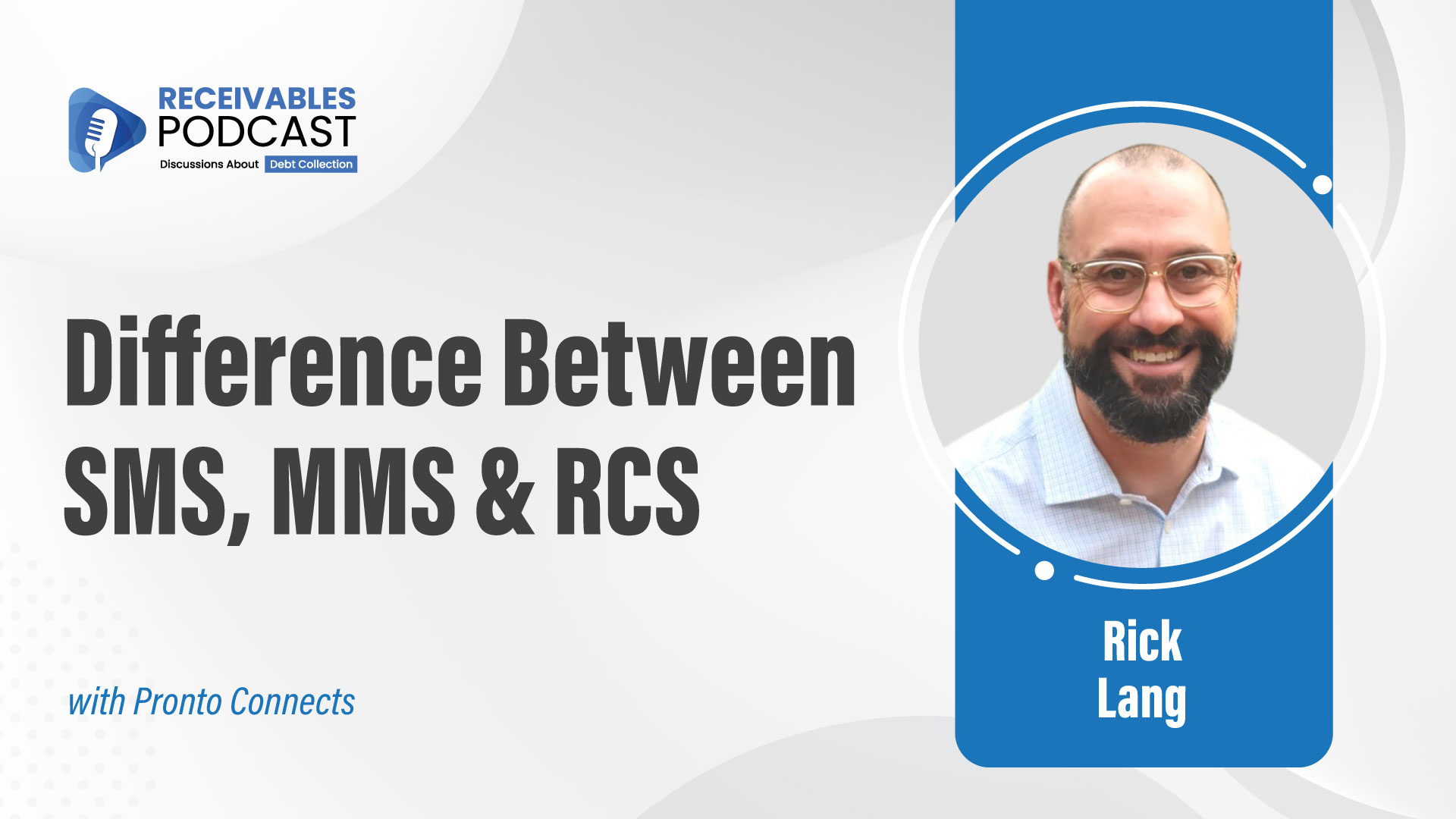
Hello everybody, Adam Parks here with another episode of Receivables Podcast. Today I’m here with my good friend and quite possibly my spirit animal, Mr. Rick Lang, joining me from Pronto Connects. Rick and I have had the opportunity to work together for a number of different years on many different communications related projects. And as I’ve been exploring and trying to better understand
Rick Lang (00:17)
you
Adam Parks (00:32)
SMS, MMS, RCS, and what the text messaging world is going to look like over the next couple of years. Rick’s the first guy that I call. So Rick, thank you so much for coming on today, sharing your insights with our audience. I appreciate the opportunity to yet again learn from you.
Rick Lang (00:49)
Awesome pics man. I appreciate being here and you know, of course immediately you distracted me with the whole spirit animal thing now it’s like what kind of spirit animal would I be? And I gotta say if I was one animal you’d be the you
Adam Parks (01:04)
is.
Rick Lang (01:05)
like if I’m a tiger, then you’re a lion or if I’m like a badger, then you’re a beaver, right? Like, we would have way too many. I don’t know if you want to put that in the podcast.
Adam Parks (01:10)
You Very, very similar. But honestly, Rick, that’s what makes it so much fun to learn from you and to work with you through these years and all the consulting projects that we’ve had the opportunity to touch together and all the successes we’ve been able to bring for those clients. Rick, for anyone who has not been as lucky as me to be your friend through the years, could you tell everyone a little about yourself and how you got to the seat that you’re in today?
Rick Lang (01:26)
Yeah, I don’t know if we have enough time for that full story. I saw a few of your other podcasts. So, uh, there’s almost like a bar that has to be set, right? I’ve seen some of the other stories and, and, you know, I’ll tell you, I’ll tell you the real story and I’ll make it super short. Uh, it actually started in, Chicago. You know, I grew up in Chicago. huge, you know, most everybody knows that I’m a huge Chicago Bears fan. But honestly, I, you know, I was working in the city one day, I was driving home. And, you know, as I’m getting off on my exit to go home, there was a guy there and he’s like pulled over on the side of the road. And I will make this short and sweet, I swear. Side of the road, the guy’s broken down. So it’s cold outside. So I pull over and I’m like, hey man, do need a ride? And, and so yeah guy needs a ride. So he gets in, we’re driving like about a mile. And I look over at him and I’m like, is your name Ben? And he looks over at me he’s like, Rick? And no kidding, turns out, it turns out that this guy was my childhood friend. He lived two houses down from me. So from like first grade to fourth grade, this was my homie.
And then I never saw him again, right? So long story short, he’s a college DJ. He hates being on the air. He gets, you know, has panic attacks, anxiety. And so he’s failing this class. And so I basically said, yo, I’ll go on the air for you. I’ll pretend to be you. So for an entire year, I pretended to be a DJ, pretended to be Ben Yackley. and I loved it. had tons of fun. like got, you know, know, rave reviews, but it was me on the radio. And so I wanted to go and be a DJ. My grandfather told me, you know, when I asked him for money, he me to pound sand. So he’s like, why don’t you get a sales job? So I tried to get a sales job. Couldn’t get anybody to hire me and I wanted to sell cars. Nobody would hire me. The only company that would hire me was AT&T. And so this is like, you know, think 97. And so. Basically, I started work for AT&T just knocked it out of the park, you know, came up in the ranks in Chicago, they moved me to Kentucky. I was a sales manager there. And then they started deregulating markets. And, you know, I, what happened then was I started running into people on the street and, know, one day I was falling behind, you know, MCI, you know, they were selling like 14 cents per minute long distance. I had like 15.
And so then, you know, I ran up these guys and I was gonna, you know, I was gonna get into it with them because they were taking all my sales because they were literally a block ahead of me. And so it turns out these guys were agents and, you know, I like, what is that? And so come to find out, you know, you could work directly for AT&T or you could be an independent or you need to work directly for the long distance carriers or you could be an independent agent. And so As soon as I realized that I started my first company when I was 20. And I took over the Nashville market. And what we did was, went down there as independent contractors. And I started off down there with AT&T. That AT&T contract led to a contract with Home Depot, with Target, Columbia House Records. So we would go to all the college campuses and sign up people for CDs, right? That whole thing. I ran that company for five years and sold it. Went back to Chicago. Thought I was going to get into securities. I got all my securities licenses, my Series 6, my 63, my 65. Passed that test, pass it on the first try. that what it’s a 65, right? ⁓ It’s the hardest test that you’ll ever take in your life if you decide to do it.
Adam Parks (05:20)
I think so. I don’t have any securities licenses.
Rick Lang (05:27)
That’s probably one of my greatest achievements is that I actually passed it on the first try because it’s insane. So I built up a business in financials, like as a broker, moved to Colorado and just moved here to enjoy the mountains and snowboarding and just being outside. And I didn’t want to work on the weekend. So I got back into technology and make a long story short, started my second company in 2007 in the collections industry. I worked for Touchstar Software, which was some people may know that name because they were a pretty big player in the collection space, probably, 2000, 2005 timeframe. I started working with them and I built out their PBX. kind of services there, those called TouchDark Connect. And that was, you know, like the hosted services model. But I wrote the business plan for them and that division and we went to market selling an all in one solution, right? So we do your contact center, your voice, your data services and a PBX. And it was a huge success. People loved the idea of having a single point of accountability, having a single vendor that eliminated the finger pointing between all of those services. And so it was a pretty big success there.
They had issues with their funding. you know, I told the owner, said, Hey, I wrote this, this was my plan. you know, I the business model for it and I’m going to take it. And so I started single source, single source was we followed that business model and as the industry changed and as technology changed, you know, so did we, I think we, I think we rebranded single source, like, you know, three different times as far as our approach to the market. But with each one of those, approaches, I learned more and more about the technology behind it. We started as just like a, you know, referral type of a relationship with the with the different carriers. And then we, you know, just did more and more volume. And so then it made sense to bring all of those services in house and start managing them in house, which is a whole different animal, right? It’s easy to It’s easy to provide support when it’s not your stuff. You know what I mean? When you’re not, you know, when you’re just basically collecting a commission, that’s kind of easy. It’s when it’s your, you you’ve got the technology in house and then, you you’re responsible for all that. When you’re running that type of a shop, you’re definitely very, very careful on the commitments that you make to your customers because, you know, you got to back it up, right? So we sold that. So, that business continued to grow and we had a lot of fun and established a lot of great relationships in the collection space. What happened there was, and this is a good story to tell real quick, I was having dinner with my girls, my family, and my phone rang.
Adam Parks (08:09)
Make sense?
Rick Lang (08:27)
And my girls lost their mind. They’re both like, my God, Dad. And you know, it’s like what your phone and I’m like, what? It rang. Who cares? Well, God, you know, it’s like they were so embarrassed that my phone rang. And and and like at first I was pissed off because I was like, shut up. You know, it’s like, cares? But then. I’m looking at their faces and it’s like, what do you do? And so my oldest daughter who is insanely intelligent off the charts, you know, um, you know, she’s more, more, she’s the one she’s so intelligent that she, you know, lacks social skills. She, that’s a fact, know, this, right? Like either got it or you don’t. He’s that intelligent. know, anyways, so she’s like, well, me and my friends are on discord and this, that, and the other.
Adam Parks (09:02)
I can understand that. I understand.
Rick Lang (09:14)
And then I’m like, really? And so she starts telling me that she, her and her friends were on two, know, two platforms and they’re communicating. And I’d never heard of Discord at that time. This is like, you know, 10 years ago. And then my other daughter, who’s a very intelligent as well, but she’s also a cheerleader. She, you know, was the vice president of her jazz club. And then, you know, also in theater and costume design, all stuff. What do you do? Well, they’re on Snapchat, they’re on Instagram, TikTok, right? That’s how they communicate. And so in that moment, it dawned on me that, okay, wait, I’ve got my two daughters are collectively communicating with their friends on five different channels.
And then it’s like, they both, you know, one was a junior, the other was a senior. I’m like, they’re going into college and then within five years, they’re going to be in the workforce. Right. And so it dawned on me. It’s like, I am, you know, I should be embarrassed that I’m looking at voice as the primary means of communication. So immediately I was like, we need to change. Right. That was that pivotal moment where I was like, the communication, you know, channels are going to change the way that we communicate is going to change. And if my girls are sitting at table and they’re so embarrassed because my phone rang, do you think they’re going to answer their phone when somebody calls them? So that was one of like, we got to redo, we got to change our whole model. And so then that leads to Pronto Connects which is essentially we’re a communications platform as a service. And so,
Rick Lang (10:34)
our infrastructure, we’re in two different environments. We’re in AWS and CloudFlare, We’re geo-redundant, active environment, right? All the fun stuff.
Rick Lang (10:46)
But as a communication platform as a service, we have all of those channels. So whether it’s voice, whether it’s email, whether it’s chat, whether you and I were talking about social medias earlier, you we have Facebook, have WhatsApp, we have Instagram, we have all of those already built into our platform. So when they become relevant to the collection space, we’ll be ready. So that’s the long.
Adam Parks (10:52)
Thank which is happening faster than I would ever expect. Like we’re moving into these new communication technologies. And as you talk about the generations communicating differently, I know I’ve talked in the podcast before about the giant differences between the way that my wife and I communicate. So like we’re down here in Brazil, and when she’s communicating with her friends, she’s recording a voicemail and she’s messaging it via WhatsApp to her friend who’s listening to the voice and they’re going back and forth with this.
Rick Lang (11:12)
Yeah. Yeah.
Adam Parks (11:35)
then there’s me who hasn’t listened to a voicemail since like 1996. Like send me, you want to communicate with me, send me a text message and we’ll talk if there’s a necessary reason, but just thinking about how everybody’s using things a little bit differently and even how the channels themselves have started to change because we started off with SMS and I mean, at least when I started with SMS, it was, you know, hit the three button four times.
Rick Lang (12:01)
Yeah, right, think that was a flip phone.
Adam Parks (11:59)
to get a letter, right? And this is how we started. And now it’s kind of moved on. Now we’ve got, it was a flip phone. Now we’ve got like MMS, right? So we started moving into having deeper, longer communication capabilities, right? We’re not getting blocked into two messages when we say too much. But I think, honestly, I SMS messaging really did help our society think about what they needed to say.
Rick Lang (12:07)
Yeah.
Adam Parks (12:25)
just like how when we used to pay for minutes, we used to think about what we were gonna talk about, we’d have an agenda before we called our family on the other side of the world. And now it’s, now people just talk and talk and talk, but we had to learn how to communicate in these much smaller chunks of content, which I think is still a challenge that we’re facing today is the industry. So then we go into MMS and things become a little bit richer. And now we’re going into RCS,
Rick Lang (12:29)
Yeah, dude. Yeah, totally.
Adam Parks (12:49)
It’s night and day compared to what we communicate with from an SMS standpoint. Now, this is just what I understand in terms of the limited stuff that I’ve done from a consulting standpoint and the phones that are sitting on my desk and how I should be using them. But help the audience understand what’s really the difference between these channels and why should they care as debt collectors.
Rick Lang (13:10)
SMS is, you know, in our opinion, it’s my opinion, it’s your kind of like what you just said, short communication, right? It’s short, sweet. Totally. And, you know, and.
Adam Parks (13:20)
Notifications over communication.
Rick Lang (13:26)
as a society, SMS is perfect and really text messaging as a whole is perfect because everybody wants everything right now. They want to know right now. Everybody wants instant gratification and so I think that we kind of missed that point and nobody takes advantage of that. So with SMS, know, those are your short like those to me, those are our payment notifications. Those are just really just short message. I don’t really think that SMS is your vehicle for establishing credibility. I don’t think it’s where you’re going to. I don’t think you should use it really as your only method of communication, especially in the in the collection space. So, you know, I look at SMS as like you just said, payment reminders. two-factor authentication, short, sweet, just messages we’re trying to get in touch with you, right? Those type of things. MMS to me it’s so misunderstood and it’s so underutilized, right? Because, MMS is your opportunity to establish credibility. And that’s the thing that, again, I think most people in the space overlook. With MMS, this is where you want to say, hey, we are such and such agency, we’re reaching out to you regarding such and such account that you had. Here’s the last four digits of that account number, here’s the balance. If you can send a few MMS messages first. establish, you know, it allows you the chance to establish credibility, right? The consumer and the general public, they’ve been conditioned to be weary of any URL, anybody that’s asking for payment, right? And so the biggest mistake that we see is people are like, SMS, I’m going to send you this quick message that says, hey, you owe us money, pay here. I’m not going to that link. You know what I mean?
Adam Parks (15:11)
Nobody is, yeah. Why would you? Why would you?
Rick Lang (15:13)
Nobody is right. It’s every, you know, it’s like once a year as, as, companies, we’re supposed to train our employees. Don’t click on links. Right. And then we’re going around and telling, the collection, the agencies, send out SMS messages with your payment link. No, you need to send out MMS messages, establish that credibility so that the consumer starts to, you know, so they recognize your name. So they recognize the phone number, right? And that’s kind of the other thing. With an MMS message, you can send your logo, right? You don’t have to wait for RCS. You could send your logos today via MMS, right? And that’s where I think a lot of the like attorneys and law firms, I think they’re missing the mark with that one as well because, Attorneys have very unique names. when you get a letter from an attorney, you know right off the bat who Johnson’s, so and so and so and so is they’re coming to get you because you owe money. You should be putting your logo. Yeah, could be. There’s enough of those around, but, that logo or that MMS, you know, that’s your opportunity, right? To send your logo, send your full name and not get charged, you know, two messages.
Adam Parks (16:09)
Could be a band, you never know.
Rick Lang (16:25)
MMS should be your model validation notices. Like there’s just a lot, there’s a huge opportunity because with, with MMS, uh, you’re not limited to characters like with SMS. And that’s the other thing with SMS, a lot of people don’t recognize or realize that you’re limited to 160 characters. And if you go over 160 characters, that’s two messages. If you put an emoji in an SMS, that changes the codec of the message and then that automatically separates it out into two messages. There’s actual there’s yeah and there’s actually you know the other thing that’s crazy is that there’s actual font like people will send us you know agencies will send us templates and then what we do is we’ll run those templates through essentially a decoder and basically that will tell us the character count but it will also tell us if
Adam Parks (17:02)
Interesting.
Rick Lang (17:23)
When they wrote that template and when they put it into the Excel spreadsheet or when they uploaded it, when they sent it over to us, if they’re using a font that doesn’t correlate or won’t be received in the right way from the mobile providers, that font will trigger additional and it’ll make it two segments.
Adam Parks (17:47)
That’s really interesting. It reminds me of like sometimes you see a text message come across and it almost looks like it comes from a Cyrillic alphabet or something else. Like you can tell that it doesn’t match everything else that you receive. And my gut immediately goes scam. Scam. This is coming from the Eastern Bloc. This is a scam.
Rick Lang (17:55)
Go. Yeah. Totally, no, you’re right. And you what else it does is you have to be very careful about, you have to really look at your messages and what you have to look for is, know, character count. But then also you have to recognize that with a 10 DLC number opposed to a short code, there’s different spam filters.
Right? So with the 10 DLC, we could get somebody, if we have all the information, we can get their brand and campaign approved seven to 10 business days, right? On a short code is four to six weeks. That four to six week timeframe is the mobile providers doing their due diligence. They’re vetting out the company. They’re vetting out your campaign. They’re digging into your use case. And then when they approve it. they give you more freedom on the backend. have greater throughput, right? You have less spam filters after the fact because the mobile providers have done their due diligence on the front end. If you’re doing a 10 DLC, right? When I’m talking about, we can get this up and running in seven to 10 days, great. Like you can do that and we can get it up and running very quickly, but you have to know that then on the backend, they’re monitoring those messages. You’re going through additional spam filters and they’re scrubbing and looking at your messages for keywords, for anything that seems fishy or shady. And so going back to that whole thing with the font.
If you’re pushing a font that’s not standard, well, that’s going to get caught by the spam filters and they’re going to think the same thing that you think, which is, this is somebody scamming me. And then they’re immediately going to put you this spam filter, which I feel like I’m rambling, but that’s a whole other thing is just because it was delivered, but where on the device were you delivered? Were you delivered to the spam filter?
Adam Parks (19:50)
Well, this comes into iOS 26, right? And we start thinking about how now everything, even unknown callers versus potential spam is all separated and you don’t necessarily know. It’s similar to email. Like you know if you were delivered, but you, because you did not receive a bounce back, but you don’t know if you made it past the spam filter or not. I think that brings up some really good points, but I know at different points in time, as an industry, we’ve had significant challenges with debt collection, related communications through short codes, or even through the standard SMS. Are we still viewed as subpar by the carriers themselves, or has that corrected itself over time?
Rick Lang (20:33)
That’s a great question. You know what it is? One of the things that we’ve learned is that it really comes down to relationships. And I know that’s not your answer. That’s not what you’re looking to hear, but
Adam Parks (20:43)
That’s actually, it’s a very realistic, what I’m looking for is a realistic answer, because that’s what our audience wants to understand is like, what are they truly up against and how do you get past it?
Rick Lang (20:55)
I’m glad that I can tie my previous long winded story into something. When we, the previous company, we did a ton of volume on the voice side, right?
Adam Parks (21:02)
I told you I had questions.
Rick Lang (21:09)
We had a direct sales, we had an agent model, and then we were a wholesaler. And so we were a backend service provider to a lot of the contact center platforms in the collection space. My last company was a voice provider for them. So with Pronto, it was very easy for us to go back to those same voice providers and say, can we add text messaging to our contract, right? And also because we had those existing relationships, already knew people within the, at AT&T, Verizon, all the providers.
It was very easy to like, hey, talk to me about this. What are your feelings on this? And so what we’ve learned was that the biggest challenge or the reason why we’re in the situation that we’re in today is because they didn’t feel that the providers who were supporting the industry had a handle on how to manage the traffic, right? Those different stop gaps that you have to put in place to make sure that the consumer is respected and that there’s credibility. And so what we’ve done a really good job of is, and this is why I say it’s relationships, is going to them, understanding their concerns as a provider and then building the infrastructure to report back to them, right? So like everybody’s familiar with like the template IDs.
Adam Parks (22:31)
Communication, right? Like the clarity in the communication is making a significant difference in how they’re viewing us as organizations. Because look, we had similar challenges when it came to the payment rails and MasterCard and Visa trying to make things more and more difficult over time. So it sounds like the transparency is the key.
Rick Lang (22:43)
Yes. Yeah, and it’s really like us going to them and saying, OK, understand your concern and then opening the kimono and saying, this is our infrastructure. Here’s what we’ve put in place. Here’s essentially the filters that we have. Here’s the metrics that we’re tracking. And then basically responding in a very timely fashion.
This year or in over in 2025, I’ve gotten two text messages from two different providers where it was like, hey, Rick, such and such account looks like they were, you know, we were getting these spam messages and looks like they’re exceeding this and, you know, when they’re reaching out to me via text, right, it’s not like, mean, yes, you get the formal email notification, but when you got somebody that’s reaching out to you personally is saying, I saw that this account was exceeding this limit.
We’ve already we we already identified it on our side. We because we’re matching. We’ve got the same filters in our place. And so I’m responding and saying, yeah, I saw that, too. I’m seeing that they’re running at a four point two percent and, you know, spam, whatever or opt out, you want to call it. Are you seeing the same thing? Yeah. But. that me being able to say, I see they’re at 4.2, they know that we’re tracking this. They know that we’ve got the same stuff going on in community. And what that does is then it gives them the confidence that we take this seriously, right? We have a compliance attorney on staff. We do require templates. We have all of these processes and things that we do internally. All of those things I go and promote to our providers, I would say at least quarterly, just, this is what we’re doing. I know I’m kind of, I’m talking all over the place, but we’re.
Adam Parks (24:36)
No, it’s trust in relationships, Rick. I think you’re bringing it full circle to what we’ve been talking about, which is, like my question was really about, are we still being seen the same way? And it sounds like we’ve been able to develop the relationships now as an industry and develop the level of trust by doing things the right way.
Rick Lang (24:40)
Yeah.
Adam Parks (24:55)
And I think if you look back at 2010 and the debt resale market and other things about the debt collection space, there was a lot more bad news. And I think RMAI certification and other things have played a really positive role towards it. But kind of twisting into kind of my last question for you, Rick, I think the industry is pretty familiar with SMS. We’re pretty familiar with MMS. And now we’re really starting to see the deployment of RCS.
It came out on iOS 18 and was supported by iPhone. Now we’ve moved to iOS 26 where it’s clearly supported. And that I think is going to be what we’re going to be seeing into the future, like the acceptance of it on more modern devices. What opportunities does the debt collection industry have in leveraging RCS as a communication technology with consumers?
Rick Lang (25:43)
A lot of people ask about RCS and there’s a lot of, I don’t want say, there’s a lot of miscommunication around it or maybe some misunderstanding. It is being released. It is something that right now we’re putting an agency into production next week, think. Pronto ourselves, moving into production on it as well, but to answer the question. When they rolled it out, they made it very, very clear. This is for Fortune 500 companies first. And because the technology is, there is so much more functionality and it is a better consumer experience, they gave it to the Fortune 500 companies first. then once they kind of get the chance to capitalize on it,
Rick Lang (26:43)
and then they’ll start kind of opening up the opportunity for others. That doesn’t mean we can’t do it. It just means that the beginning of the year, they made it very, very clear. We’re not gonna give it to anybody else. This is who it’s going to. But that wasn’t communicated to anybody. What we heard in the market was everybody’s jumping on this. Everybody’s like, RCS, RCS. it’s like, yeah, well guys, it’s, yeah. And it’s like, you’re not even allowed to do it.
Rick Lang (27:11)
But with that being said, yeah, but I think for collections and the industry, think it’s your first party agencies are the ones that we’re getting approved. Those are the ones that I see that we don’t have any issue with. And the reason why I say that is because again,
Adam Parks (27:11)
Hey, but that’s the honest answer that we want to hear about. you
Rick Lang (27:33)
The greatest, the biggest value that I think we add with anybody that we work with is we truly want to be a partner. And we want to be a resource for you. We want to be a part of your organization. And so that means being honest, right? So like somebody comes to me and they got third party stuff. I will tell you, with all the first party agencies that we’ve kind of brought to the table for RCS, all the providers come back and they’re like, Rick,
Rick Lang (27:57)
It’s not approved for debt collection. And I always respond back, I know this is first party, right? And so, right. And so then, it’s creating the business case. It’s creating again, yet to look, this is what we’re doing. This is how we’re managing the traffic. This is why you want the business. And they’re like, okay, well, cool. We can do it. But again, no debt collections. And you’re like, yeah, I know it’s first party payment reminders. And, and again, being honest with the agency, being honest with the vendors and just full transparency so everybody can feel comfortable with it. At some point, just like with text messaging and I think maybe three to six months, maybe, I don’t know, they will open it up and they will start accepting it.
Adam Parks (28:41)
It’s a matter of time, but until we can actively start leveraging the technology as an industry, but it’s interesting and I appreciate, look, I appreciate the bluntness and the honesty because that’s the real information from someone who’s on the phone with the carriers, who has those relationships for the last 20 years.
Rick Lang (28:48)
Yeah. Yeah.
Adam Parks (29:02)
who’s been actively engaged in it versus what I hear in the marketplace and people trying to position themselves, right? It’s not available for debt collection. And I think it’s important that we follow the rules. We don’t trip over it because then we’re gonna get blocked and we’re not gonna have the same opportunity in the same timeframe that we would have as if we just follow the rules. But for anybody who’s watching, I highly suggest if you have not talked to Rick before, I know he’s gonna be out at the RMAI conference in February.
Rick Lang (29:15)
Totally.
Adam Parks (29:29)
in Las Vegas here in just a couple of weeks. And I don’t know if you still got time on your calendar, Rick, but I know you can find them at the networking events, the opening reception and those kinds of things. But Rick, I really do appreciate you coming on, sharing your insights, spending a little bit of time with me. I learned something from every conversation we have.
Rick Lang (29:48)
Can I make one more comment on RCS and the whole? So RCS is the buzz, right? But the truth of the matter is, nope, again, MMS. It’s like you have, we look at the profile of usage across all of these agencies, you’ve got this heavy saturation on SMS.
Adam Parks (29:51)
Please.
Rick Lang (30:10)
because it’s the least expensive, people are under utilizing MMS, but then you’ve got everybody saying, I want RCS. And it’s like, you’re not even trying to do MMS. And you, you know what I mean? It’s like, you’re to go from like SMS to full blown RCS. It’s like, why don’t you, why don’t you do MMS right now? Like, you know what I mean? Right.
Adam Parks (30:31)
You crawl before you try to run full speed.
Rick Lang (30:34)
Develop your MMS campaign, develop your overall texting strategy because there’s a strategy. There’s a way to go about sending out your messages where you can drive revenue far above and beyond what people are doing today. And it’s not RCS. It’s just understanding MMS more, get that down, and then go to RCS. And by that time, it’ll be ready.
Rick Lang (31:00)
Now I’ll say yes, let’s meet at the upcoming shows.
Adam Parks (31:01)
Rick, well, I really do appreciate you coming on and sharing insights. For those of you that are watching, if you have additional questions you’d like to ask Rick or myself, you can leave those in the comments on LinkedIn and YouTube and we’ll be responding to those. Or if you have additional topics you’d like to see us discuss because Rick is a wealth of knowledge, you can leave those in the comments below as well. And hopefully I can get Rick back here at least one more time and help me continue to create great content for a great industry. But until next time, Rick, I really appreciate it. I’ll see you in just a couple of weeks in Vegas.
Rick Lang (31:08)
Yeah, dude, for sure. You bet, Looking forward to it.
Adam Parks (31:34)
And thank you everybody for watching. appreciate your time and attention. We’ll see you all again soon.